
 Canine tooth - Sept 2, 2012 At 9:46 PM last night, we got a call that hunters were tracking a wounded male bear. They caught up to him late this morning and killed him, a bear we hardly knew and seldom saw. He was very skittish. He had a beautiful practically unscarred face and untorn ears. He must have been a terror in mating battles to emerge as unscathed as he did.
Now, when we can see his teeth, we realize how old he is—and we’re doubly impressed that he has so few scars. The distance between his gums and the enamel that covers his big canine teeth is a rough indicator of age. The distance was a half inch (exactly). Enamel covers only the crowns. Cementum covers the roots. The line between the enamel and the cementum reaches the gum line at 3 to 4 years of age. After that, there is a space between the line and the gum. At a half inch, we guess him to be in his teens. The hunter will let us know what age the DNR estimates from the teeth the hunter sends in. We’ll also do our own aging at an independent lab. We pioneered much of the aging by cementum annuli and have looked at the annuli in many known-age bears. Males confound interpretations by adding annuli during mating seasons as well as during hibernation, so they often have 2 lines in a year. The extra line is from not eating during mating season. Males can lose as much weight during the highly active 6-8 weeks of mating season as they do during the 6 months of winter. We’ll see what his tooth shows and may use it in an exhibit at the Bear Center comparing annuli patterns in males and females for determining age.
 Sharon - Sept 1, 2012Hunting season has stimulated interesting discussions on Facebook. Some of it questions our motives for conducting research and education. We don’t feel that we need to defend our salaries of $30,000 each. Most people understand that celebrity and employment are not what drives us. We didn’t ask for celebrity, and we are perhaps the lowest paid full-time biologists in the nation, receiving a third to a quarter what biologists with comparable experience in government jobs are paid. Sue left a well-paying job to study bears, and Lynn could make more money in several other ways if he wanted. Our lives are devoted to learning about bears and sharing the information with the public. Much of the time, we and you learn together.
Some of the discussion questions the value of the research and education and demands that we take a strong stand against hunting. Much of that discussion misses 2 major points.
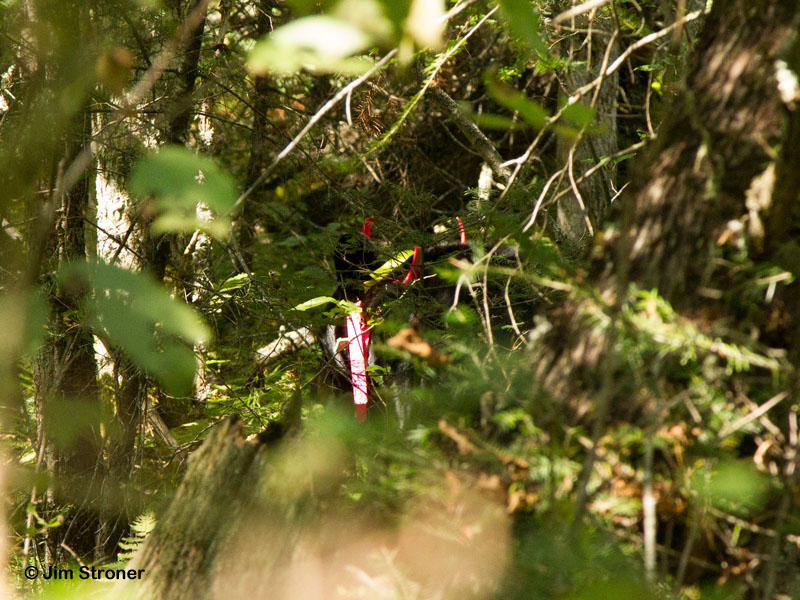 Braveheart's ribbons in the woods - Sept 2, 20121. The major underlying factor is that people will not coexist with animals they fear. True education about bears is of ultra importance. Through our research, people are learning that black bears are not the ferocious animals they once thought. We simply could not do what we do with bears if they were like most people thought. As people see what we do and learn what we are learning, public attitudes change. Public attitude determines whether people will tolerate bears living around them, and it drives bear management. For example, fear of bears led the public to demand bounties on bears and conduct eradication campaigns in the late 1800’s and early to mid 1900’s. Fear led people to gut-shoot bears simply for walking through their yards. The bears slowly died out of sight and out of mind. Fear led people to shoot bears in the face to teach them to fear people, blinding the bears in the process. Poison, trapping, and shooting wiped bears out from huge parts of their former range. There was no biology behind the management decisions then, and any biological knowledge takes a distant second to public attitudes and liability concerns in managing bears today. Attitudes are changed by scientific research and education. We think it’s important that we continue.
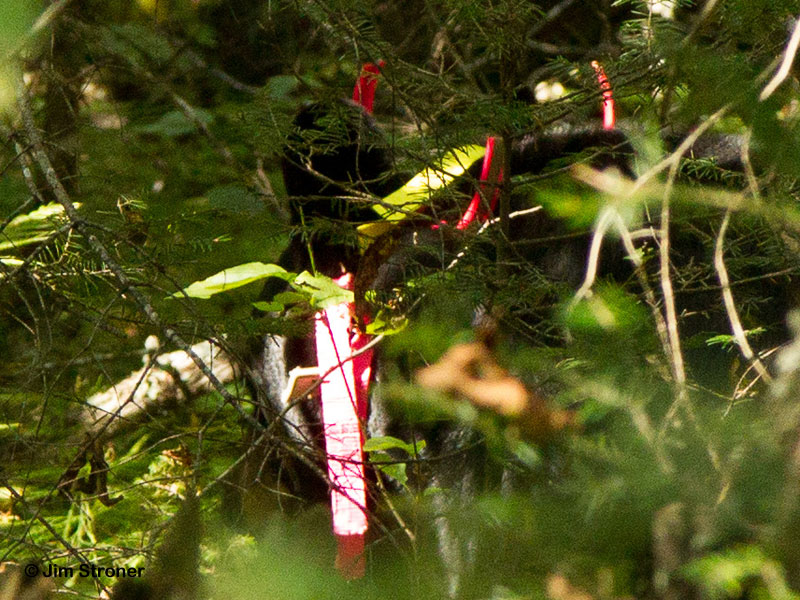 Close-up of Braveheart's ribbons in the woods - Sept 2, 20122. The second underlying factor that seemed to be missed in the discussions we saw was that bears can become more numerous than people will tolerate. Education can increase the tolerance level, but still there is a limit. The more people know about black bears, the higher that limit. If the limit is exceeded, people will take matters into their own hands as mentioned above, and their methods are crueler than those employed by hunters who strive to achieve quick kills. The management goal of hunting today is to limit bear numbers to that which people will tolerate. It’s not about biology. It’s about attitudes. Scientific knowledge shared with the public can improve the welfare of bears worldwide. As people learn to care more about bears, they will be less tolerant of bears being held in tiny cages where bile is extracted, they will become less tolerant of the many forms of cruelty perpetrated against bears worldwide, and they will care more about maintaining bear habitat. Some of those things are what will be featured in the new Hope Education Building.
 Braveheart - Sept 2, 2012
Some of the discussion asks if our research methods lead to the deaths of bears. We can only say that our methods are the only way anyone can learn the ways of animals that live in dense forest like black bears do, that what we are learning will help all bears forever, that we have watched our study clan develop from one matriarch, Shadow (now 25), into a clan of over 52 living study bears (plus males that dispersed to other areas), that the bears in the study clan now dominate much of the area between Ely and Tower (22 miles apart), and that we are learning more every year as technology improves.
Yes, bears are killed by hunters—about 55,000 bears across North America each year—and a few of these are our study bears here in Minnesota, but we are seeing higher survival and higher reproductive success among study bears than in the overall population. It is extremely important that the radio-collared bears survive because these hold the keys to learning and are the windows for the world to change attitudes and let people see how bears really live. Keep your fingers crossed along with us for the study bears as we go through the hunting season. We have never seen so many hunters around here.
Braveheart’s GPS failed so we needed to locate her to check it out. As we homed in on her location, we noticed a hunter’s bait site and skirted far around it. No hunter was there, but we didn’t want to disturb the site. We had planned our field work so we would hopefully be out of the woods before hunters came in. We found Braveheart bedded in a cedar swamp—with her GPS unit tucked neatly under her chin. No wonder we weren’t getting signals! We spun her collar back around, changed her GPS batteries, adjusted the placement of the bright plastic strips and ribbons on her collar, then bushwhacked to the nearest road to avoid walking back by the bait. As we walked the road back to our car, we checked out the bear bites on the creosote soaked posts of a bridge we crossed.
People are wondering if the fire some miles north of Ely will affect the study bears. No. We weren’t aware of it until we got a call just now. We have been totally caught up in keeping track of the study bears on this 2nd day of the bear hunting season. Thank you for caring and keep up the stimulating discussions. Your passion for the bears is what will drive education, spread positive public attitudes, and ultimately lead to better coexistence. We’re all trying in our own ways to do that.
The next in our series of archive footage videos from 2007 is posted at https://www.youtube.com/watch?v=_1W4c706pjU.
Thank you for all you do.
—Lynn Rogers and Sue Mansfield, Biologists, Wildlife Research Institute and North American Bear Center