
 Sharon - Sept 3, 2012 All is well with the radio-collared bears. Sharon walked off on us as we changed batteries in her GPS unit early this morning, but we were able to track her down to a bed site and complete the job.
We heard shots but received no calls from the guide. Only the guided hunters have pledged to let us know about kills. Many hunters use bows, which are quiet.
More on the bear of yesterday. After comparing photos from yesterday with those in our file, the cowlick on the top of the bear’s head and the size of the bear matched Little Harry. The behavior description from last night remains the same. Little Harry has lived in the area since at least as far back as June 28, 2003. He was a shy bear that never interacted with anyone. As a result, no one knew him well. People could watch him through a window, but he’d disappear if a person went outside. Each bear has its own personality.
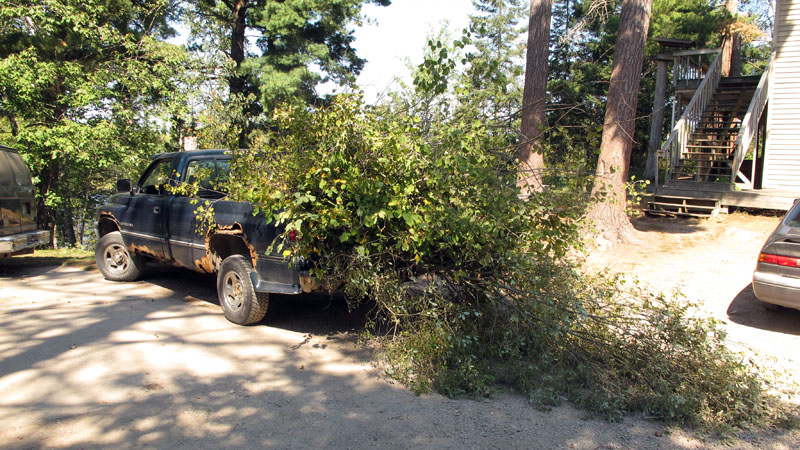 One of many loads of brush cut by volunteers! - Sept 3, 2012We called him Little Harry because he was smaller than Big Harry and both had springtime afflictions of hairless faces. Both had mange that activated overwinter. After a month or so of being out in the open, dry air, the hair would start to grow in again. We think the concentration of mange on their faces and a little on their chests was because of overwinter warmth and moisture from exhaling. Bears hibernate with their heads tucked under their chests to keep the muzzle warm and to inhale some of the moist air that they exhale in order to recover its warmth and moisture. The muzzle is the area with the most rapid heat loss in winter according to our infra-red pictures that color-code areas of heat loss.
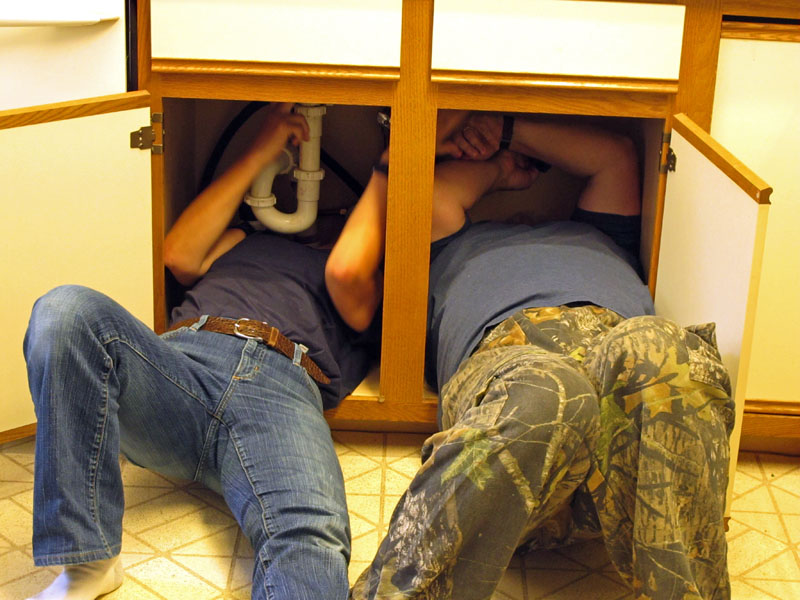 Volunteers install a new kitchen faucet - Sept 3, 2012We hate to dwell on salaries but do want to clear up misconceptions we saw on that topic. We each receive $30,000 per year from the Wildlife Research Institute. We are both volunteers at the Bear Center and take no income from it. We both were also volunteers at WRI until October 22, 2007. Donations to the Bear Center or WRI do not go for salaries and never have. Our salaries are independently financed by the Black Bear Field Courses, not by the NABC. Donations to the NABC presently go toward the Hope Education Building unless they are specifically designated for something else.
Along that line, a big thank you to the Lily Fans who are sending money for food for the 8 volunteers monitoring the bears and working in teams to accomplish many tasks that have piled up here. It’s another case of Lily Fans stepping forward and doing what is needed to support the research and education. Tonight’s good meal was pizzas they picked up from Sir G’s in Ely.
We thank you for all the supportive comments we saw following last night’s update.
Archive footage of June and cubs from 2007 is posted at http://www.youtube.com/watch?v=n2yQnmMiwQk.
Thank you for all you do.
—Lynn Rogers and Sue Mansfield, Biologists, Wildlife Research Institute and North American Bear Center