
Hope on the Move
June 30, 2010 – 11:01 PM CDT
Hope has not visited the feeding site since 9:15 PM on June 28. If we didn’t have the radio-collar on her, we’d be worried. We suspect that bringing the food to her is allowing her to explore more widely. This morning, she was still at the same white pine she was at last night, so she probably spent the night there. Back when we walked with bears for 24 hours at a time, we found that they typically went to sleep an hour or two after sunset and woke up about a half hour before sunrise. Most of their travel (and a couple naps midday) was during the day. Of course, bears that are trying to avoid people while seeking garbage or bird feeders often become more nocturnal, but that doesn’t apply to little Hope. The only time she was seen in a yard (May 25) was late afternoon, and she ran as soon as she was spotted. In fact, she traveled 2 miles back to the area where she and Lily had spent the spring.
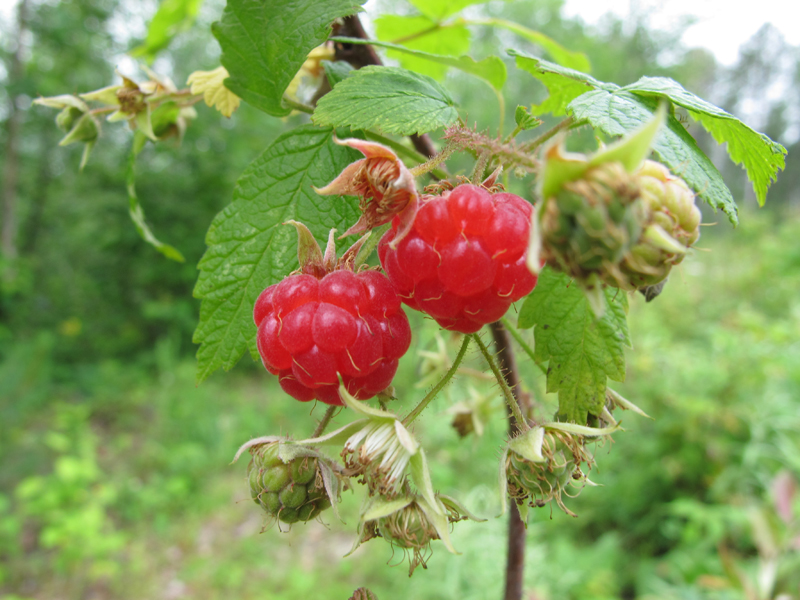 Today, Hope moved 0.46 miles south to another area she had visited with Lily. If she traveled in a direct line, she may have fed on the many raspberries lining the route. This evening, she was at the exact tree where we had found her with Lily on May 29. The navigational abilities of this young cub are somewhat of a surprise. Not entirely, though. In earlier studies (back in the early 70’s), we noticed that little cubs that accompanied their mother on a trip 20 miles outside their usual territory remembered the distant location and returned there as independent adults—the only bears from that study area known to travel there. We found that out when two of the cubs (a male and a female) were killed by hunters there and their ear-tags were turned in. The new methods and technology show so much more these days.
An interesting feature of Hope’s location this evening is there is an old den there that would fit her, and it looked like she’d been in it from the fresh dust on leaves outside the den. If it wasn’t her, it was somebody else. Another thing the new technology and methods are showing us is how early in the year bears check out den sites. The earliest we know of is July 19 when we videotaped June digging the den in which she gave birth to her first litter that winter. We’ll see if Hope uses the den we think she checked out today. Interestingly, when we located Braveheart today to change her GPS unit, she was also near a den.
Now that we are taking Hope’s formula to wherever she goes, we’ll see if she begins exploring beyond the area she learned with Lily.
We visited Lily today and found her sleeping alone in early afternoon—no sign of a male.
We also saw Big Harry stomp-walking toward a location where another male had seen Harry and ran. Harry got to the location, ran after the male, came back, then vigorously scent-marked a balsam fir tree by standing up and rubbing his back on it. He stood 82 inches from the bottom of his feet to the tip on his up-stretched nose. It looked like he was still feeling competitive toward rival males. His testosterone will begin to wane shortly, and they’ll all get along more peacefully. Back in 1976, we found that testosterone is high from late in the denning period until mid-July (McMillin, J. M., U. S. Seal, L. L. Rogers, and A. W. Erickson. 1976. Annual testosterone rhythm in the black bear (Ursus americanus). Biology of Reproduction 15:163-167.) Click on the title if you want to see the whole paper. All the papers Lynn wrote are available at www.bearstudy.org. Hover over Research, click on Research Papers, then click on Black Bear. Any titles that are underlined can be seen in their entirety.
Thank you for getting behind the grant opportunity from Chase Community Giving. You have already put us into 18th place. You can vote only once for each nonprofit, but you can select 20 nonprofits to vote for. The winner gets $250,000 and the 4 runners-up each get $100,000. This is big!
VOTE for the North American Bear Center:
http://apps.facebook.com/chasecommunitygiving/charities/411838192-north-american-bear-center
VOTE for the Wildlife Research Institute:
http://apps.facebook.com/chasecommunitygiving/charities/237320150-wildlife-research-institute
Thank you for all you do to support our bear research and education.
—Lynn Rogers and Sue Mansfield, Biologists, North American Bear Center