
A New Hope Strategy
June 29, 2010 – 10:01 PM CDT
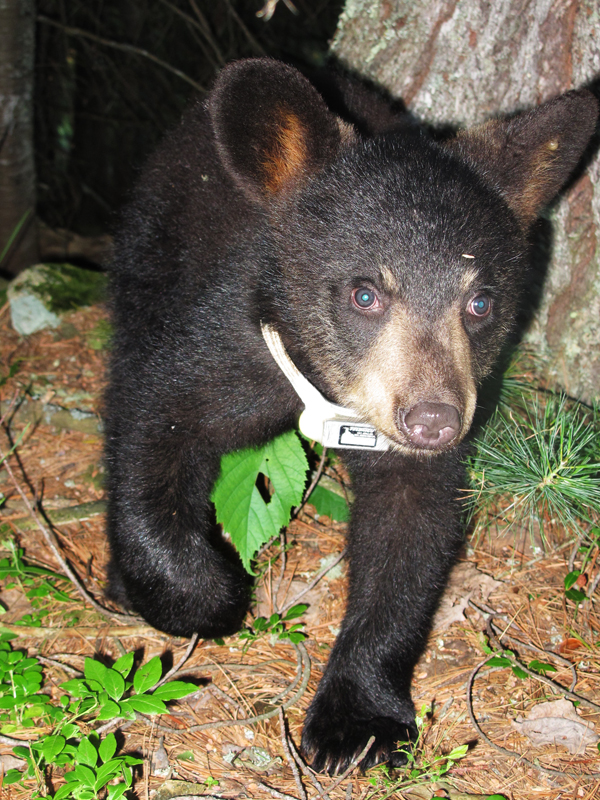 This morning, as Sue was putting out Hope’s food, she saw Hope eat wild Canada Mayflower berries.
This afternoon, the BBC crew was filming in a pretty shoreline location when they noticed a radio-collared cub high in a white pine. Hope eventually came down and ran away. We were glad to hear it.
This evening, she was four tenths of a mile away up a different white pine in the vicinity of where she and Lily split the second time. She wandered around a bit while getting her food and ate some wild dewberries growing there. We’re on the lookout for her droppings to see what else she’s eating. Both kinds of berries are eaten by other bears. Somehow, she just knows.
In the days leading up to the radio-collaring, we attempted to gain Hope’s trust. We even tried giving her bottles to satisfy her need to suckle. Rehab facilities hold cubs and give them bottles until the cubs learn to lap up formula. Hope didn’t understand bottles, so that method of gaining trust failed. In trying to radio-collar her, we could see how little she trusted us and how much she feared being touched. It took about a hundred attempts to get the radio-collar around her neck. With each attempt, she jumped back and was defensive. She was hungry enough to keep coming back for more formula and mealworms, but became ever more wary. Finally, she diverted her attention to the food enough for us to put the collar loosely on her. We wondered if it would fall off. Now that we see it’s staying on and that it’s very loose, we believe it will stay on and stay loose as she doubles in size, probably long enough for her to enter a den.
With that in mind, we’re considering just bringing food to whatever tree she takes refuge in when she hears us coming, and then leaving. We’re guessing that a little cub with no companions and a strong urge to play could bond too closely with caregivers. We doubt that bonding with us would transfer to others—as she showed today when she encountered the BBC crew. However, we’re considering minimizing her exposure to us. We’re already minimizing her exposure to other people by keeping her location secret, which isn’t hard because she moves around so much that even we don’t know where we’ll find her!
When her droppings show that she’s eating enough wild food to survive, we’ll cut back or eliminate the supplemental food. Already, we’re making sure the supplemental food doesn’t influence her movements by taking it to her rather than continuing to maintain the feeding station.
Each day, Hope shows us a little more, and we know a little more about how to proceed. We are impressed with her good condition. We’ll know more as we find her droppings and follow her travels by telemetry.
Today we learned that someone gave us a possibly wonderful surprise by entering the North American Bear Center into the Facebook Chase Community Giving Project:
Much appreciated! There’s so much we want to do for bears. People are moving into bear country like never before and there’s an urgent need to replace misconceptions with facts. To do this, we want to reach out to classrooms, children, and families. We want to upgrade bear.org to handle the increased traffic and add information, videos, and den cams. We want to build “The Hope Center” to rehabilitate injured or orphaned bears back into the wild. We want to build a classroom/office/library building to expand our educational efforts and house staff for greater outreach to bears around the world. We want to add exhibits on “Endangered Bears” and “Coexisting with Bears.” To do that, we want to pay off the debt, and move forward. Entering the Bear Center into this contest could help. Of the many projects in the running, the leader has a little over 6 thousand votes. More on this later.
Thank you for your support in so many ways.
—Lynn Rogers and Sue Mansfield, Biologists, North American Bear Center