
Busy Bears
Update April 28, 2010 – 9:15 PM CDT
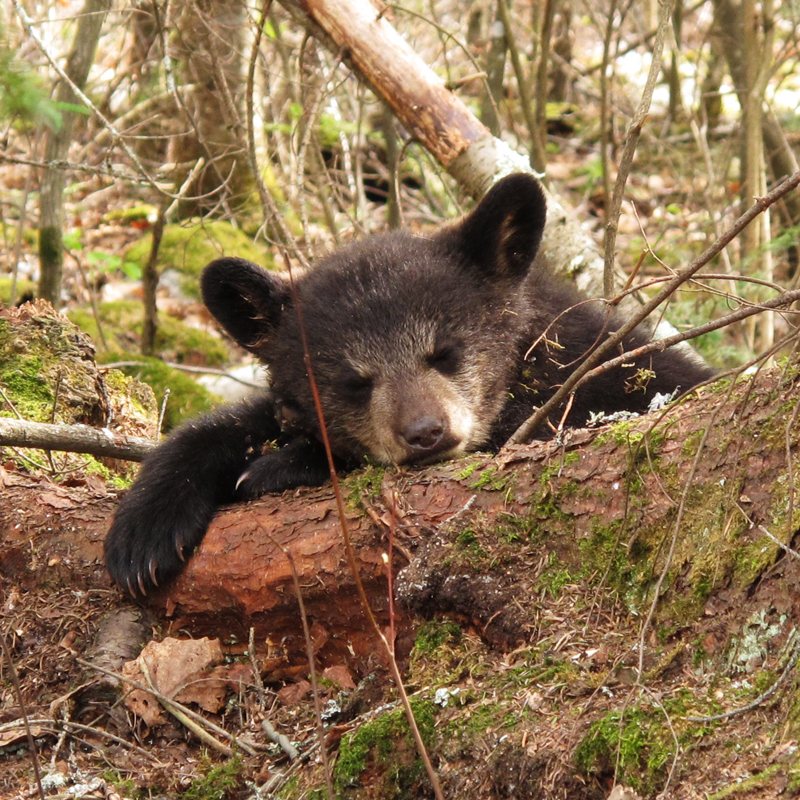 Lily and Hope are still in the same place and it looks it. They are busy bears in their small, out of the way spot. Lily is eating large-leaved aster leaves, tiny hazel leaves, and a tiny unknown root. Hope is up in trees mouthing or eating red maple seeds and birch buds. We’re glad they’re staying in one place. Lily took off her collar, but it was near her, so we put it back on her. If she had moved to a new place, we’d still be looking for her. Video from today’s visit will be posted at http://www.bear.org/website/lily-a-hope/den-cam-video-clips.html.
Bow and Ty are still together, so it was a false alarm that they were breaking up already. Crackle is nowhere to be seen now.
June and her yearlings slacked off from their travels after exploring most of her territory. They spent much of the day in a cedar swamp, mostly resting.
Braveheart did about the same thing if she indeed has her radio-collar on. We’ll check that tomorrow.
Jo was a little traveling girl yet, covering mile after mile.
We believe spring movements of females are to determine food availability, mark territories, patrol territories for intruders, and in Jo’s case to see what land might be available to settle into.
Today we picked up Dot’s collar and will be on the lookout for her. This gives us the opportunity to outfit it with a GPS transmitter so we can track her movements once we get it back on her.
We’re down to just 5 radio-collared bears now—Lily, June, Braveheart, Jo, and Colleen—and keeping our eyes open for wayward bears to put their radio-collars back on.
The reasons bears take them off is that they lose weight over winter and we put them on barely tight enough in the first place. When bears rub on trees, they especially try to rub the back of the neck and the crown. This action often removes loose collars without the bears even trying. Another reason they come off easily is that we don’t put ear tags on the bears. We’d have to drug them to punch holes in their ears for the ear tags, and we don’t do that. The ear tags would help keep the radio-collars on. Losing radio-collars from time to time is part of the price we willingly pay to use our kinder, gentler research methods.
Thank you for your continued support of our research and educational efforts.
—Lynn Rogers and Sue Mansfield, Biologists, North American Bear Center