
At the Bear Center, major changes are happening. People will think they are in a different place. Walking in the door, you will be met by an expansive Gift Shop 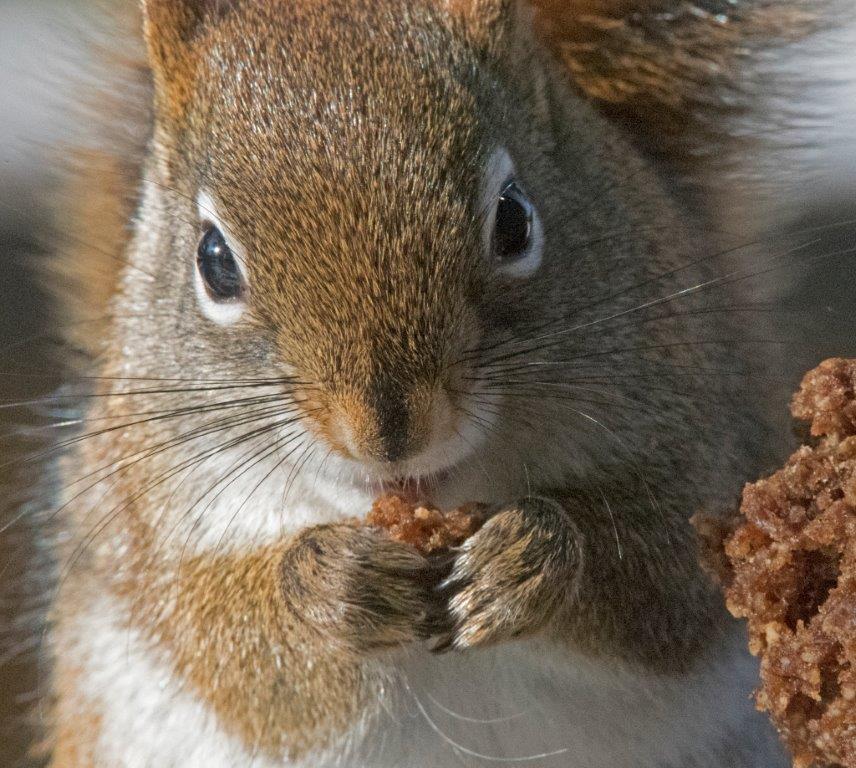 Red squirrel eating date mashwith an eating area and a view of much of the Bear Center from most of that area. Here’s an early 3:44-minute look at the construction in progress https://www.youtube.com/watch?v=eUObreR3ouM. The team is designing new merchandise to fill it, as shown in this 6½-minute video https://www.youtube.com/watch?v=joZPX1KRcv8. I would love to see feedback on what you would like to see in the store. We’re looking for new ideas. Send your ideas to
 Red squirrel takes a bite of mashI love the t-shirt that has all four on the front. I have two of them and wear one or the other most days. It’s probably what I’ll wear to the Hinckley Gathering coming up on April 22 at the Grand Casino in Hinckley, MN. For more on that go to https://www.facebook.com/events/152868651869191. I’ll probably wear it to the LilyPad Picnic in Ely on July 21-23.
Lily Fans have asked what it means that Ted is eating straw and defecating. Has he passed his fecal plug? In the update, I left a question hanging by saying it looked like there were multiple droppings on the Ted Cam. Actually, when I got there, I saw only one—the one he defecated in front of the camera. The other dark spots were parts of a log protruding through the snow. Ted’s dropping didn’t look like a fecal plug. Fecal plugs are made mostly of body wastes like dead cells, enzymes, bacteria, etc. These slowly accumulate and have the water absorbed from them in the large intestine. Ted did the unusual by eating straw. If he eats straw and pushes the usual body wastes out with each defecation, he will likely not make the usual fecal plug. There is always some bear that does the unusual, which is why I can never say never or always.
 Pine marten with mash stuck to the roof of her mouthOut the window, red squirrels generally prefer sunflower seeds. They mostly ignored the date mash. They’d nibble it now and then, but we didn’t see any squirrels concentrating on it enough to make a meal out of it. That changed the last few days. Most of the squirrels still eat mainly sunflower seeds, but 2 or 3 have been making date mash a major food item, biting pieces off one after the other and even squabbling over it. Have some learned to like it? Unlike Ms. Marten who takes big bites of it, the squirrels take little nibbles or, if they end up with a bigger piece, they hold it in their paws and take little nibbles like they would do with sunflower seeds. Consequently, the squirrels never end up with gobs of date mash sticking to the roof of their mouth like Ms. Marten does. Notice the piece of date mash sticking to the roof of her mouth. You can tell when she has a piece stuck because she makes many head, tongue, and jaw movements.
Ms. Marten and the squirrels do all this just outside my window. Ms. Marten is so accustomed to me sitting at my desk maybe 5 feet away that she doesn’t bother to look. I make odd noises, but she’s heard them all. If I make it sound dangerous, she looks in all directions but at me. It’s hard to get nice face shots of her anymore. I stepped out the door 12 feet from her for a better picture. She immediately looked, identified me as a human or maybe as the harmless person at the desk, and kept working on the date mash stuck to the roof of her mouth. It feels good to be accepted and not feared. It will be fun to see if she is the same with Black Bear Field Course visitors this summer.
Thank you for all you do.
Lynn Rogers, Biologist, Wildlife Research Institute and North American Bear Center