
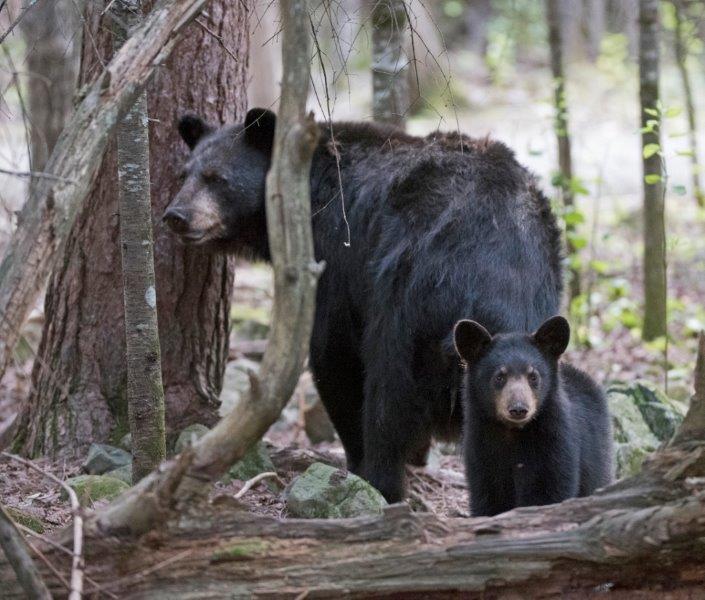
 Shadow and Cub on August 17, 2015Shadow is the only bear I’ve heard of that has produced cubs beyond the age of 27. I’m looking for information on old black bears (or any kind of old bear) producing cubs. Shadow raised Spanky this year at 28 and is presumably in a den with Spanky at this time. A single cub seems to be the rule for final litters. Can Shadow mate this spring at 29 and beat the odds by having a litter at 30 in 2017?
Back in the early 1990’s, we had high hopes that old 641 would have a litter at 30. She was the oldest black bear we’d heard of at that time, so we named her Minda-Moye (Ojibway for Old Lady). In 1991, she had raised a single male cub when she was 26. It seemed to take a lot out of her. She weighed only 104 pounds the next spring (1992) when she was 27. She undoubtedly mated that spring, but food was scarce that summer, so it wasn’t surprising she didn’t produce a litter in January 1993 when she was 28. Would another year of weight gain do the trick for a bear her age? From what other bears showed us, she would have to reach a fall weight of at least 148 pounds to have any chance of giving birth, and she would have to reach a minimum fall weight of 176 pounds to be in the weight range where 28 of 30 females go on to have cubs in January. 1993 had reasonably abundant bear food, but there were no little voices in her den when I visited on February 14, 1994 when she was 29. The summer of 1994 had a bumper crop of berries and hazelnuts. With so much food, I thought maybe an old bear with worn teeth like Minda-Moye could put on enough weight to reproduce, but she was killed by a hunter at 29 ¾ before she could enter a den.
In other studies, no black bear that I know of has had cubs past age 27. Maine began a study in 1975 that has become one of the longest studies of black bears ever done. They had three bears produce cubs at advanced ages—25, 25, and (this year) 26. Few black bears live long enough to see what happens beyond that age, but the Minnesota DNR radio-tracked an exception—bear no. 56, who survived to 39 ½. She raised a single cub at 25 and was expected to have a litter at age 27, but “researchers found her healthy in a den and producing milk but without cubs.” I suspect she gave birth to stillborn cubs or non-surviving cubs and ate them. She never produced another litter.
The only other very old female we studied (besides Shadow and Minda-Moye) was Midge, who raised 2 cubs at 24, mated with Lumpy at 25, and apparently had a cub or cubs at 26. However, those cubs were no longer with her by the time we saw her on August 27 when she was in failing health due to a terminal case of blastomycosis. Her necropsy revealed the placental scars that showed she had given birth.
On another subject, another error. A Lily Fan was good to notice the error on Dr. Donald Griffin’s name. She wrote, “I noticed a typo in the scientist's name who argued that animals have feelings. He was "Donald Griffin" rather than "Griffith". He was an amazing smart man who loved designing experiments to show the intelligence and emotions of animals. He passed away in 2003.” Mention of his name brings back good memories. I bought Donald’s ground-breaking books, and he attended my lectures in Boston back then. I remember my last lecture at Concord Academy not long before he died. He was there with his beaver research equipment to give me. I’d had a Beaver Cam, and he did years of research on beavers, so I was the likely one to inherit his equipment. Knowing what I know now, I suspect he knew something he wasn’t sharing about his health and was trying to see that his research tools were put to the best use for the future. I also remember a nice lunch together at the home of the couple who arranged my talks in that area. With my background in animal behavior, I was interested in anything he had to say. I remember having him stand up in the audience at my lecture that night. A great guy, so full of knowledge and fighting a battle for acceptance of the idea that animals are more than automatons. Today, any Lily Fan knows better than that—partly because right won in the end thanks to Professor Donald Griffin of Harvard.
Thank you for all you do.
Lynn Rogers, Biologist, Wildlife Research Institute and North American Bear Center