
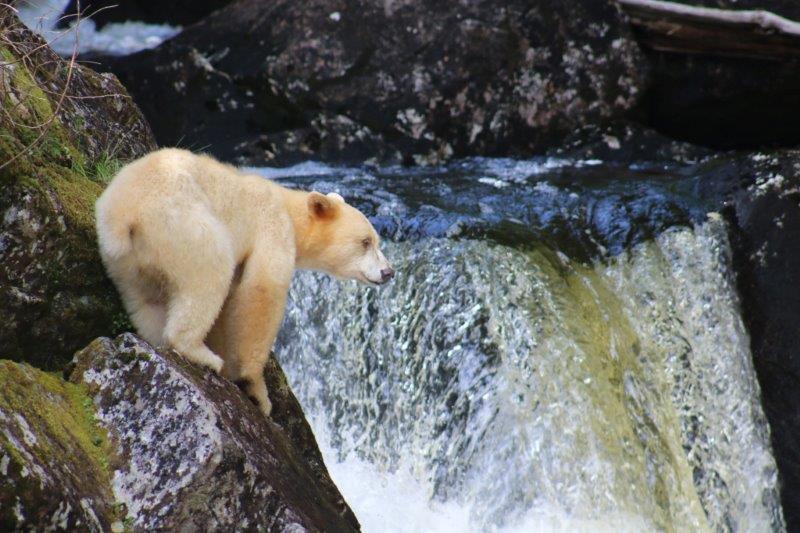
 Spirit Bear - photo by a Lily FanLily Fans sent more examples of how difficult it is for animals to break their attachments with those they have bonded with. One mentioned how a male mallard stayed by his mate for days after she was killed on a road in Pennsylvania. Another sent this story of a male swallow bringing food to his mate who was injured by a car. He then stayed with her after she died http://www.earth-heal.com/news/news/17-amazing-animals/36-when-a-swallow-falls.html. Other examples involve elephants. Others show the outpouring of emotion when animals reunite with people or animals of their own kind—like Hope showed toward Lily.
As far as emotions go, Harvard Professor Donald Griffin told me at lunch one day in Boston that we miss the truth farther by denying that animals have emotions than by admitting that they do. Any cat or dog owner knows about animal emotions. I believe that emotions are the foundation for social relations among intelligent animals whose behavior is based as much on learning as on instinct.
Among other things, I think emotions play a part when female bears in this study seek out certain males to mate with year after year. We even see them nuzzling them and feeding nose to nose with them months after mating season is over.
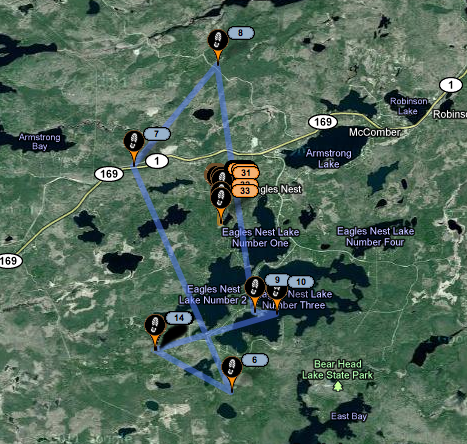 GPS map of Lily's run on the night of 09-27-11We remember what Lily did after yearling Hope ventured off on her own to a hunter’s bait on September 16, 2011, and never returned. At first Hope’s scent lingered. While she undoubtedly missed Hope, Lily took care of Faith, probably expecting Hope to show up at any time. But after a few days Hope’s scent faded. On the night of September 27-28, Lily walked and ran over 16 miles between areas she and Hope had visited together. Lily was probably constantly alert for any whiff of Hope in the air, on branch tips, or on the ground until she knew she had to get back to Faith. We would have loved to heard Lily’s vocalizations during her travels to know what she was thinking. Was she making the grunts and tongue clicks of a mother looking for her cub? We had never before documented travels like Lily made that night.
That was four years ago, so let me give some background on Lily and Hope’s story for newer Lily Fans. Their lives were an emotional roller coaster for us and for them, leading up to Lily’s search on September 27-28, 2011. In 2010, Lily gave birth to Hope on January 22. Although only 3 years old, Lily was the consummate mother until she developed a hormone problem. With only one cub to nurse, she evidently didn’t produce enough prolactin to prevent ovulation, so she came into estrus. Driven by her hormones, she went off to mate, abandoning Hope. When Hope saw Lily 5 days later, Hope gave the biggest show of emotion I have ever witnessed in the wild. They played and nursed for 5 days. Then Lily went off again. Six weeks later, after mating, Lily encountered Hope in mid-July, fully accepted her, and resumed lactation. That winter, on January 21, Lily gave birth to Faith and Jason and nursed Hope right along with the newborns. Shortly after leaving the den, Jason died—probably from a coyote bite that punctured his skull. Hope and Faith bonded through play and became inseparable. Despite the separation, Lily and Hope were together for 22 months, which is 5-6 months longer than usual. Could that have made a stronger than usual bond? Or would any mother go looking for a lost yearling?
A value of this long-term study is that the combination of close-up, trust-based observation and new GPS technology revealed more about bear life than was ever possible before. When we saw what had happened that night of September 27-28, it moved us to tears. Given the timing, we can’t think of anything other than Hope that could have triggered such travels at that time of year.
On another topic, Lily Fans wondered how the black bear with the salmon in its mouth in the update of December 8th could be a spirit bear. Only about 10 percent of the subspecies (Ursus americanus kermodei) that produces white spirit bears have the double recessive genes for whiteness. The mutation that produces white bears is a single nucleotide replacement in the melanocortin-1 (Mc-1r) receptor. The mutation causes this double recessive gene to produce adenine rather than guanine. According to Drs. Kermit Rutland and Craig Newton, offspring are white when both parents contribute this gene. How does this mutation that is so rare elsewhere persist in the coastal islands of British Columbia? Two reasons. It is evidently favored in those islands where salmon is a major part of the diet. White bears have a 30 percent higher success rate in catching salmon during the day when white matches the cloudy skies common in that area. The second reason is that this white gene is not swamped by bears from other areas because of the steep coastal mountains that reduce gene flow onto the islands. In most of the black bear range, black fur containing melanin is favored because it makes hair stronger and better able to stand up against the black bear’s brushy, forest habitat.
A Lily Fan took the Spirit Bear picture. She and the Lily Fan who took the picture in the update of December 8 are both from Europe (Spain and England), had visited the British Columbia home of Spirit Bears, were in Black Bear Field Courses this past summer, and let us have their best pictures for updates.
Thank you for all you do.
Lynn Rogers, Biologist, Wildlife Research Institute and North American Bear Center