
 Juliet eating snow - Jan. 27, 2014In this 8 ½ minute highlight video from February 27, 2014, Juliet and cubs are feeling the temperatures rise from the overnight low of 31° degrees below zero to the day’s high of 11° above zero F. A cub is lying exposed and protesting but all are fine and eventually nursing.
At 11:01:33 AM, Juliet lifts her head and begins ingesting snow while the cubs nurse. She continues ingesting snow for 4 minutes and 44 seconds, 284 seconds at her usual rate of 2 licks per second is 568 licks. If we can estimate the amount of snow ingested per lick from the size of the holes we see in the snow and could see how much water that amount of snow melts down to, we could get a ball-park estimate of her water intake. In addition to her ingested water intake, she is producing metabolic water from her fat breakdown.
The video ends with Juliet settling down on the cubs which are soon nursing contentedly.
YouTube: https://www.youtube.com/watch?v=faIy_k7cJqg
Vimeo: https://vimeo.com/120854546
Archives: http://www.bearstudy.org/website/research/2014-juliet-archives.html
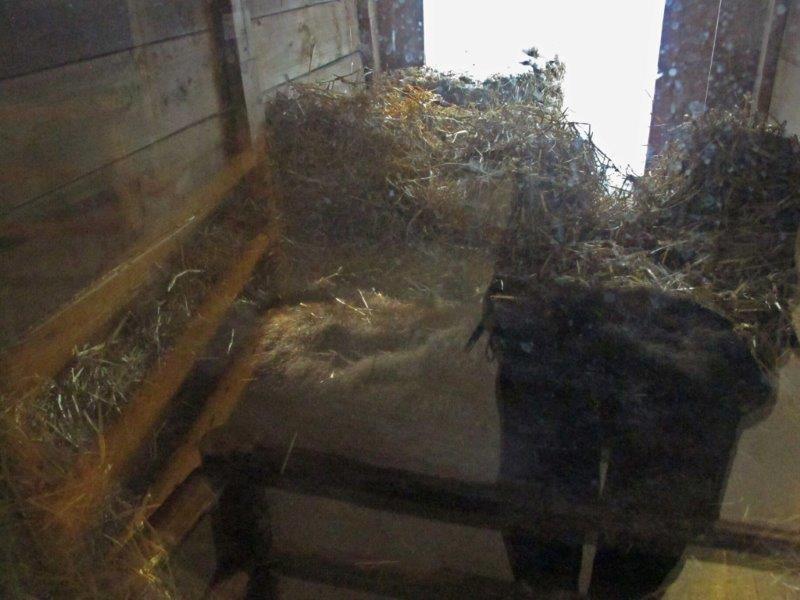 Honey asleep in the window denThe picture of Honey shows her sleeping curled deep in her straw. Not visible in the bright snow beside the unused bale of straw we gave her a few weeks ago are tongue marks where she has been licking snow. The size of the tongue marks converted to volume of snow removed might give an estimate of the amount of snow ingested per lick.
As I find pictures for exhibits in the new Ecology Hall, good memories come back of animals who revealed some of their secrets through trust. Red-breasted nuthatches who flew to me to check my hands for food wherever they saw me were favorites. One of them would even fly in the office door and across the room if he saw the door open. By following them in the direction they departed with each bit of food, one led me to its nest hole 10-15 feet up a tree and the other showed me the dimensions of its territory. For that, I followed a nuthatch in the departing direction and learned where it was storing the food in bark crevices, presumably in the core of its territory. By moving farther in that direction I eventually found it departing back toward where we had started, showing that I had gone beyond the core of its territory. Other birds showed how trust varies between species. Gray jays will learn to land on a hand. Blue jays wouldn’t think of it. White-breasted nuthatches wouldn’t think of it either. Does this mean that trusting species are not as wary or that they have more ability to assess risks and benefits? Trusting species are species that remain in cold, snowy habitat throughout winter, a time when many hawks migrate south and the main overwinter problem for these non-migrants is finding food. By contrast, non-trusting birds live in snowless areas year-round and make anti-predator behavior their priority. Similarly, animals that live on islands without predators, such as in the Galapagos, develop the same willingness to trust.
Other good memories that pictures bring back are of walking with deer and moose that ignore us and revealed previously unreported aspects of their diets and routines. Some of the secrets they revealed will be in the deer and moose exhibits. Also, secrets of raising young that Pileated Woodpeckers revealed as we filmed from 45 feet away. The video shows a young woodpecker who had never been outside the nest hole and had never been able to spread its wings launch into its first reckless flight and nearly fly into the camera. Many good memories.
Thank you for all you do.
Lynn Rogers, Biologist, Wildlife Research Institute and North American Bear Center
All photos taken today unless otherwise noted.