
 SummerAll study bears with cubs have now been accounted for since a mother with cubs was struck on Highway 169 on Friday, July 18. The written report on file with the 911 operator we called said the mother had been sighted lying in the ditch with her cubs beside her but when a Conservation Officer arrived the family was gone. We checked the location where the bear was supposedly struck and found a large blood spot on the highway.
Within days, all study bears with cubs were sighted in the study area—except Summer and her 3 cubs. She was last seen 11 days ago on Wednesday, July 16, two days before the incident. At 12:35 PM today, she and her cubs strolled into a community feeding station a half-mile from the blood spot. All were fine.
 Summer and cubsWe now believe the bear hit was passing through and was not a study bear. We wish her a swift recovery as others have done after being hit.
The landowners who sent these pictures said, “We thought she was the one hit by the car and we have been feeling so bad. Today, even though there are clouds, a ray of sunshine broke through in knowing Summer and her cubs are okay.”
They also sent a picture of two of Donna’s yearlings sleeping in their yard. This is nothing new in yards where the bears are fed and feel safe in this community that loves wildlife, including bears. Documenting the effects of the feeding on the bears and on bear-human relations is a major purpose of our studies here. One finding is that the bears here are certainly not prone to attack people. That finding is directly contrary to the beliefs of many, including many officials, who believe habituation and food-conditioning create nuisance bears and jeopardize public safety. In some situations, habituation and food-conditioning can contribute to nuisance bear behavior, but not here.
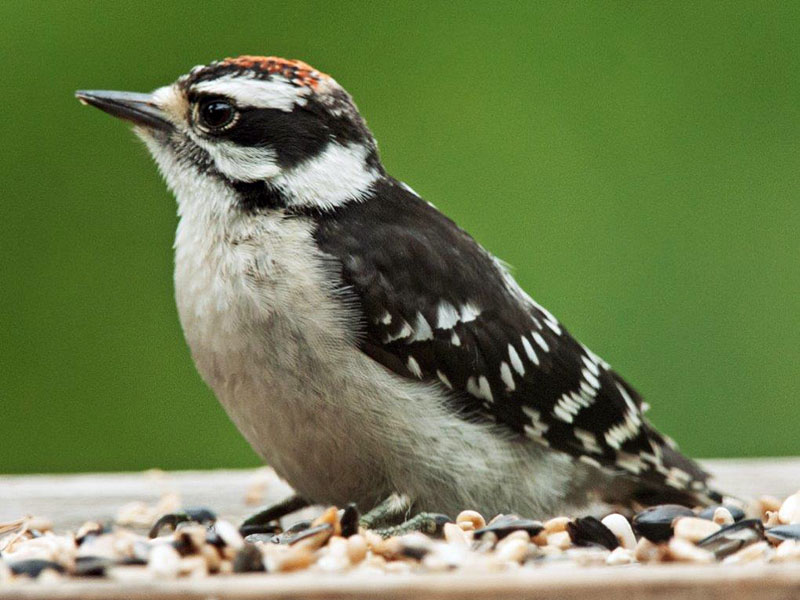 Juvenile male Downy WoodpeckerThrough the window, the juvenile male Downy Woodpecker (Picoides pubescens) showed that this year’s hatch is out on their own. Young male Downies have the red on top of their heads instead of on the back of the head like adult males.
Thank you for all you do.
—Lynn Rogers and Sue Mansfield, Biologists, Wildlife Research Institute and North American Bear Center
All photos taken today unless otherwise noted.