
 Tamaracks
Larix laricina
The last trees to brighten are doing it now, big time, tamaracks (Larix laricina). And the first snowflakes we’ve seen this Autumn hit the windshield in a flurry too brief to photograph. Big and wet, they melted immediately. Then sun lit the trees.
Two nights ago, Aster left her den area in the middle of the night and moved a mile to her usual community feeding site. Instead of returning to her den, she returned to an area 250 yards from the den where she had rested many previous days this month.
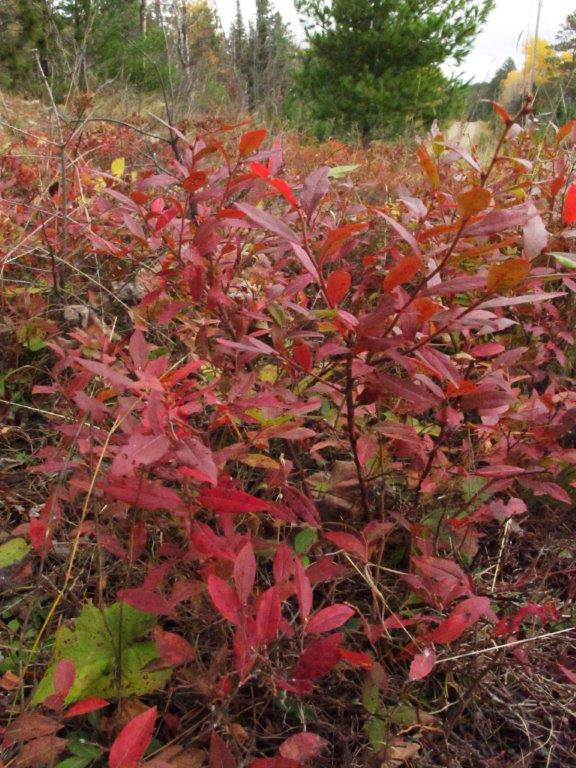 Blueberry leaves
Vaccinium angustifolium
Last night, she left that resting spot and moved nearly 4 tenths of a mile toward the community feeding spot, changed her mind, and moved the half mile to her den area and is still there at 7:22 PM.
Will she stay there now? We remember Blackheart in the fall of 1999. Each night, she left her den and moved 1.1 miles (1.0 mile as the crow flies) to a community feeding site and returned. In late January that winter, she gave birth to Dot and Donna.
 Northern Pin Oak
Quercus ellipsoidalis
Lily and her cubs went on the move Wednesday evening (October 16), just after 7:30 PM, leaving the place she had rested a few days. She arrived at a new area 0.8 mile northeast by 8:42 PM and is still moving around there. Is this her final den location? Did Lily try to excavate dens in the previous areas and run into boulders and give up like she did the fall of 2009 before moving 1.6 miles (0.72 mile as the crow flies) to the old den of another bear where we got to know her January-April 2010?
 Tamarack
Larix laricina
Jewel gave her last GPS signal at 10:05:56 AM Thursday morning October 17 at the spot where she has remained for so long. We believe she has a den there. It’s expected that her GPS locations would stop then because that was the 11th day on her GPS batteries. We usually change them at 10 days. We’d like to ascertain that she is in a den while we can still do that without leaving tracks in the snow.
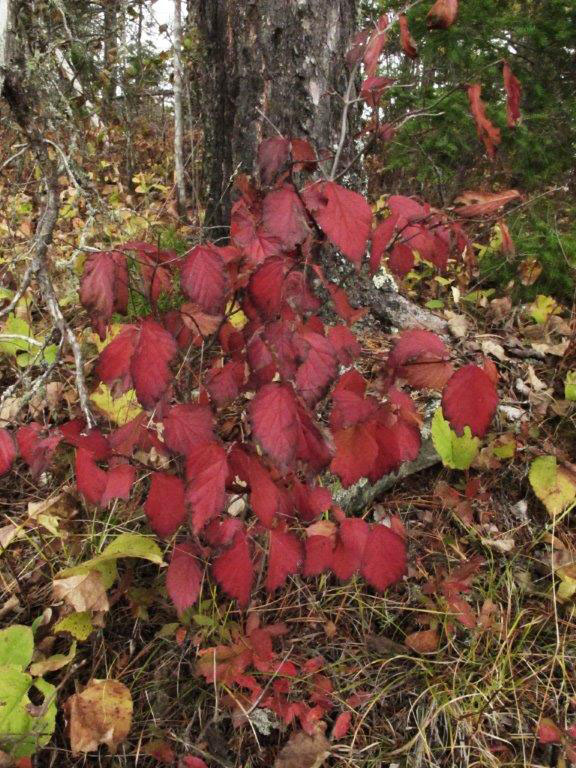 Downy arrow-wood
Viburnum rafinesquianum
Ursula and her cubs gave their last GPS location last evening (Friday, October 18) at 9:03:29 PM after not giving a reading for over 20 hours (since 12:43 AM that day). Did the gap mean she finally went into a den? Ursula’s GPS batteries are on their 12th day, so we were lucky to get that last location showing the gap before it as a clue she was in a den.
Faith remains a mystery in her remote area in the middle of a huge tangled cedar swamp. Walking through a swamp like that is not ‘walking’… it is climbing over and crawling under long-lasting cedar logs. Mike and Lorie made a valiant 5-hour attempt to connect with Faith and change her GPS batteries yesterday with no luck. They never got close and came back bushed and wet. They finally gave up trying to keep their feet and pants dry and just went to slogging or crawling through the wet areas. Faith’s GPS batteries have long since died, so the next step is to rent an airplane and home in on her telemetry signal to get a fairly precise location to help with planning. We have to pay for a minimal time in the air, so we’ll use up that time looking for a visual on Ursula in the location where she has been for so long.
 Two DocsAs bears enter dens, we can then go back and look at the GPS locations to see when they arrived there. Those data are archived, so it takes a bit of doing to retrieve the locations.
 Lynn answers questionsThe high point today was getting a call from a highly respected professor from Lynn’s grad student days at the University of Minnesota in the early 1970’s, the last time the professor and Lynn had seen each other. The professor, his wife, and their extended family saw the Hope Learning Center, the Northwoods Ecology Exhibit Hall, and the empty office for the World Educational Outreach person we eventually want to hire. Kids with them were exceptionally bright. All had questions about bears and how to spread the word. One was connected with Boy Scouts and suggested developing a Boy Scout Merit Badge. A Boy Scout camp is just 20 miles away. They already bring most of their campers to the Bear Center. Enhancing that with a Merit Badge is a natural. The professor has long taught ecology. One of Lynn’s goals in showing him the new addition was to encourage collaboration. They will be following up. They all were terrific.
Another highlight was hearing of good things that Lily Fan volunteers are doing.
Thank you for all you do.
—Lynn Rogers and Sue Mansfield, Biologists, Wildlife Research Institute and North American Bear Center
All photos taken today unless otherwise noted.