
 Lucky plays with PVC pipe feederLucky got a new toy, and he loved it. The staff made him a PVC pipe with small holes then put food into the pipe. He went crazy flinging it around like a baton, throwing it, and banging it down. Food would fall out. He’d eat it and go crazy again. He also climbed trees and bit the tops and ran for no obvious reason. He obviously is feeling no paid from his surgery.
Out in the woods, Jewel paid a 20-minute visit to a residence and left fast according to her GPS locations. It was a house deep in the woods with no others around for a half-mile or more. We wonder why she left so fast.
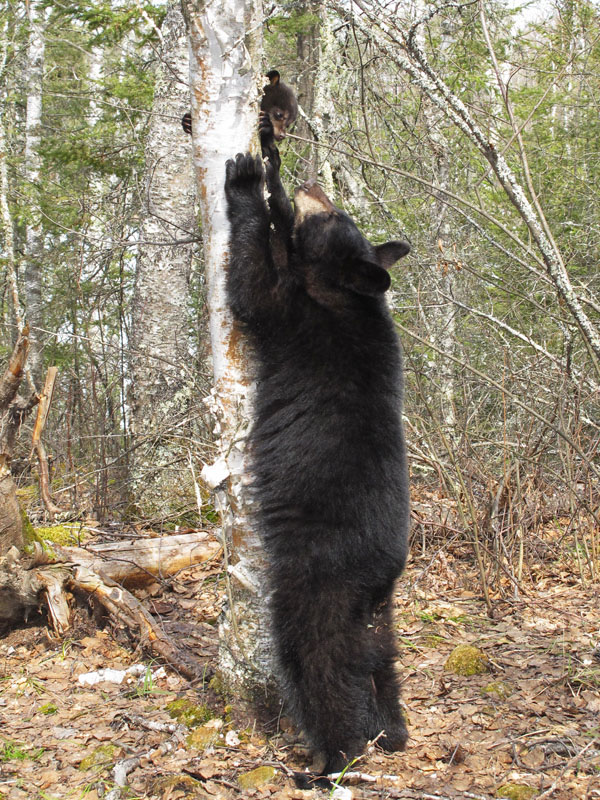 Hope reaches for Faith - April 22, 2011Lily is at a new spot with fond memories. We found her there with Faith and Hope on April 22, 2011. Faith seemed to be more bonded with Hope than Lily and initiated play with Hope. At one point, Faith fell behind. It was Hope that went back to check on her. Hope lightly bit Faith to drag her down from a tree to catch up with Lily.
Another memory from that spot is Lily attempting to make a den but hitting boulders and giving up to go to the den where she gave birth to Hope. The iconic picture of Lily’s face with dirt on her nose was taken at this spot the fall of 2009.
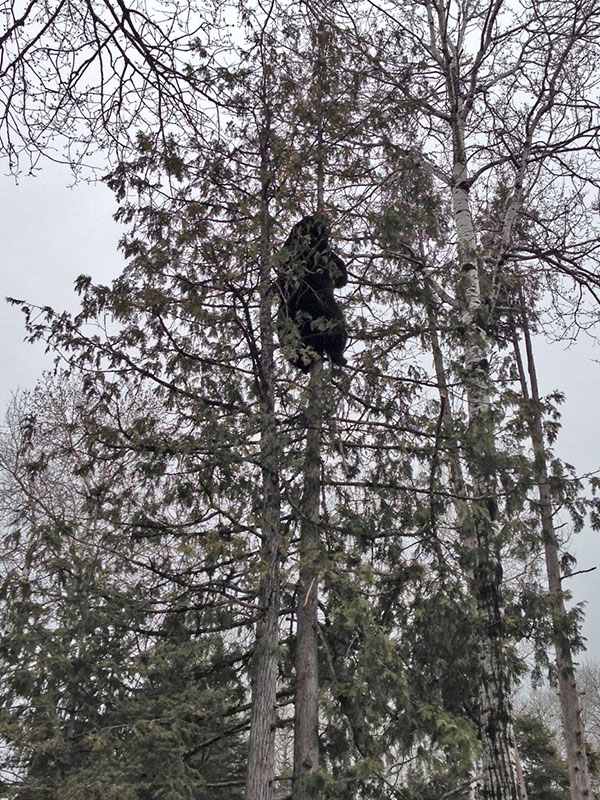 Lucky bites top of cedarWith food so short in the woods, we’ve been asked, “Do you provide a food source for the bears due to the weather?” Actually, no, except for the few nuts we give so they will let us change GPS batteries. Feeding them would prevent us from learning their natural behaviors in a time of scarce food in a year like this record late spring. If we fed them significant amounts, we’d wonder if we stretched their stomachs more than is natural for this time of year, triggering behaviors we could only guess. If we fed them, we’d wonder if they might be pickier about their natural food choices than would be natural. We want to learn natural behavior, diet, travel patterns, etc.—all of which could be influenced by our food.
The community in the middle of our study area has been feeding bears for over 50 years and experiencing fewer bear problems than other areas. One of the things we are documenting is frequency of visits to the feeding stations, which could be altered if we fed bears out in the woods. So we don’t.
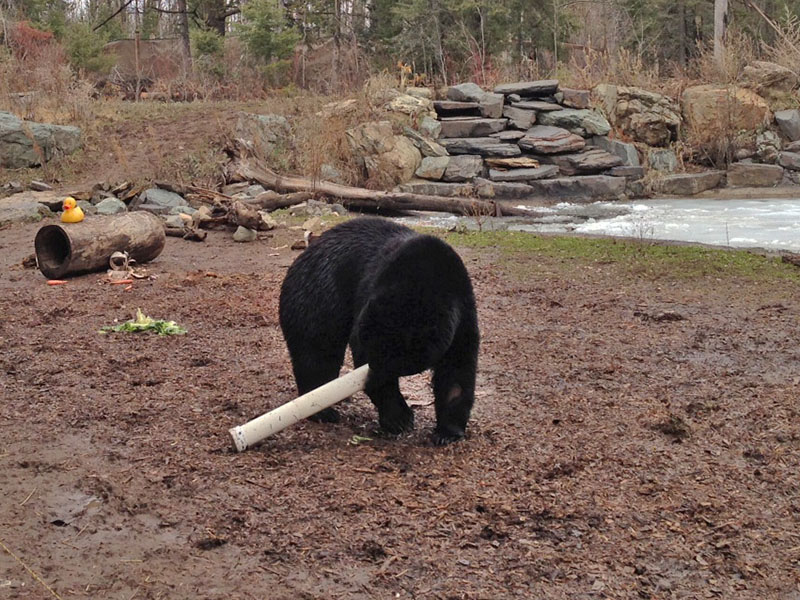 Lucky works to figure feeder outSome might ask, “Then why did you feed little Hope?” Feeding Hope answered many questions that biologists were asking or had long believed. Some of the questions/assumptions at the time were that (1) Lily abandoned Hope because Hobe was defective and would not survive. (2) Lily left because she was a young and inexperienced mother. (3) Lily made the decision to leave and would likely kill Hope if she saw her again.
To answer those and other questions, we did two things. We reunited Hope with Lily and saw a joyous reunion with suckling, bawling, and total acceptance. On May 26, 2010, we wrote, “seeing Lily and Hope’s reunion was the most beautiful expression of animal emotion I have ever seen. Hope was bawling very loudly, and Lily was doing her pleasant grunts as Hope latched onto a nipple and Lily half dragged her nearer to the white pine where they had nursed together so many times in April.” Over the next few days they played more than usual, perhaps renewing old ties. Then Lily left again as described in the May 31, 2010 update.
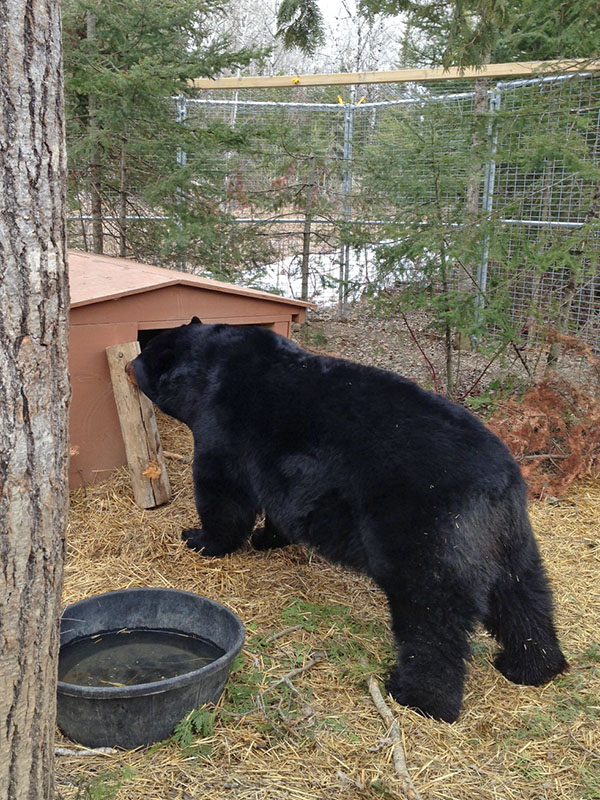 Ted finds food in holes in logWe knew it wasn’t that Lily was too young to be a good mother because about 85% of the first-time mothers in Pennsylvania are also 3-year-olds, and they do just fine. We believed it was not because Hope was defective because we couldn’t see anything wrong with her. Feeding her would let us see if she lived or died. If she died, we could necropsy her to learn what was wrong. If she was fine, we could document that feeding in the wild can lead to survival and a lot more learning and wildness than if a bear is raised in captivity and released. We believed by then that one cub, for some mothers, is not enough to stimulate enough prolactin to prevent ovulation. Sure enough, Lily mated. After mating was done, she came across Hope and they were together ever after like nothing had happened.
Interestingly, we had been criticized for simply observing bears and not developing any kind of “experimental design.” When this situation came along, we experimented and were glad we did, but the criticism for interfering and saving Hope was loud and long.
Thank you for all you do.
—Lynn Rogers and Sue Mansfield, Biologists, Wildlife Research Institute and North American Bear Center
All photos taken today unless otherwise noted.