
 Black-capped ChickadeeAt the Bear Center, construction workers removed the wooden forms from the foundation—filling in with dirt and covering the concrete with insulating blankets to keep the snow off. There’s now a lull in the construction as we wait for the concrete to fully cure, which happens more slowly in the cold. The pre-cast concrete walls arrive December 17 when the foundation should be ready.
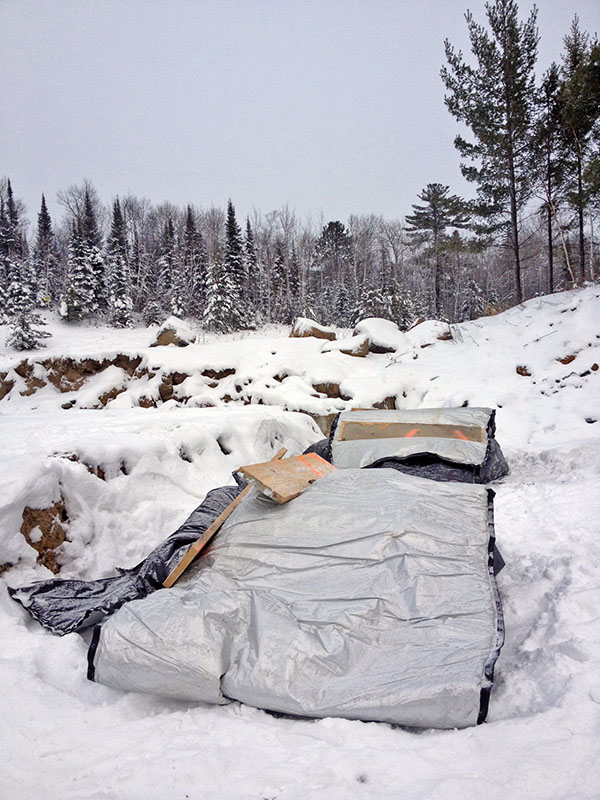 Blankets cover concrete as it cures - Nov 27, 2012At the Research Center, the lull is between bears denning up and the arrival of the den cams. Lynn and Sue did indoor work on PowerPoint presentations and scats.
Ted’s scat that contained an intestinal parasite, Baylisascaris transfuga, had only his normal food—no leaves. Questions usually asked when bears rid themselves of these parasites before hibernation are:
“Was it because the bears stopped eating?” or “Was it because the bear ate special leaves?”
We found no leaves, only the foods Ted routinely eats. The most likely explanation for ridding these parasites in fall is that the life cycle of these parasites is adapted to the bears’ annual cycle of hibernation and activity. How that works remains a mystery. If bears could eat special leaves to rid themselves of these parasites, it would seem they would eat those leaves periodically through the summer, but the only time we’ve seen these parasites appear in the scats is shortly prior to hibernation. This has coincided with their eating fibrous, mature willow and alder leaves that we don’t see them eating in summer, but it apparently is just coincidence, not cause and effect, as evidenced by the worm in Ted’s scat with the same foods he eats all summer.
Thank you for all you do.
—Lynn Rogers and Sue Mansfield, Biologists, Wildlife Research Institute and North American Bear Center