
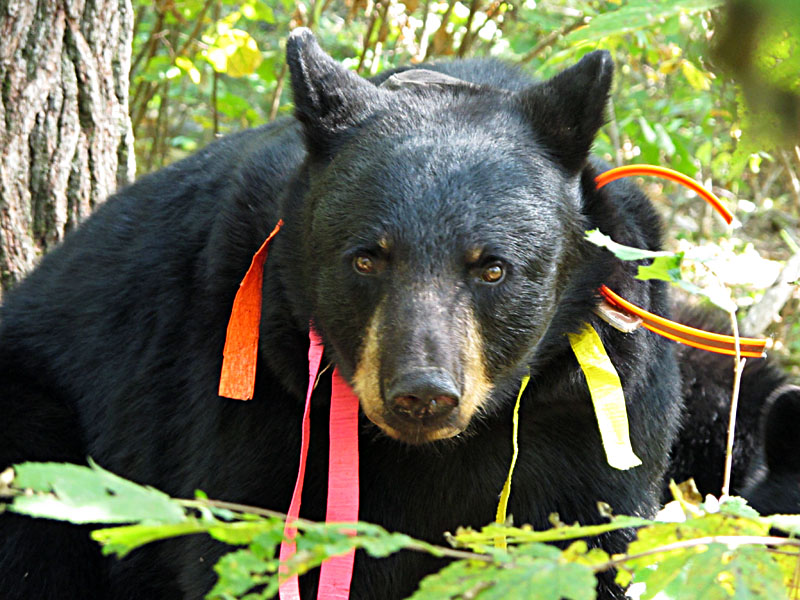
 Juliet - Aug 31, 2012 Tomorrow is the first day of the bear hunt. We feel well-prepared. All radio-collared bears are sufficiently adorned with 4-layer neon duct-tape ribbons and reflective plastic strips. GPS units are working and batteries should make it through the weekend and beyond. We see your good wishes for the next few weeks and thank you. We’re all in this together. The future of the research depends upon all of us. Calm, professional behavior is of utmost importance. Please be mindful of comments posted online.
 Yellow-legged meadowhawk - Aug 31, 2012
We thank the DNR for sending a letter to each licensed hunter with a permit for this area asking them not to shoot radio-collared bears. They also issued a press release yesterday (http://news.dnr.state.mn.us/2012/08/30/dnr-to-hunters-dont-shoot-radio-collared-bears/), which referenced our study as well as the DNR studies, reminding hunters to avoid shooting radio-collared bears. At the DNR’s suggestion, we used their logo on the signs we post throughout the study area asking hunters not to shoot radio-collared bears. The signs quote the 2012 Minnesota Hunting Regulations which state “Hunters are asked not to shoot radio-collared bears with brightly-colored streamers or ear tags.”
Only the 6 people named on the permit can walk with the bears. However, no one will be walking with bears. No one except Lynn, Sue, and possibly Jim Stroner will be in the woods—and then only if GPS units fail. We are cooperating with hunters in avoiding disturbance, just as we expect their cooperation in sparing radio-collared bears and, hopefully, mothers with cubs. We are maintaining communication with the guide to avoid any conflict. He will call Lynn to examine, photograph, and collect DNA samples from any bear killed in this area. The hunters will send teeth to the DNR for aging, and we hope they will pass that information on to us for our records.
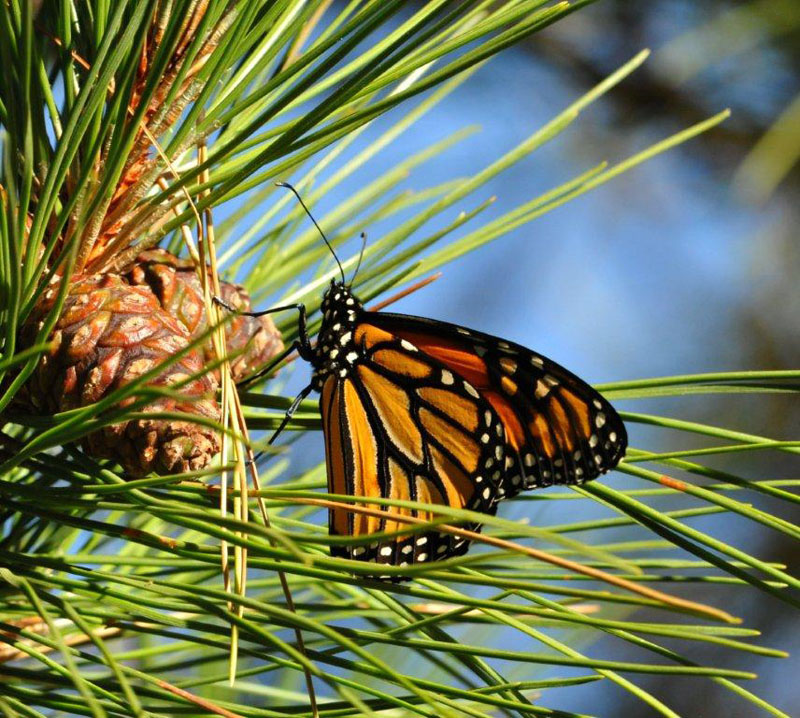 Monarch on red pine - Aug 31, 2012
We feel confident the guided hunters will pass up the 14 radio-collared bears (Dot 12, Donna 12, June 11, Braveheart 10, Juliet 9, Colleen 9, Ursula 7, Lily 5, Jewel 3, Star 3, Sharon 2, and yearlings Faith, Aster, and Daisy). The guide will charge them an extra $2,500 if they shoot a radio-collared bear. The guide is also asking his hunters not to shoot any mothers with cubs—radio-collared or not. So we also feel fairly confident they will pass up the 3 non-radio-collared mothers with cubs (RC 13, Keefer 8, Cookie 7, and Samantha 3).
Although the older bears in our study have GPS units that send their locations to our computers every 10 minutes, the 3 yearlings do not. Volunteers are here at the Research center to help in various ways. Some will be radio-tracking the three yearlings from roads to provide data for our studies of yearling movements relative to each other and their mothers’ territories. Free time between tracking outings is filled with work on the To Do list. Other volunteers from around the country are helping via donations which go toward meals for the onsite volunteers. The researchers and volunteers are grateful for this support.
 Bald-faced hornet nest - Aug 31, 2012We weren’t able to radio-collar the matriarch Shadow (25), but have faith that she will do what she has always done and avoid hunters. She has not been seen now for a couple weeks. She has regularly been the earliest bear in the study to den when she’s pregnant. We remember her settling at a den in late August in another year when she was pregnant.
We prepared a collar for Oliana, but we haven’t seen her for a couple weeks. She may be going to baits. We have no way of knowing. She is valuable to the study and would have been radio-collared early on except for the limit on radio-collars and the choices we had to make. We can only hope for the best.
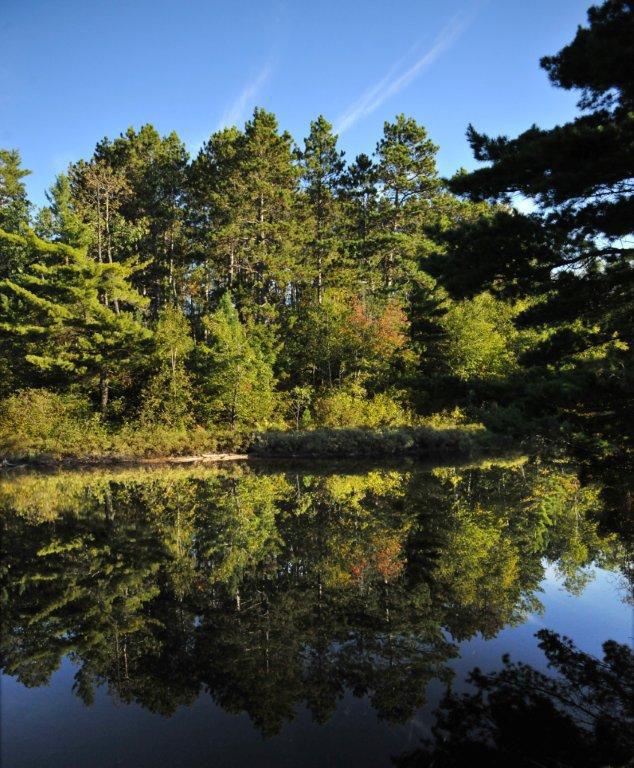 Eagles Nest Lake One reflections - Aug 31, 2012There’s a good chance the older bears, male and female, will survive the hunt. They don’t get to be ‘older bears’ without being cautious. Big males carrying good amounts of fat den up about as early as pregnant females—in September. One-eyed Jack (~16) and Big Harry (~15) are trusting males that ignore us when they join radio-collared bears we are walking with during mating season. These are the bears that show us courting and mating behaviors and that are showing us mate fidelity we hadn’t suspected. Shylow (10) and Pete (7) are clan males that have dispersed to other areas to mate but return to feeding stations in the study area when food is scarce. Jack disappeared a few days ago and the other big males earlier. Maybe they are visiting hunters’ baits, but we believe they are doing what they have done to survive until now.
The younger bears usually den up in October here and will be more vulnerable to the hunt. At least this year the guide will let us see which bears are killed, so we are not left to wonder about their fate. Although the bear hunting season runs for 6 weeks, few bears will be killed in this area after September 16 when other hunting seasons open.
We enjoyed this beautiful late summer day as we went about locating Juliet and Lily to swap out their GPS units—stopping to take pictures along the way. Juliet’s 3 cubs made our work a bit challenging, but working together we got the job done.
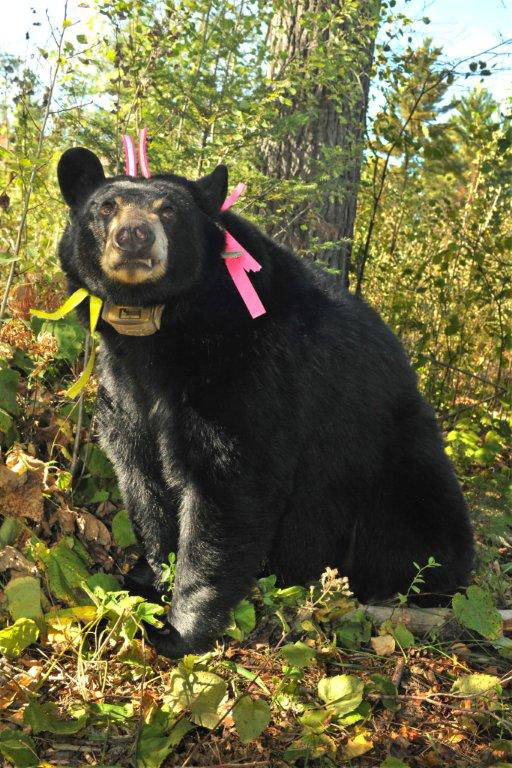 Lily - Aug 31, 2012Lily is slowing down in preparation for hibernation. Her heart rate today was only 57, the lowest we have recorded this early. This compares to heart rates between 75 and 93 during May to August 28 in 2010, 2011, and 2012. We look forward to following Lily through a ‘normal’ pregnancy, delivery, and care of cubs this winter. She slowed down drastically at this time in 2010 when we measured a heart rate of 62 on September 1. However, she was accompanied by Hope—who was not ready to settle down—and they didn’t den until the 3rd week of October. Her heart rate varied from 48 to 60 on October 25.
Even in her slowed state, though, Lily was able to muster a high heart rate when she was obviously nervous on October 29, 2010. We brought the 4 landowners to view her at her den that day to get permission to install a den cam. Her heart rate that time was 112. It seems whenever we try something new we learn something new. Bringing the quiet group to view her from a distance that day showed us she could elevate her heart rate at that time of year and that she responded differently to that situation than to familiar routines with familiar people.
Lily’s high heart rate was nowhere near as high as the heart rate Lynn heard in a den long ago. That bear went from no audible heart rate—with Lynn’s head against the sleeping bear’s chest—to a heart rate of 175/minute that filled the den as Lynn exited and listened from outside.
Today we posted the last in the series of videos of Juliet and cubs from July 12 at https://www.youtube.com/watch?v=aPxrpjH3G44. Boy the cubs have grown since then! Seeing the cubs frolic and play reminds us of why we continue to do this work. Bears pass through our lives—some stay longer than others—each leaves memories. And each spring there is new life in the den.
We thank all of you for your support in this critical time. Thank you for all you do.
—Lynn Rogers and Sue Mansfield, Biologists, Wildlife Research Institute and North American Bear Center