
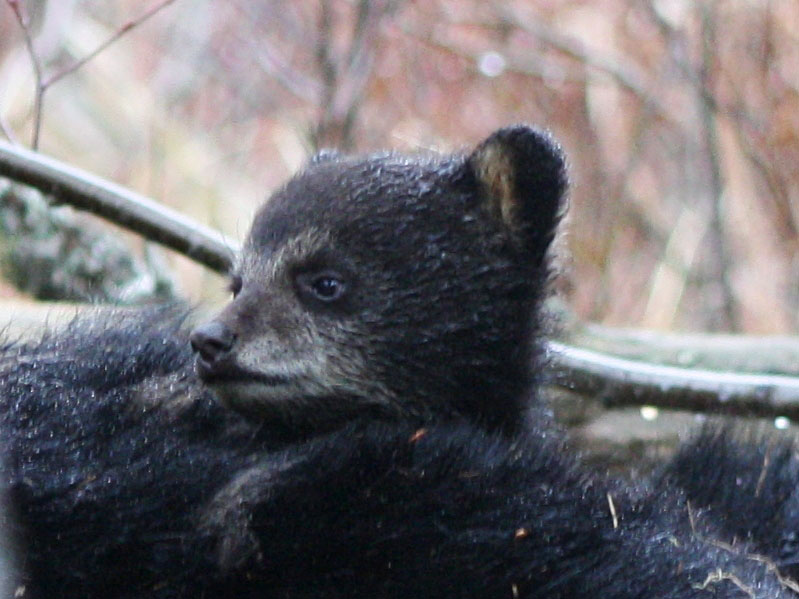
 Cub peeks over Juliet - April 25, 2012With newspaper articles warning people about bears showing up around Duluth, the radio-collared bears are setting good examples. Lily and Faith are deep in the woods foraging for natural foods. The same is true for her closest kin—June and her yearlings and Jewel and her cubs. Long ago, these and other bears we’ve studied over the decades showed that it is not habituation and food-conditioning that makes “nuisance” bears, it’s hunger. And when bears are hungry due to scarce food in the woods, there are almost always snacks available from bird feeders, garbage cans, and other human sources.
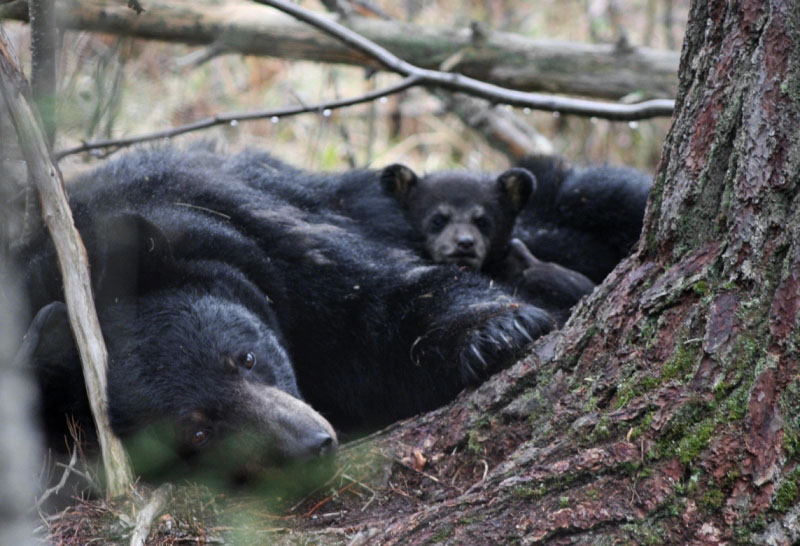 Juliet and cubs bedded by white pine - April 25, 2012People have moved into bear habitat all over the US. Homes are part of the black bear environment. What bears eat depends on the alternatives. When food is scarce in the woods, bears don’t have to be taught that bird feeders and garbage cans contain food. They just follow their noses. Food can lead bears into trouble or out of it. They generally prefer natural foods, but when those foods are scarce they still want to eat.
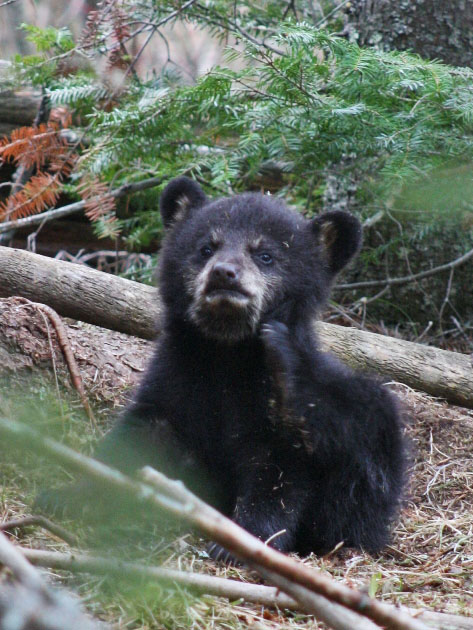 Juliet's cub scratching chin with hind foot - April 25, 2012One of the things we are studying is what if any problems exist where people welcome hungry bears with supplementary food that diverts them from problem areas. The answer is fewer problems. Lily and Faith paid a visit to a feeding station a couple days ago. Now they are a mile away pursuing natural foods. By comparison, Jo and Victoria live where there is no welcome area with supplemental food. They spend most of their time out in the woods, but checked out bird feeders last evening. Without a feeding station, they did what bears across the country do when they are hungry—go from house to house seeing what is available. Their fate depends upon the attitudes people in those houses have toward bears.
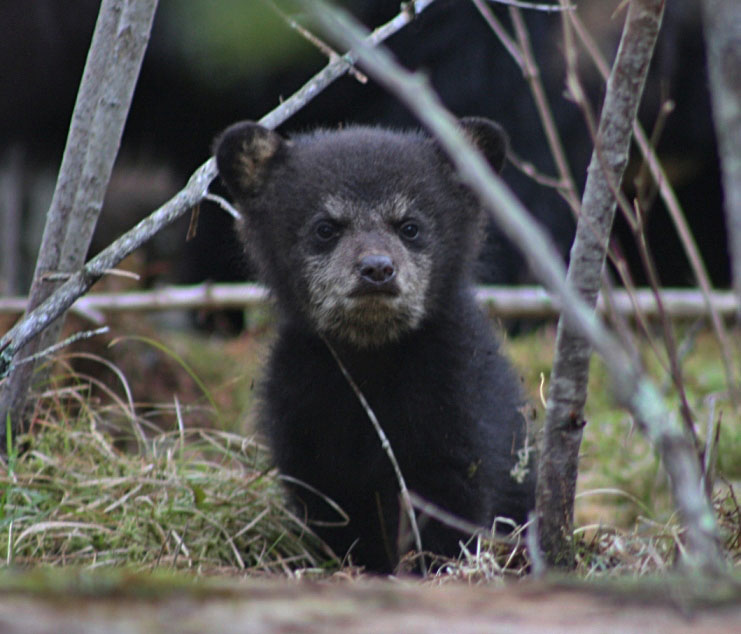 Juliet's cub - April 25, 2012Where there is a feeding station, hungry bears are much less likely to go house to house. That’s why the records for this area show 80% lower nuisance problems than statewide. That’s why in a previous study diversionary feeding reduced problems 88%. In the year 2007— when a near absence of food was leading to many house break-ins— diversionary feeding around Lake Tahoe drastically reduced the problems. Nothing is foolproof, of course, but the 50-year history of feeding stations and reduced problems in this area says a lot. In this year when early blooms may possibly have been hurt by late frosts, the feeding stations might be put to an unusual test in preventing problems.
Lily Fans are asking if 9-year-old Colleen and 12-year-old Donna and their yearlings made it through hunting season. We haven’t mentioned them lately because no one has seen them and we don’t know what they’re doing.
We do know that Donna and her yearlings made it through hunting season and the winter. We lucked out last fall and found Donna and her yearlings in an old den we checked. We gave her a radio-collar, but she left it at the den when she emerged. They were good enough to pose for our trail cam before leaving the den area. We’re waiting for her to be seen so we can get another collar on her.
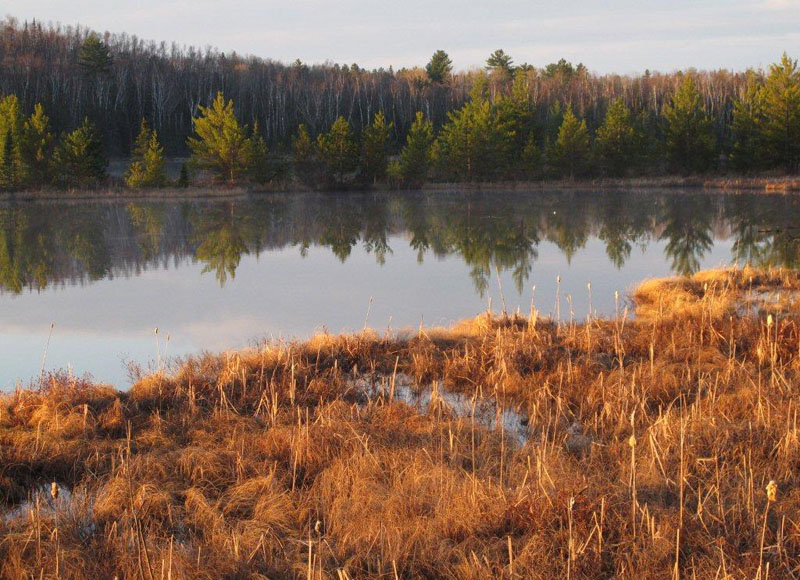 Deadman Lake - April 24, 2012Colleen is a mystery. In the fall of 2010, she and her radio-signal disappeared. In the summer of 2011, she was spotted with 2 male cubs and no radio-collar. She evidently had removed her radio-collar over winter like many bears do. We put another radio-collar on her that summer (2011). That fall (last fall), she and her signal disappeared again. We fully expect her to be seen one of these days with her 2 yearlings. Our best guess is that she has a deep, rock den where she spent the last 2 winters and that she managed to remove her radio-collars in the den each winter. We want to radio-track her and get GPS locations from her this fall in hopes of locating that den, although the chances of her using it 3 years in a row are slim.
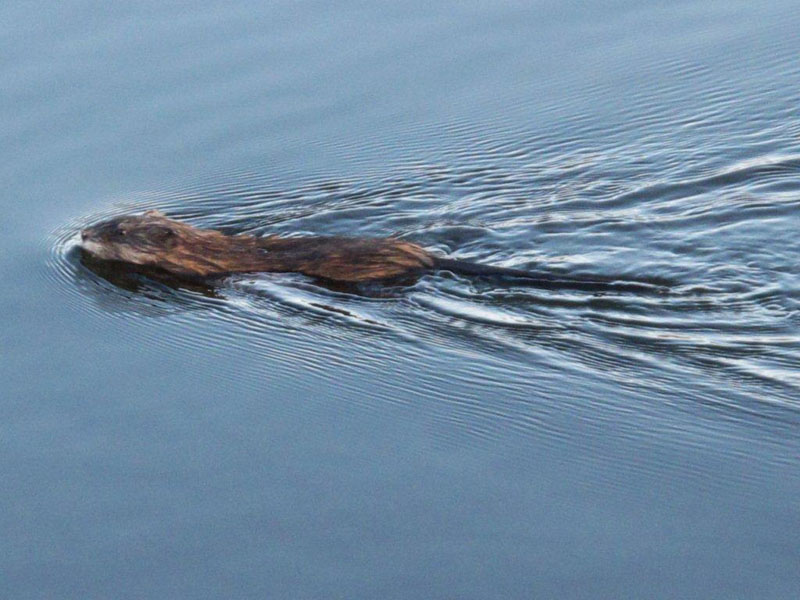 Muskrat swimming in Deadman Lake - April 24, 2012Yesterday morning was to be treasured just for the beauty of the morning and the views of nature. We’re monitoring when birds arrive and the vegetation leafs out and flowers in this unusual year. At dawn, the wind was calm, the lakes were glassy, and the sun was golden. Loons were calling, beavers and muskrats were swimming, and ducks were diving for food in the mist. The phoebe pair arrived—on time despite the early spring. A beautiful morning.
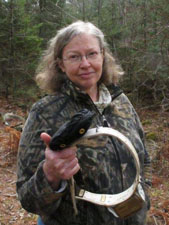 Sue with Braveheart's collar - April 25, 2012Today it rained and Braveheart dropped her radio-collar. We liked yesterday better.
Bears in the News: What should we believe? Today, 2 polar bear items arrived in the mail—a 2011 book on polar bears by one of the top experts in the world and Science Magazine with a polar bear picture on the cover. The book said polar bears split from brown bears 150,000 years ago. The magazine said new evidence from “nuclear genomic sequences reveal that polar bears are an old and distinct bear lineage” that arose 600,000 years ago. It said that polar bears have survived a number of warm phases and glacial cycles but that low genetic diversity indicates these climate conditions may have been the cause of genetic bottlenecks.
Thank you for all you do.
—Lynn Rogers and Sue Mansfield, Biologists, Wildlife Research Institute and North American Bear Center