
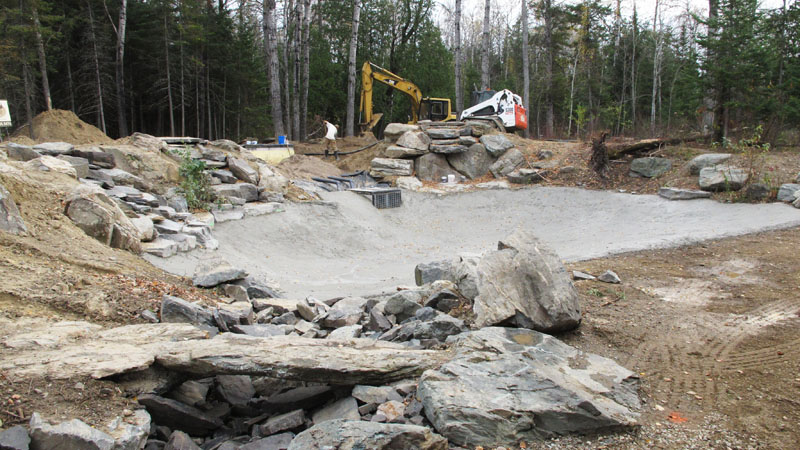
 By late this afternoon, the landscapers had finished the electricity and spreading black dirt. It was time to let Ted, Lucky, and Honey check out the changes. Honey was the first to have her door opened. She ventured a short way out, turned around and lay back down in her wooden shelter and the thick pile of straw in it. Donna Andrews coaxed her out with a food bucket of nuts, but before she ate any nuts she stopped to eat grass. She mostly stayed in the woods and never fully checked out what was new. Ted exited next from his private area where the den cam was last year. He was mostly interested in food rather than the changes. He is about 5 weeks away from lying down for the winter. Lucky finally decided to get up and check for food, too.
The plan is to fill the pond with pure untreated well water that will be trucked in. We have to see the waterfalls run before winter after all this work, and it‘s better to leave the pond full of water all winter to reduce frost heave. Either this fall or in early spring, we’ll seed the black dirt to a combination of white clover for bear food and a variety of wild flowers to attract butterflies and hummingbirds. We’re picturing it as beautiful, although it might take a year to fully bloom. We’re talking flowers and clover from the viewing windows to the pond and beyond. A lot will get trampled and eaten and a lot will remain.
The activities we are seeing lately with the radio-collared bears will make better sense in retrospect once they settle into dens. We are hesitant to visit the bears unless we have to change their GPS batteries every 10 days. We want to know that their activities were not prompted by us.
GPS locations showed that Lily and Faith returned to the cedar swamp briefly and then promptly moved 7 tenths of a mile away from it and are semi-settled again. Time will tell what they are up to.
Ursula and Braveheart and their cubs are similar stories of moving and settling. Glenn and Nancy checked on Cookie and Colleen and couldn’t get telemetry signals from their den areas. They are probably moving and around as well.
We’re a little surprised that pregnant Cookie moved, since pregnant Juliet and Dot are still in their dens.
We checked on Shirley and Sharon by telemetry. They seem to be in the same locations as the past few days and may possibly be in dens.
We have four ways of tracking the bears to gather data.
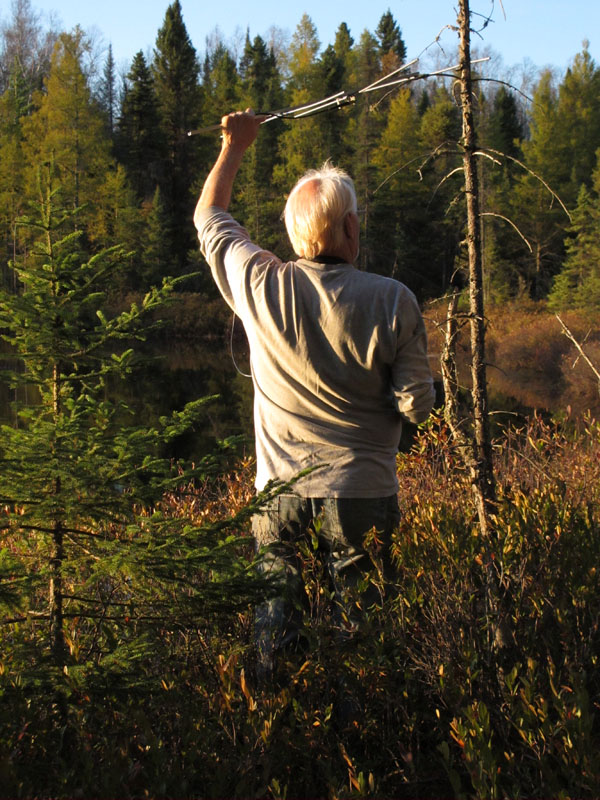 Lynn tracking a bear with telemetryThe old time-consuming way is by telemetry. The collar sends a signal that is picked up by our antenna and receiver. To find the signal, which has a range of 1-2 miles, we drive around and listen from hills, which give the best range. Once we get a signal, we take a compass reading and try to pinpoint the bear’s signal by triangulating. This is, we get signals from various locations and see where the lines cross. The accuracy is approximate because of bounce. The signals wend their ways through the woods to our antenna and receiver. The signals bounce off hills and trees, making it hard to determine the exact direction, especially if the bear is moving. When they move, they send a variety of strong and weak signals because different parts of the collar give off different strength signals. We have to wait until the bear is standing fairly still to get a good fix on the direction. We used to spend much of each day driving around to plot the ranges of the bears and how they divvied up the land and how their land tenure system was influenced by kinship. We were pleased if we could get one good location a day on each bear.
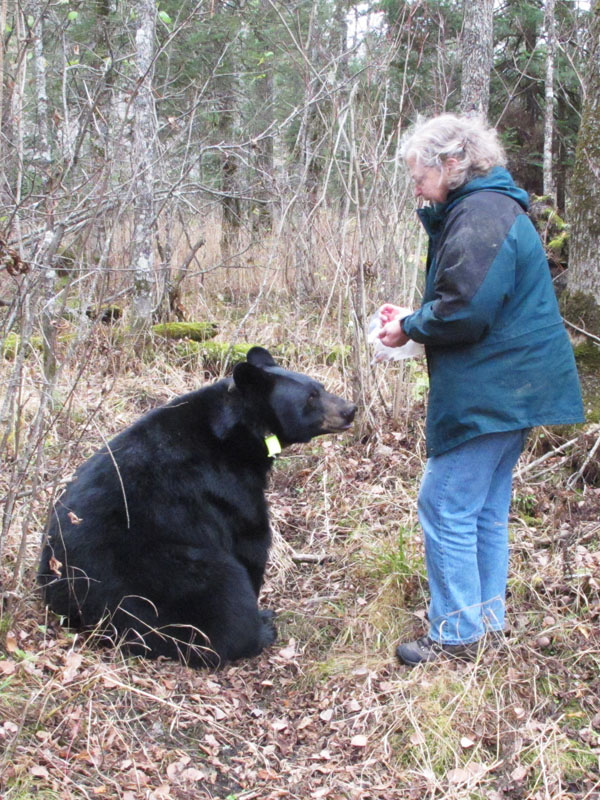 Braveheart let's Sue change her GPS batteriesNow, we have GPS units on the larger bears. Huge improvement! For those, we get accurate signals every 10 minutes unless there are problems. The detailed movements they show are what let us write what the bears do each day. Very few biologists have this technology. Sure, many have GPS technology, but most have bulky collars with big batteries that accumulate locations for a year or so for downloading periodically, often at the end of the year. We have light units (214 grams, including batteries) that send locations to our computer throughout the day. Yes, we have to visit the bears and change batteries every 10 days or so, but that is a small price to pay for the huge increase in data over the last couple years. The key, of course, is the unique situation of being able to join wild bears in the woods and have them let us change their batteries without traps and tranquilizers.
The third way is to walk with the bears after finding them with the help of telemetry and/or GPS locations. The GPS locations help show us when we can get the most data out of a visit. Some bears we can easily collar by hand at the field station, but we can’t approach them in the woods. Others we can approach in the woods but they’re not comfortable with being followed. Only a few research bears will ignore us and let us walk with them. This makes these bears invaluable to our research.
The fourth way is to watch them in dens with Den Cams, of course.
Altogether, the combination of old fashioned walking and new fangled technology has opened the door to more information about black bear life than we ever thought possible. Sharing it with the public makes it all the more exciting for us. It makes our day whenever we run into someone who is following our research and is up on the bears and their lives.
Thank you for all you do.
—Lynn Rogers and Sue Mansfield, Biologists, Wildlife Research Institute and North American Bear Center