
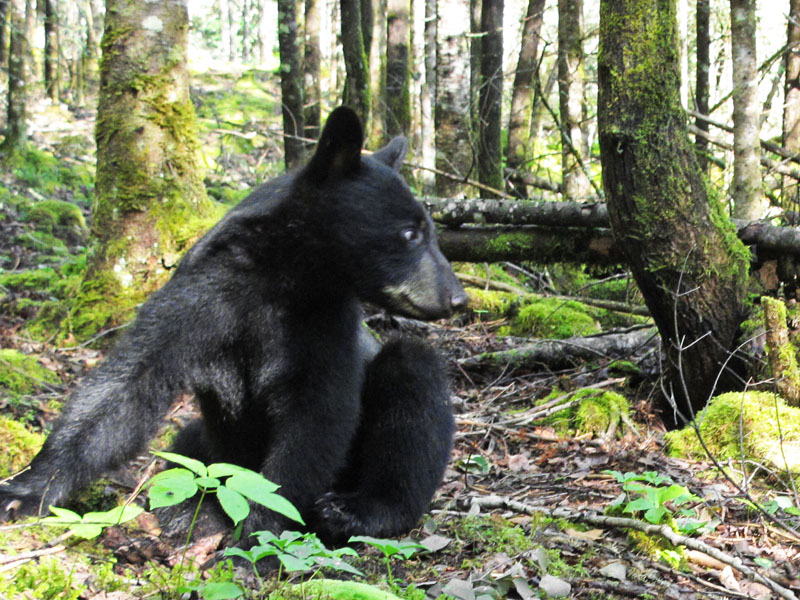
 Braveheart has returned to the study area. Our efforts to locate her from the air yesterday were hampered by bad weather and we had planned to fly again tomorrow. We will never know where she ventured to, but we’re glad she’s back. Some things just remain a mystery.
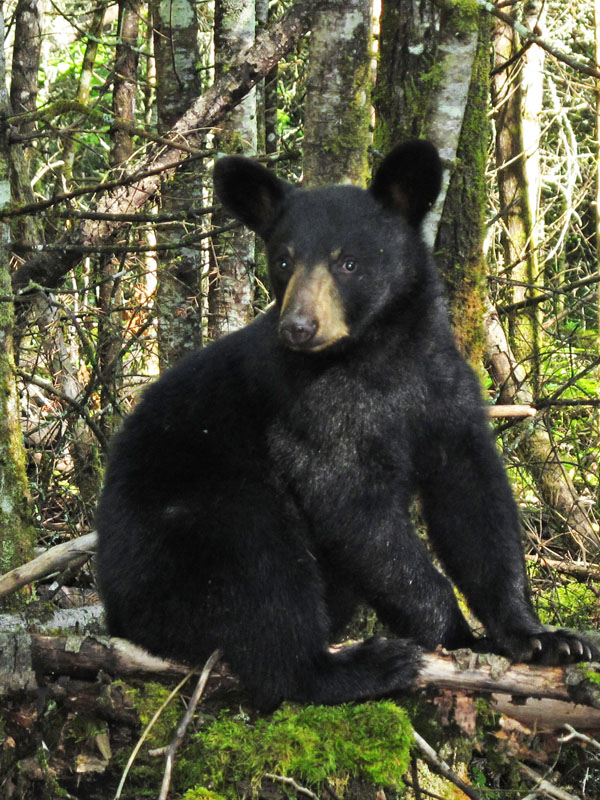 Yesterday we started June on antibiotics to help her fight any infection that may be brewing in her wounded eye. We remember how One-eyed Jack’s eye oozed for several years and we're trying to prevent that from happening to June. Because June is collared we can locate her every day for the 10-day course of antibiotics. These pictures of her cubs were taken today. Her female cub (right) has a lighter face and is braver than the male.
Still catching up on many items that accumulated during the International Bear Conference trip. Among them are opportunities that arise for education about bears.
A story that came in from a long-time bear observer in West Virginia is worth publishing in a journal. Kathy Hornby saw a 6-year-old mother black bear’s reaction to a timber rattlesnake. Seeing such an encounter is practically unheard of. Actually, it is entirely unheard of according to the scientific literature. We searched the data bases of scientific literature and found nothing on the subject. Encounters between poisonous snakes and black bears are apparently so hidden in the forest that only someone who accompanies trusting bears would see such encounters. We found nothing about encounters between snakes and bears of any kind in the literature, except the article by Gabriella Fredriksson of a reticulated python swallowing her radio-collared sun bear in Borneo. We’re going to include Kathy Hornby’s story in the Bear Tales book that a team is trying to finalize and get printed. That’s the book that over 80 of you have contributed stories to.
When the mother and cubs sensed the rattlesnake, the family leaped up a tree and stayed there, agitated, for an hour and a half until the snake left. This differs from the reactions of bears to the nonpoisonous snakes that live around Ely. When bears encounter a garter snake or red-bellied snake, they just ignore them. They don’t eat them or avoid them. Are there regional genetic differences in reactions to snakes depending upon whether generations of bears lived alongside poisonous snakes or not? Or does each bear individually learn about such snakes?
There is a twist to this story. When Kathy happened to stand (unsuspecting) less than 2 feet from the snake, wondering why the bear suddenly became upset, the mother bear slid down the tree, rushed toward a petrified Kathy, and bumped her away from the snake. The mother then climbed the tree and continued to direct her agitation toward the snake, slapping the trunk, blowing, and clacking her teeth. Kathy has known this wild mother from the time the bear was a cub. She believes the bear tried to save her from the snake. We can only report the bear’s actions. People can agree with Kathy’s interpretation or look for another explanation.
We heard a bit about how Oak Park roared past us in the voting for America’s Favorite Park. Celebrities pitched it on national television and gained a huge following. To vote for Soudan Underground Mine State Park, go to http://www.livepositively.com/#/americasparks/leaderboard and vote over and over. This contest closes September 6th. Your support for Soudan Underground Mine State Park is much appreciated by us, DNR Commissioner Tom Landwehr, the local residents, and the research bears!
The survey total is now 6,156 with 4 days to go. We’re looking forward to seeing the tallies and reading your comments. The link to the survey is https://www.surveymonkey.com/s/7S5B2GZ .
Thank you for all you do.
—Lynn Rogers and Sue Mansfield, Biologists, Wildlife Research Institute and North American Bear Center