
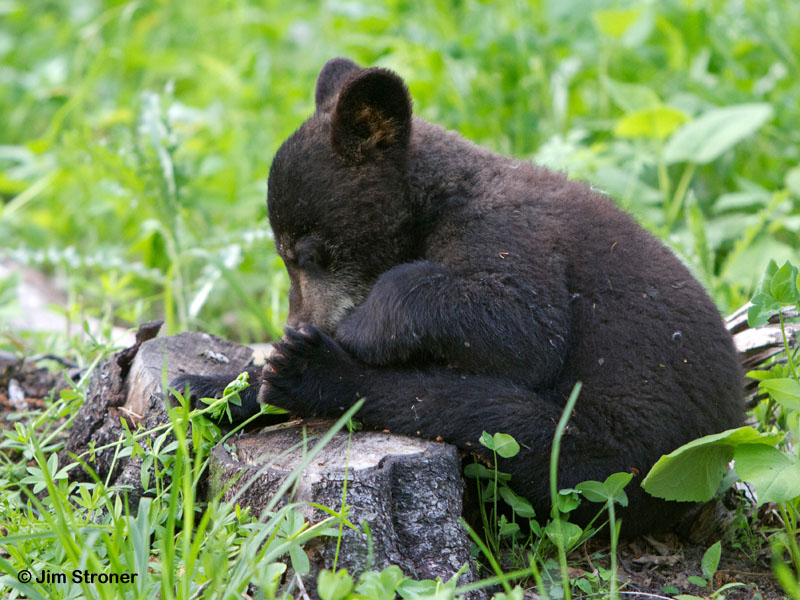
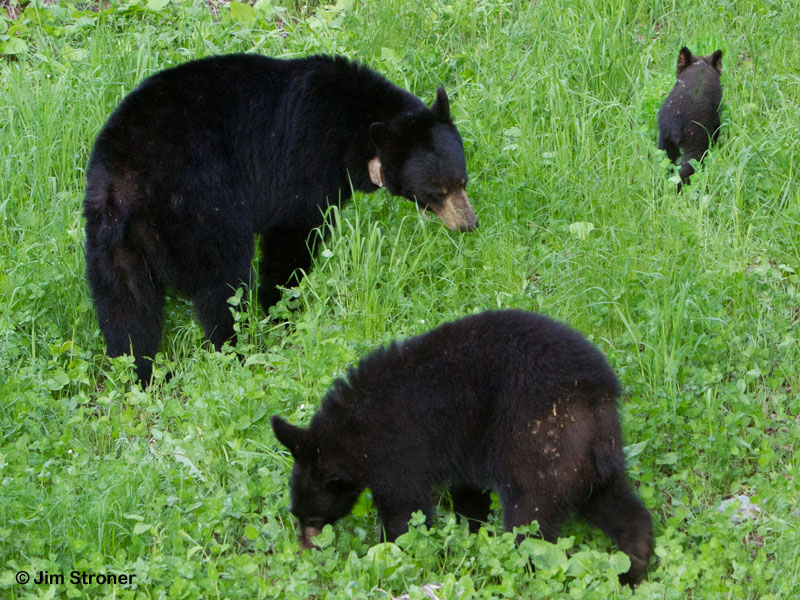
 Lily, Hope, and Faith are still far out in the woods with little change from yesterday. June is still in and around the clover patch. Jo is in the area her mother RC is known to roam. Juliet is in her territory alone. RC is done mating and is also alone. Her beau Loppy is on his own, too, but probably still looking. Braveheart’s 2-year-old daughter Samantha is spending time with Bow’s 2-year-old son Ty. Might something come of that? Braveheart was seen with 3 cubs, so at least we know that much about her. We very much want to get a radio-collar and GPS unit on her.
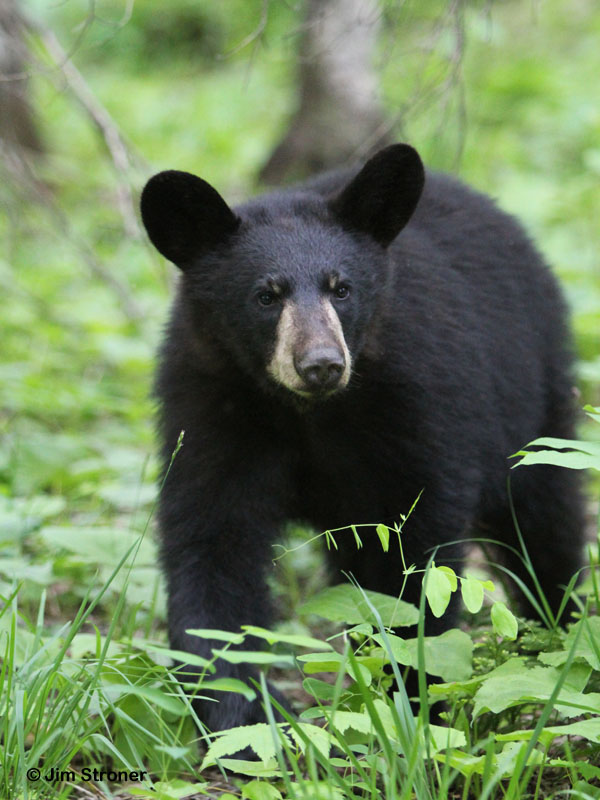 The pictures of Lily, Hope, and Faith in tonight’s update were taken yesterday. A video of Jo and her cub will be posted later tonight at http://www.youtube.com/user/bearstudy#g/u.
T. R. Michels posted a great blog about protection at http://www.startribune.com/sports/outdoors/blogs/123546069.html .
The National Geographic Wild series ‘My Bear Family’ brings home the 2010 story of Lily and Hope in a way that our videos and updates could never do. It should give viewers a better idea of what black bears are really like—not the ferocious animals they are often portrayed. We looked on this series as a major opportunity to educate. We were disappointed, then, to see that National Geographic added uninformed, biologically wrong words to the screen without a word to us.
 When we read on the screen that black bears typically don’t have cubs before age four and that “biologists believe that young bear mothers like Lily are less capable parents and more prone to abandoning their cubs”, we dug out Dr. Gary Alt’s Ph.D. dissertation “Reproductive biology of female black bears and early growth and development of cubs in northeastern Pennsylvania.” It’s the biggest study on black bear reproduction ever done. Lily had Hope at the age of 3. In Gary Alt’s study, 85% (29 of 34 mothers) had cubs before age four. His area was particularly good habitat, and one female even produced and successfully raised a litter as a 2-year-old. He reported mothers also commonly producing cubs at 3 in Massachusetts and Tennessee but not in Alaska, Arizona, and Idaho where food is not as abundant. The National Geographic statement is almost identical to a statement about Lily and Hope in the St Paul Pioneer Press Dispatch a year ago. Based on the high success that 3-year-old mothers had raising cubs in Alt’s study, we don’t think Lily’s age was the reason she abandoned Hope. We don’t know of data that would support that. However, there is ample biological data supporting the idea that a single cub in a species that typically has 2 or 3 cubs might not provide enough suckling to prevent ovulation, and the fact is that Lily went off temporarily and mated. When she returned, still a 3-year-old, she was a great mom.
One of our great desires is to have beliefs about bears based on science, not opinion—especially when it is put out to the world on national television.
That is what makes Lily fans so great. Our goal as a group is to do just that—learn the truth and put it out there where people can replace their beliefs with facts. We think we’re making some headway.
On this calm, clear evening (66 F), the main sound is green frogs and gray tree frogs.
Thank you for all you do.
—Lynn Rogers and Sue Mansfield, Biologists, Wildlife Research Institute and North American Bear Center