
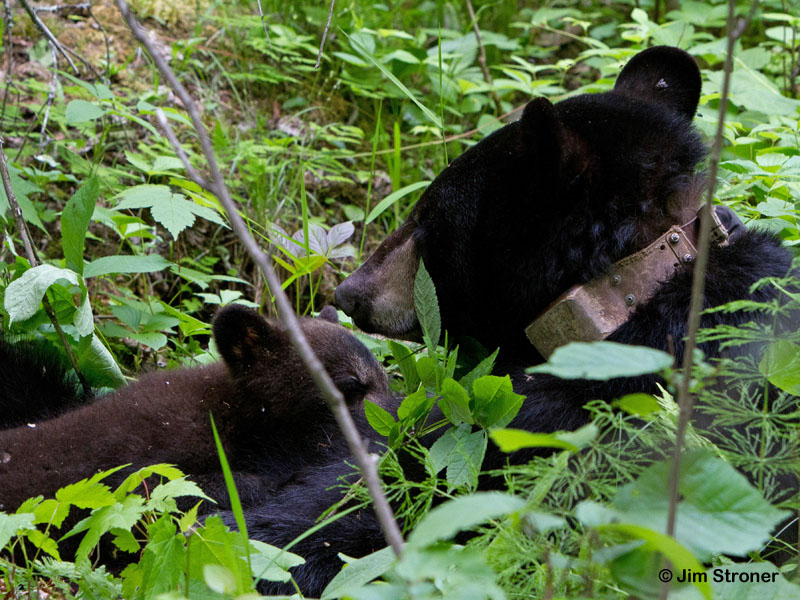
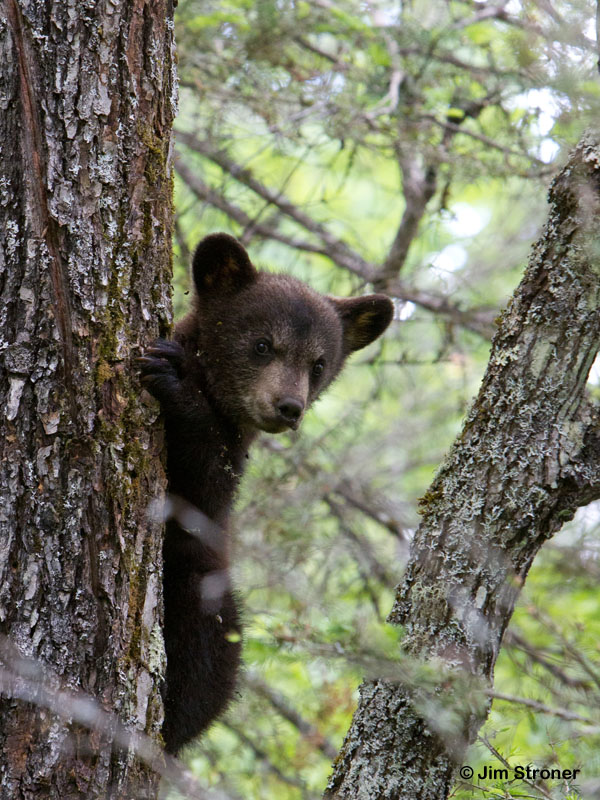
 Jo’s cub finally got brave enough to come down from a tree and let us determine her sex. Careful examination of the video footage confirmed it. Photos are of Jo and her cub.
Jo seems to be struggling to find a territory to raise her daughter. The one mile by two mile area she primarily has used since leaving her den was occupied earlier today by Juliet, while Jo is over 3 miles away. Jo is now in an area traditionally used by her mother RC. We don’t know a lot about where RC lives now because she hasn’t worn a radio-collar since 2005. She became a little too edgy for us to find anyone who dared to put a radio-collar on her. People have seen RC 1-2 miles from where Jo is today, but RC easily could 'own' Jo’s location without anyone knowing it because no people live in that patch of woods. Jo’s movements may tell us more.
June is back in the clover patch. She keeps returning to that infamous patch. She may be foraging on new growth that has formed where she previously browsed.
Lily, Hope and Faith found a different clover patch that includes peavine, a green that remains palatable longer than most other greens around here. We changed the batteries in Lily’s GPS unit today, and she and her family are all doing fine.
The conference in Alaska focused on diversionary feeding for polar bears to reduce conflict with native villages as the bears spend more and more time ashore due to waning ice. We enjoyed hearing presentations by others doing diversionary feeding and happy to share results of the diversionary feeding activities that are part of our studies in Minnesota. In our study area, people have been feeding bears since 1961 and have become more willing than most to coexist with them. The bears here are showing us how much they prefer natural food and how little their lives are changed by the availability of diversionary food. When natural food is scarce, bears would be prowling the community for bird seed and garbage—problems that are minimized here by diversionary feeding sites. It is a subject that has received little previous study and is proving to be a powerful tool in reducing conflict. Food can lead bears into trouble or out of it. The old saying, “A fed bear is a dead bear” is not necessarily true.
Thank you for all you do.
—Lynn Rogers and Sue Mansfield, Biologists, Wildlife Research Institute and North American Bear Center