
Today’s guest of honor has not shown up for the party. No one has reported seeing her this year. If she showed up today, it would be very appropriate. Braveheart is a favorite. She is the bear in the Minneapolis Star Tribune story at http://www.startribune.com/sports/outdoors/105081984.html?source=error. We remember trying to catch up to Braveheart that day with reporter Dennis Anderson and the photographer who took the great picture of her looking regal, at least that was our take on it. Braveheart was elusive that day, as is usual when we try to catch up to her in the woods. She takes extra assurance that it is really a safe situation with safe people. Once she is sure it is us, she is calm and trusting as in the picture.
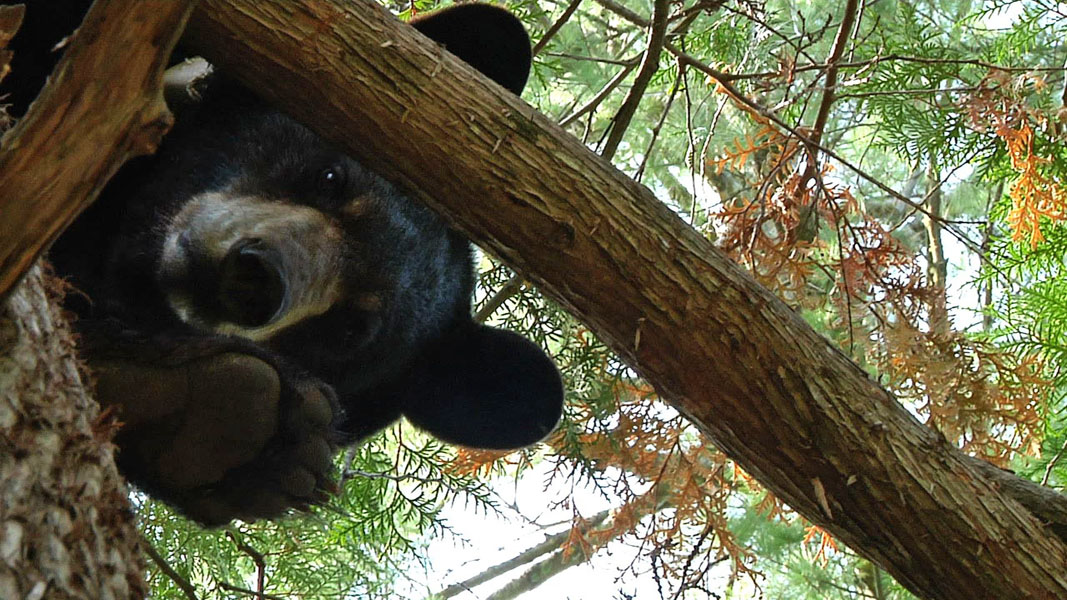
Braveheaert is so hard to approach that we haven’t walked with her much. Lynn remembers walking with her one day and seeing her disappear. He walked up onto a rise to scan the valley for her. Dense raspberry bushes made it hard to see very far. He stood there looking a long time. Then Braveheart moved. She had been within 4 feet of Lynn the whole time he was standing there. Braveheart is 9 years old and is the biggest female we know. On the day she disappeared in the bushes she weighed over 400 pounds—a lot of bulk to hide that close to someone. There are many stories to tell about Braveheart’s life. We have known her since she was a cub. It will be a relief when someone reports seeing a bear with her distinctive chest blaze. We called her Braveheart because she was the bravest cub in her litter. She is the cub in the bear language video pouncing toward the camera and slamming her little foot down. She is also the adult doing the same thing for comparison.
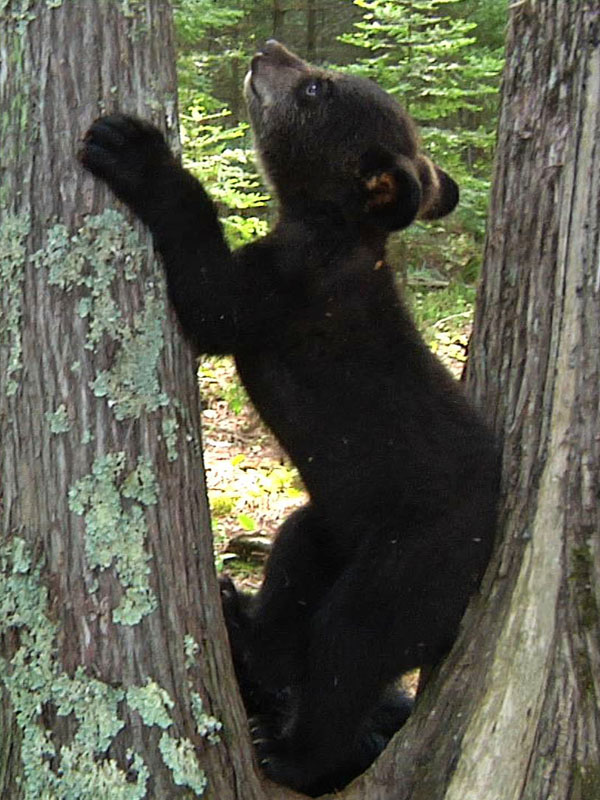
Lily gave us a scare today—and shortly gave us a sigh of relief. At 7:34 AM, we got a call that a cub was up in a tree abandoned by a mother and yearling that had left her, and the cub was crying. Oh no, not again, we thought. Lynn rushed to the area to radio-locate Lily in time to see her and Hope dutifully coming back for Faith. Lynn hurried ahead to the tree Faith had climbed. She was on the ground, climbed a short way, and then came back down. She stood with her front feet against the tree and looked up the trunk. Lynn marked the height of her nose in his mind and later measured how tall she stood—26 3/8 inches. She is growing! Then Faith looked away into the forest and hurried up the tree. She looked again and came down just as fast. She met Lily 5 feet from the tree and stood up and put both paws on Lily’s face and touched Lily’s lips with hers. So human! Then she ran 5 feet to Hope who was standing on her hind legs looking around. Faith stood up with her paws against Hope’s belly and stretched up as far as she could to greet her. After Faith’s crying and undoubtedly feeling abandoned, her relief and joy of reuniting was obvious. Then the 3 walked off at a fast walk—Lily on Faith’s left and Hope on her right with Faith at a near run to keep up.
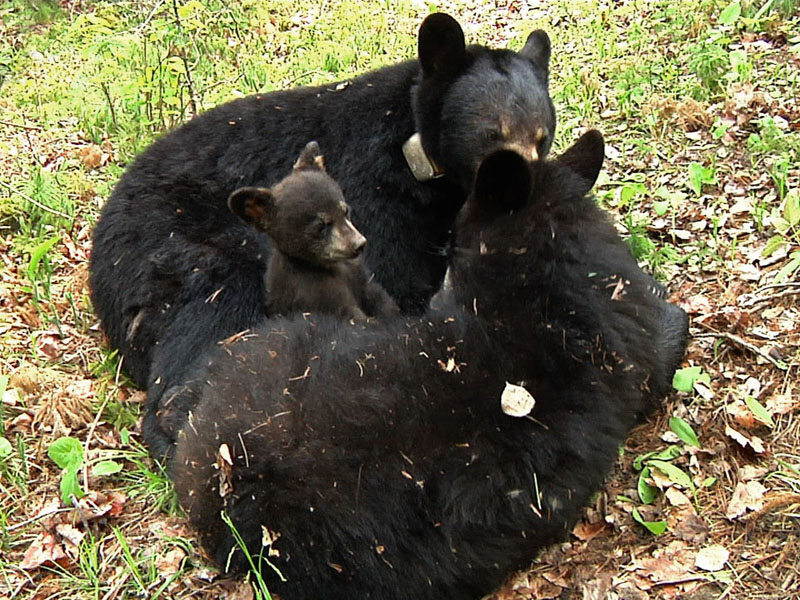 Later this morning we connected with Lily to change her GPS unit. We found the family together and very playful—as can be seen in the video which will be posted later tonight at http://www.youtube.com/user/bearstudy#g/u.
The chokecherries are in blossom and the last trees to leaf out are bursting their leaves. These are the mature black ash trees in wet swamps. A few days ago we reported that black ash were starting to leaf out, but those were mostly saplings. Now, many of the biggest black ash are showing green. The leaves of other trees are enlarging, losing their yellowish look, and become a more mature green. At the same time, the ground vegetation that has been a mainstay of bear diets is maturing, too. That means bears will soon have to turn to other foods—typically ant pupae which have been delayed by the cooler than average spring. We’ll see what they do next.
With 2-3 weeks of lean food coming up, we worry a bit about Jo who is living in a mostly forested area of about a mile by 2 miles—but surrounded by residential areas. We hope she doesn’t turn to bird feeders and/or that homeowners will be tolerant. One of the things we are studying is how bears survive as more and more people move into bear habitat.
Thank you for all you are doing.
—Lynn Rogers and Sue Mansfield, Biologists, Wildlife Research Institute and North American Bear Center