
How do we identify 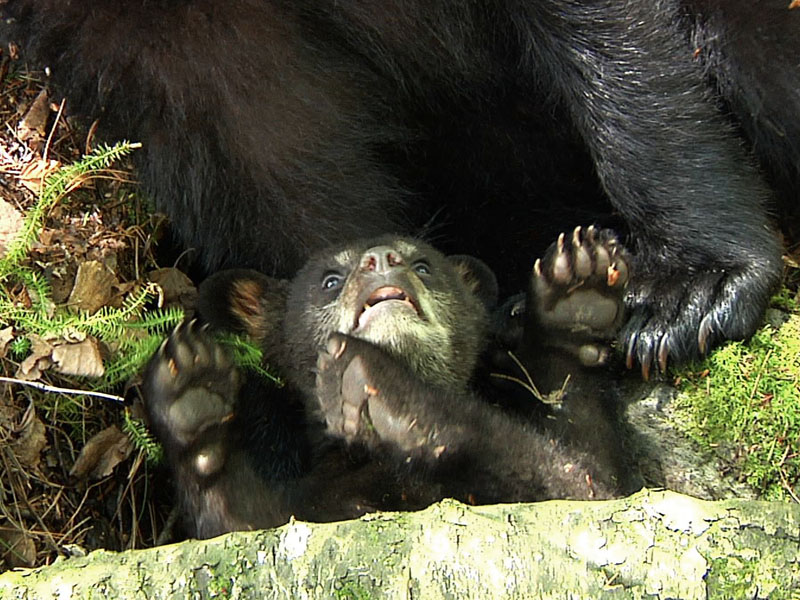 the bears we see? It isn’t always easy, but for the old favorites, it is. Their faces are very different, especially the color and shading of the muzzle, the size and color of eyebrow patches, and any scars. Some have more brown on their ears than others. The chest patch is next. If they have one, it’s different for each bear—color and shape. Some patches have sparse white hairs. Others are bright white or yellowish. Bodies differ not only in size but in shape. Some are more sway-backed than others. Some have a more pronounced hump. The size and shape of their heads vary. Coat color in this area is usually black, and those with brown fur are so uncommon that we immediately narrow down who they are. Finally, personalities differ greatly.
Another cue is scars under the fur that you can’t see but can easily feel. A couple years ago, Willy showed up after being gone for years. Could that be him? The bear was obviously a male with its bulky 500-pound body. The dark muzzle was unusual. It had to be Shylow or Willy. Both were mellow males that knew us. Lynn approached, saying “If he lets me walk up to him it is either Shylow or Willy, and if he lets me feel for the scar on the lower left side of his neck it is definitely one of them.” A person new to bears was watching and holding his breath. It looked dangerous, but it wasn’t. If the bear didn’t feel comfortable with Lynn approaching, it would show some discomfort. The bear stood confidently as Lynn came up and felt for the scar. No scar. It was calm Willy.
 The interesting thing about Willy and the others is that they will accept familiar people approaching in familiar areas. But in other places where they don’t expect familiar people, it’s a whole nother ball game and takes a whole nother level of getting used to seeing us. That’s what makes June, Lily, Juliet, and Jo so special. They have learned our voices and usually will accept us anywhere. On windy days, they are more nervous and approaching can be harder. But for the most part, they trust us enough to open the world of black bears for us all. We’re hoping Willy shows up again one of these years. He must live far away that we don’t see him most years, but we’re glad he returns to the study area from time to time. We suspect Cal would have done the same if he hadn’t been shot 80 miles away. He had already surprised us twice by returning to his birth area from faraway places.
We suspect the choicest spring vegetation is beginning to harden off and become less palatable. Both Lily and June have decided to try something new. The old clover patch just wasn’t cutting it, apparently. Last evening, Lily started looking for something different and led her family about 4.5 miles into areas she hasn’t visited yet this year. She’s been resting the last couple hours, now.
Early this afternoon, June left the clover patch, too, but she led her cubs only 0.9 miles into the roadless area. We hope her batteries hold up because it is a 2.2 mile walk to get to her now.
Juliet was the champion wanderer, traveling over 8 miles in the last 24 hours.
Jo and her cub stayed in an area 0.6 mile in diameter but made us worry when she came close to residences.
Part of what we are studying is bear-human relations as more and more people move into bear habitat.
 We are also recording how yearlings relate to one another after family break-up. Females usually split apart as Juliet’s yearlings Sharon and Shirley have done. Males are not as anti-social. They are not competing for territory like females are. In the Bearwalker film 3 yearling males from 2 litters teamed up to become the Three Amigos. We also remember June and Hazel, littermates, being antagonistic toward each other but either one was happy to hang out with their mellow brother Willy for brief periods. They couldn’t have too much mellow time, though, because the girls were staking out the land of their futures.
Since family break-up various combinations of RC’s 3 males have paired up from time to time. This late afternoon, all three were together with Juliet’s yearling the Boy Named Sue. Boy was seen playing/wrestling with one of RC’s yearlings.
A nice thing is developing. An anonymous donor who noticed that the Bear Center is still over $60,000 in debt teamed up with his/her employer, General Mills, to give up to $2,000 in matching donations. Team Bear is gathering prizes for a drawing. The event starts Friday June 10 at 11:00 AM EST and will run through Sunday June 12 at 11:00 AM EST with the drawing to follow. Team Bear also said, “If any fan is interested in offering any fundraising ideas, please contact
At the Bear Center, mating season is on and Ted and Lucky are not as friendly toward each other as they were, at least temporarily. Honey has changed her sleeping spot from her den to Ted’s den, but Ted is sleeping elsewhere, as is Lucky. Even though it is mating season, she chases young Lucky off but we haven’t seen her say anything mean to Ted. What a change in disposition we are seeing in Honey. She was friendly to Ted during mating season last year, too, but no cubs resulted. We’ll see what happens this year.
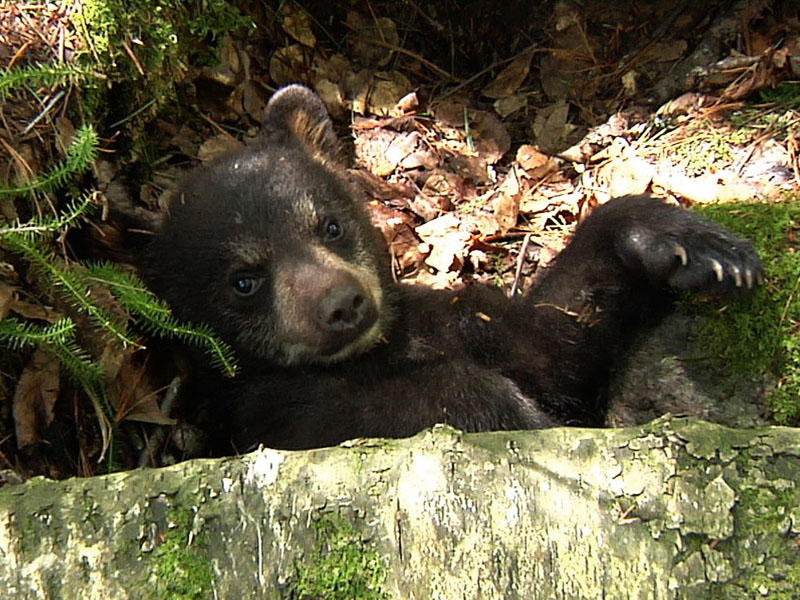
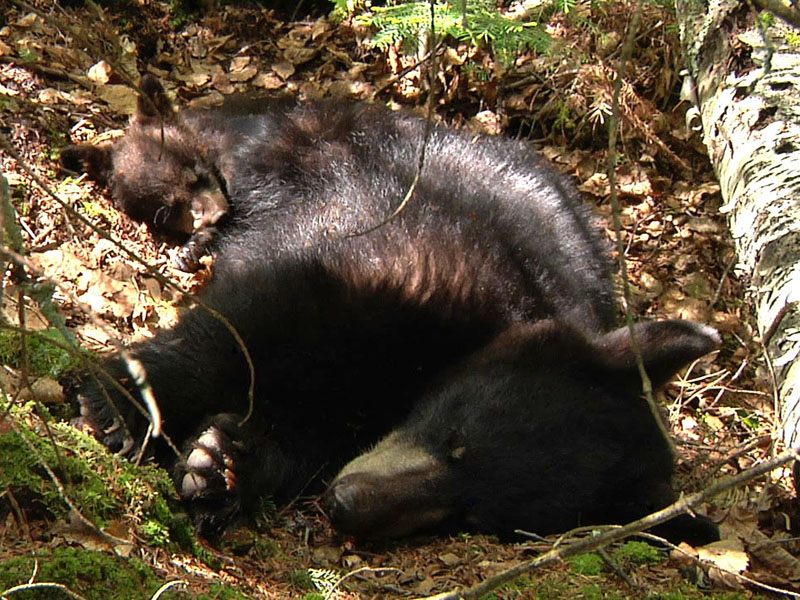
The pictures in this update are of Faith and Hope and were taken May 31. A video from that day will be posted later tonight at http://www.youtube.com/user/bearstudy#g/u.
Thank you for all you do.
—Lynn Rogers and Sue Mansfield, Biologists, Wildlife Research Institute and North American Bear Center