
Den Dilemma
September 22, 2010 – 8:16 PM CDT
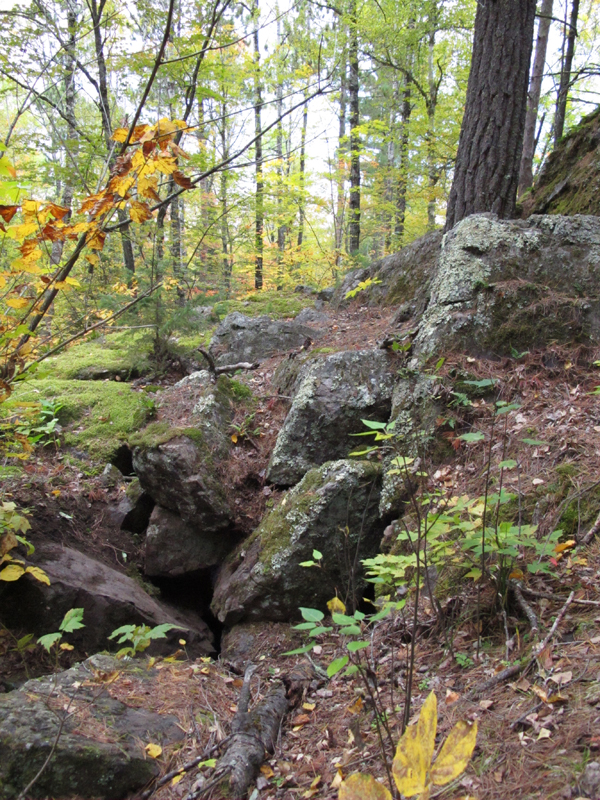 We found Jo—the poster bear for sparing radio-collared bears—in a rock den this morning. Yesterday, we located her to fix her GPS unit so it would continue to send her location to our computer. Her heart rate was only 49, the slowest we’ve recorded this season. We thought she must be close to denning. At 6:44 PM last evening, her GPS readings stopped again. We believe that is when she entered a rock den uphill from where we met up with her.
Today, we documented something we’ve never seen before and never even considered. Jo was stuck in the den. She couldn’t get out.
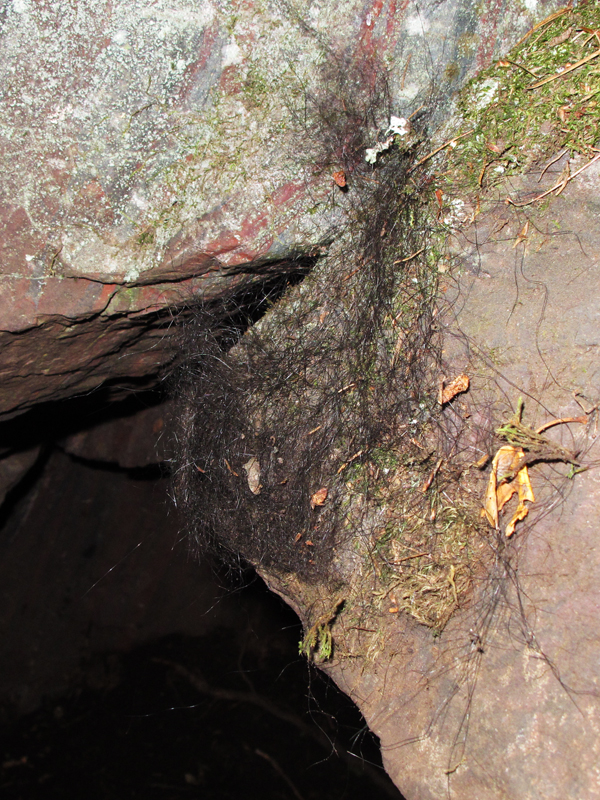 The den is a jumble of boulders—some smooth, some jagged. To get in the den, Jo squeezed down past a jagged rock that took a patch of fur off her back. She probably had visited the den earlier this year when she was skinnier. Now, she squeezed in and down—helped by gravity—removing the patch of fur in the process. The fur was still on the outside of the rock. Coming back out was more than she could do. She didn’t have anything to grab onto outside the den, and she didn’t seem to have anything to push on from inside. By the time we watched her trying to get out, she had probably tried many times. The part of her back that rubbed the jagged rock was nearly bare. As we watched, she finally gave up and slid back into her den. We left in a quandary. Should we help? Could we help?
We were relieved when we got a lone signal from her GPS unit showing Jo had left the den. We checked. Somehow she managed to get out and was downhill from the den. If it’s that hard for her to get in and out of that den, she would have trouble raking bedding into it. She will likely have cubs. But without bedding, they would be lying on non-insulated ground. Later in the winter after she loses some weight, exiting would probably not be a problem, but that would be too late to rake in bedding for the cubs.
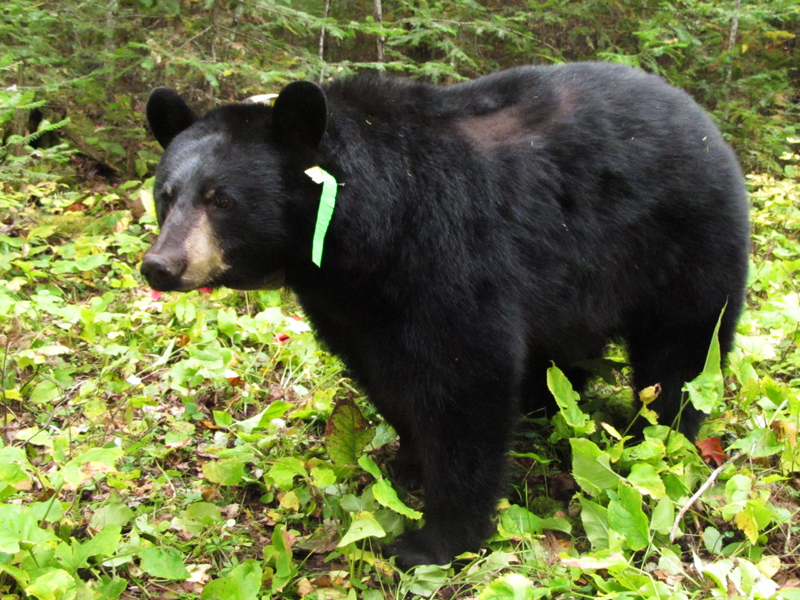 We’re now waiting to see if she goes back to that den or finds a more suitable one. This kind of problem has never been reported that we know of. If we hadn’t seen her struggle to get out of that den, we wouldn’t have had a clue why her fur was missing.
The other bears are foraging a bit and resting a lot. Braveheart has moved 2 miles away from the dug den she had been hanging around. Lily and Hope have begun a big move this evening. Juliet and her cubs have too. We’ll all learn together when they enter dens.
Many of you probably already saw the article about Cal in the St Paul Pioneer Press http://www.twincities.com/ci_16137598?nclick_check=1
We’re not sure how to respond to a couple of the statements in the article.
First, Dave Garshelis said that if our radio-collared bears were protected and his not, it would give the perception that ours were more important than his. We’d never thought of protection in that way. Dave wants to keep shooting radio-collared bears legal so he can get his radio-collars back from hunters. He needs the collars back because they cost thousands of dollars and they store a year of GPS data (and sometimes heart rate data). They need the collar to retrieve the data. For them, the main value is in the collar. So they just discourage hunters from shooting radio-collared bears.
That doesn’t work for us. We have vastly different research goals and methods. If the DNR wants to protect all radio-collared bears so none appear to be more important than the others, that’s fine with us. But the bottom line is that the radio-collared bears wearing ribbons in our study absolutely must be protected. The time has come. Asking hunters not to shoot them has not worked well enough.
How are the studies different? In the MN DNR study, the main value is in the collar. In our study, the value is totally in the bears we have spent countless hours cultivating trust. If one of those is killed, we can’t just go on with any bear. A loss is a devastating setback. Our study is about how bears live. It’s about ecology, behavior, and relationships. Recording data on those topics requires trusting bears that are completely comfortable with us being there recording data and taking video. The great thing about it all is that the bears ignore us. We are nothing to them. They don’t seek our company. They don’t think of us as food-givers other than a handful to start off a walk. But they don’t think of us as competitors. We are harmless entities to be ignored as they go about their lives. And that’s what makes the data so good for science.
It is also what makes the bears so good for education. Some of them will now ignore BBC camera crews making documentaries for millions to learn about bear life. Learning about real bear life is why you and we are captivated by these bears. They show us wild black bear behavior, relationships, and ecology that cannot be seen anywhere else. Most TV programs about bears use trained animal actors, tame bears, or wild bears attracted by bait. The bears don’t do natural foraging or interactions—especially where forest habitat is too dense to use long lenses. Filmmakers can’t spend the time we do getting black bears used to observers in dense forest. These research bears are incredibly special and must have better protection.
That lack of understanding is why we were disappointed to read the commissioner’s quote, saying "Rogers' research is not the sort of research we are going to protect. It's social research, it's about the social interactions between bears and humans. If that's going to happen, it has to happen with all the elements of society around it, and that includes hunting." We are hoping he will grant us a meeting and an opportunity to explain that hunting losses have no benefit in this research. We can’t study ecology, behavior, and relationships in dead bears and we can’t just switch to another bear and continue. Hunting losses tell us nothing. They just cause major setbacks, with some of the bears being irreplaceable in our lifetimes.
Concern was also expressed that the temporary ribbons we use can get torn off. The stiff duct tape ribbons we use are very durable. We also have enough contact with the research bears to replace or add ribbons if needed.
The rest of the article focused a lot on you, Lily fans, wondering if you could exert enough social pressure to create change and protection.
Thank you for all you do. This, and so much more.
—Lynn Rogers and Sue Mansfield, Biologists, Wildlife Research Institute and North American Bear Center