
Lily’s brother Cal is killed
September 21, 2010 – 10:00 PM CDT
Cal’s story
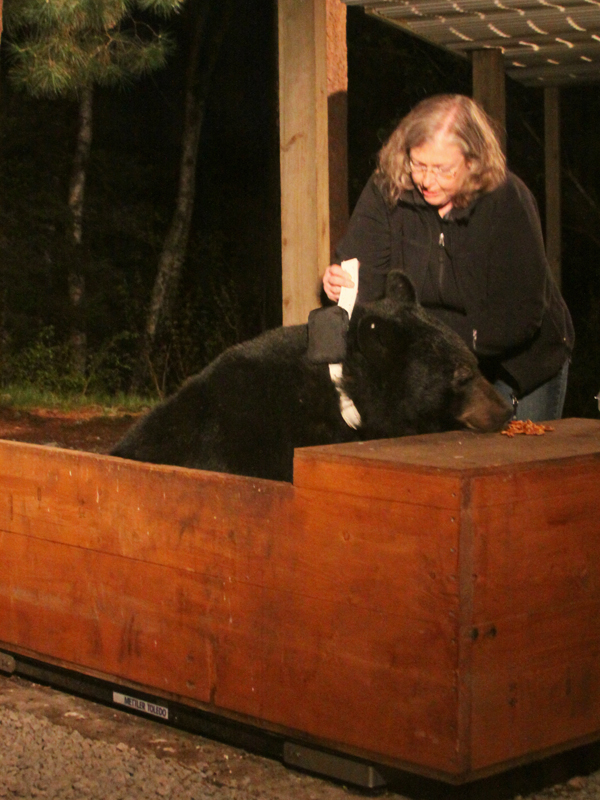 We learned today that Cal was killed September 3, a day or two before Sarah. Cal was radio-collared but had no ribbons, so we’re not blaming the hunter. If it was illegal to kill radio-collared bears, this would be a situation where we would expect a game warden to use discretion and not charge the hunter.
We would have liked to get more data from Cal. He provided the best data on the dispersal movements of a young male black bear from his birthplace that we know of anywhere. Usually, we don’t radio-collar young males because they travel so far that the chances are too great of losing them and having to spend a fortune in airplane flights to find them and remove their collars. However, with recent advances in GPS technology, we could radio-collar Cal, who is Lily’s brother and one of the 3 amigos in the Bearwalker documentary. Cal was also featured as a newborn cub in the den in SpringWatch USA on Animal Planet back in 2007, and was one of the bears in the BBC Series Life: Insects in 2008.
Cal was a sweetheart as a cub and yearling. We put a radio-collar on him in August 2008 to learn about his relationship with Mickey and Dale, the other two members of the 3 amigos. However, Dale and Mickey were shot early in the hunting season that year. We followed Cal to his den. We coaxed him to the entrance and removed his collar, thinking he would disperse the next spring and we’d never see him again. We wished we could follow his dispersal movements and learn that aspect of bear life, but it would have been too risky.
In April 2009, he left that den and probably left the area. We didn’t see him at all until August. By then, we were using GPS attachments. We were very glad to see him. We gave him a radio-collar with a GPS attachment and followed his movements on Google Earth as he made his way 30 miles north to Crooked Lake on the Canadian Border. To our surprise, he came back to his birthplace, so we put fresh batteries in his GPS attachment to see where he would go next. He stayed around for a couple weeks until the batteries expired, and then he disappeared.
We flew up to Crooked Lake and Kenora, Ontario, to look for him. No luck. Later in fall, when we figured he was in a den, we flew again. We covered a bigger area and found him 38 miles northeast of his birthplace. He was in Canada north of Prairie Portage, which is a place Boundary Waters Canoe Area Wilderness (BWCAW) users will recognize. We knew we had to remove his collar while we had a chance. Airplane rental had already cost nearly a thousand dollars and we figured he would continue to disperse north in the spring.
We paid Jeep LaTourelle to boat us up to Prairie Portage and wait several hours for us as we clambered over logs in the BWCAW blowdown area. That’s an area where straightline winds had leveled the forest a decade ago in the storm of a century. Cal recognized us and came to the entrance of his den as he had done with us a year earlier. We removed his collar and said goodbye. We were amazed how far he had traveled and thought that was the end of the story for him. We didn’t know that the story was just beginning.
To our surprise, he showed up in his birthplace area again this spring (2010). We thought that as long as he keeps coming back, we might as well put a radio-collar on him again with the GPS attachment (picture). As a 3-year-old, there was a good chance he had settled into a movement pattern and had a mating range established—probably up in Canada where we had tracked him. Wrong. But that’s why we do research.
He moved south, far south. Before he left his birthplace area, he bedded in a spot he had bedded with June, Lily, and Bud as a cub and a yearling. Then he headed out. Cal is a bear that had no fear of us. He had learned to accept BBC film crews and people who accompanied us when we followed him. You can see how accepting he was of us in the Bearwalker scene of putting a radio-collar on him as one of the 3 Amigos. One would think he wouldn’t try very hard to avoid people. Wrong again. As he meandered SSW, his GPS locations showed that he avoided any hint of civilization. He skirted around farms and cabins. He avoided towns and sources of garbage and birdfeeders as he moved some 45 miles SSW to the vicinity of Melrude and Cotton, MN and westward.
After a couple weeks, we visited him to change the batteries in his radio-collar. It took over an hour to connect with him. He wouldn’t believe “It’s me, bear.” He circled out of sight. Eventually, we got close enough to see a bit of him watching us through the bushes. By then, he must have scented us as well as hearing our familiar voices. We eased closer, talking to him. Within throwing range, we tossed him a brazil nut. Even then, he remained cautious and came only slowly. When he joined us, the tension left him. He was calm. We changed his batteries, thanked him, and left. He continued to roam the same area.
A couple weeks later, we tried to change his batteries again. His signal was close. We entered the woods, calling to him. It was breezy. He cleared out. We returned to the vehicle and tracked him nearly two miles from roads, checking the map to see how to get out in front of him and intercept him.
We saw a chance to catch up to him if we walked fast down an old road that said “No vehicles allowed.” We called out repeatedly as we hurried along. He apparently never heard us. As we came over a rise, he looked back over his shoulder and bolted—that last we ever saw of him. There was no catching up to him in the habitat he fled into that late in the day. His GPS batteries expired the next day.
On August 25, we flew to locate him. He was about 18 miles SSW—3 miles southwest of Canyon, MN. He was about a half mile from a farm house and a few hundred yards from a vacant hunting shack. This was as close to civilization as we had found him. Had the landowners seen him? We looked up the owners and called both. The farmer hadn’t seen him, and the hunter said he wouldn’t shoot him.
His travels were not over. In his final 9 days, he traveled another 37 miles WSW and was killed about 20 miles north of McGregor, MN—83 miles southwest of his birthplace and 120 miles southwest of his den near Prairie Portage in Canada. We wonder what he would have done next year, and where he might have finally settled. Would he ever have returned to his birthplace from so far away?
Happier Things
We can’t believe the creativity of this amazing group of Lily fans. The 38 posters that 9 of you have created to support making it illegal to kill these radio-collared bears are fantastic. We wish we knew how to get them before the public to help.
The letters to editors we are seeing are clever, well-worded, heartfelt, and powerful. The newspapers to send them to are the Minneapolis Star Tribune, St Paul Pioneer Press, Duluth News Tribune, Mesabi Daily News, Timberjay, and Ely Echo.
Even though the MN DNR’s press release did not give one mention of Lily fans being the ones who voted $100,000 for Bear Head Lake State Park, the newspapers and magazine writers realized the truth. When no other Minnesota State Park got over 10,000 votes, and Yellowstone National Park got maybe 30,000 votes, it was either Lily fans or some kind of miracle that got an obscure park in northern Minnesota over one and a half million votes.
Your talent is emerging in the clever Black Bear Boxes that the Education Outreach team is creating.
Your talent and generosity are emerging in the clever fundraisers you are hosting for WRI this hunting season.
We were also surprised to see M&M’s that say ‘Lilys Hope’, ‘It’s me, bear’, and ‘NABC’ at the Bear Center.
Now your talent is showing in the decals, bumper stickers, and more.
We look forward to stopping by the Bear Center to see what treats are there from you. People begged to share the coconut cream pie you sent special for Lynn. He gave in. Judy McClure said it was the best coconut cream pie she ever tasted. Others showed their total weakness. Lynn loved it but was glad he shared so he wouldn’t gain any more weight.
Your votes have put Ely School District (Ely Esy) in first place in the Care2.com America’s School Spirit Challenge with 1245 votes. Second and third place have 137 and 108 votes respectively. Good going! Cast your vote at http://www.care2.com/schoolcontest/2704/054/.
Jo Bear
Today we did something about our weight problems by walking in difficult terrain for nearly 5 hours checking on Jo. The place where we speculated she might be denning turned out to be a bedding and feeding site. She was eating jewelweed (touch-me-not) plants that are growing on an old beaver dam and speckled alder leaves. Half-eaten plants and 3 piles of scat were evidence. Jo was a mile away resting with heart rates of only 52 and 49—the slowest we’ve measured this season. We turned her collar so she would resume sending GPS locations. Jo’s conspicuous ribbons that we put on her collar nearly a month ago are in as good shape as ever. There is no reason not to make it illegal to shoot radio-collared bears wearing these ribbons.
Juliet and Sharon, Shirley, and the Boy Name Sue.
Juliet had a heart rate of 62—slow for her, and we got the first heart rate under a hundred for any of the cubs. Shirley was 99.
June’s son Jordan (1¾)
We spotted Jordan, who knows us well from growing up with June, so we had him give us a heart rate. Yearling males are among the last to hibernate, and his heart rate was still at 84. He may have been a little excited, though, as he didn’t ignore the researcher pawing at him and kept trying to immobilize the offending hand and arm by standing on it. Jordan is a sweetheart.
We take heart rates as a measure of bears slowing down toward hibernation. Bears have different heart rates, just like people—usually between 80 and 95 for adults. Braveheart is usually around 74. As they slow down toward hibernation, heart rates drop in the 60’s and sometimes down into the 40’s as hibernation is near. June had a heart rate a couple years ago of 48 in her den.
We’ll be checking all the bears again when they enter their dens and we visit them to give them small, narrow collars that are better for curling up in a den. Changing collars for hibernation is part of our kinder, gentler research that is unique in the world. For anyone else, changing collars would require tranquilizing the bears, which we avoid.
This is the longest update on record, but we wanted to give Cal his due. He was a good bear. We appreciate his trust and the data he provided to help further our understanding of young males. Thank you, Cal.
Thank you for all you do.
—Lynn Rogers and Sue Mansfield, Biologists, Wildlife Research Institute and North American Bear Center