
Hope’s 6-month birthday, and misconceptions
July 22, 2010 – 9:19 PM CDT
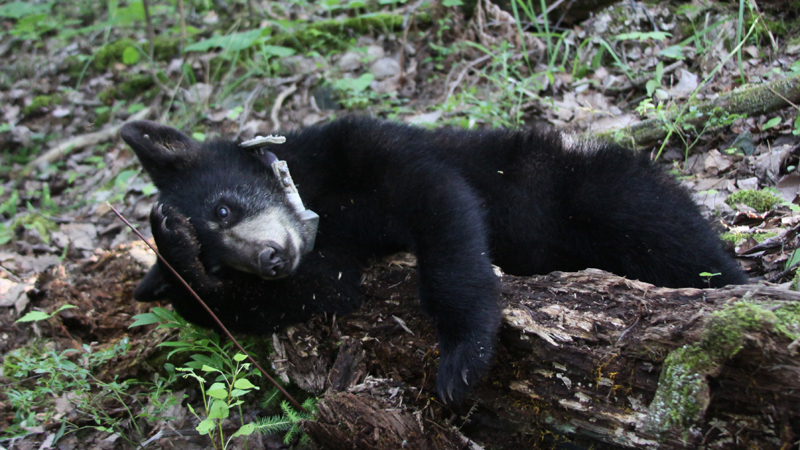 It’s Hope’s 6 month birthday. Her Facebook fans flooded the wall this evening with Happy Birthday wishes. We’re grateful to all of you for your support in bringing her through some tough times and watching her emerge so well and providing so much good information. We all deserve to celebrate. Best of all, Lily and Hope are together at this moment and doing fine. And they are doing it on their own. The last supplemental food (formula) we gave Hope was on July 11, eleven days ago.
We are looking forward to meeting as many of you as we can at the Lilypad Picnic next week.
The Black Bear Field Course that ended on Wednesday was a fun time of replacing misconceptions with facts. The 8 participants were from England, New Zealand, Australia, California, and New York. They learned mostly from the bears themselves. The bears refuted many widely accepted misconceptions. Here are some of the observations they made.
- June is perhaps the most habituated, food-conditioned bear in the study. Those are jargon words that simply mean she is comfortable with people and used to getting food from them. If she wanted to, she could spend all her time eating high quality foods at the dozen feeding stations residents operate in the study area. Conventional knowledge would say that she should be dependent upon those easy handouts, that she should be maximizing caloric intake and minimizing energy expended to get it, that she should be forgetting how to forage for wild foods, and that she should be a lazy, obese bear. What did the participants find? We saw that June prefers wild foods and spends nearly all her time working hard for ant pupae, vegetation, wild berries, and early-ripening hazelnuts. The first two days, we couldn’t hike to her because she was too deep in roadless areas. Finally on the third day, we caught up to her in a cedar swamp and joined her for a couple hours. Participants remarked that she was a lean, athletic looking bear with a sleek new coat. They remarked that her coat smelled clean and that her breath had no odor. Participants remarked that they had always heard that if a bear got food at someone’s house, it would go from house to house looking for more. They found June deep in the forest. The participants learned a totally different view of bears than they had ever heard before.
- The biggest revelation came from the huge male bears they met. Conventional knowledge would assume that these powerful bears that carry scars from many mating battles should be used to having their way, have short tempers, and be among the most aggressive bears in the population. Instead, the participants found that these bears were the wariest, most timid bears they met or were the calmest, most trusting bears they met, depending upon the individual. None fit the stereotype.
- Another revelation was about mothers with cubs. They had all heard the admonition “Never get between a mother and her cubs.” They met nervous mothers and they met calm, trusting mothers, but again, none fit the stereotype. They learned that the notion of defensive, attacking mothers is mostly a grizzly bear thing, not a black bear thing.
- Another revelation was the few bear problems there are in the area. Contrary to conventional knowledge that “A fed bear is a dead bear,” people have been feeding bears in the study area for over 40 years and have fewer bear problems than elsewhere. That’s one of the things we are studying here. Most people believe that bears that get human food will become nuisances and jeopardize public safety. The fact is that compared with surrounding areas, this area has fewer bear problems, and it has no house break-ins and no attacks. The data show that habituation and food-conditioning do not create nuisance bears—hunger does.
The participants had to sit through a bear biology lecture, but otherwise, they learned directly from the bears themselves, and that’s the kind of learning that changes attitudes. They saw it with their own eyes and drew their own conclusions.
We’re not advocating feeding bears, but we are saying that most of what people believe about feeding bears is not supported by science. There is a great need to study the bear-human interface that is so important to bear management and has received so little actual study. The amazing results produced by diversionary feeding studies show that this non-lethal way of resolving bear-human conflict should not be dismissed without due consideration.
Thank you for all you do for bears, bear research, and bear education.
—Lynn Rogers and Sue Mansfield, Biologists, Wildlife Research Institute and North American Bear Center