
Elusive Lily
June 20, 2010 – 7:00 PM CDT
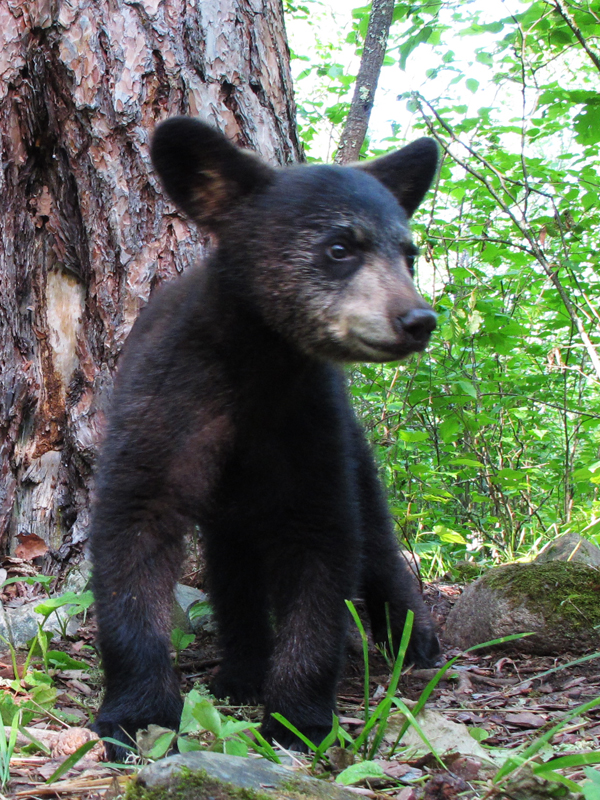 We went out twice today to make contact with Lily to check her milk glands and her estrus status. The first time, she seemed too far into the woods for the short time we had, and we chose not to pursue her. The second attempt was a woods marathon. Many rocky ridges to climb over. Finally, we glimpsed a bit of her back in tall raspberry bushes maybe 35 yards away. She paid no attention to us and ambled off 1.6 miles east into Donna’s territory as we attempted to follow, gave up, dragged ourselves back to the van, and drove around to head her off. We wanted to see if she crossed a road with a male in tow. Beautiful Victor has been around lately and we wondered if Lily had hooked up with him. The last time Lily ignored us and moved off like this, she was with a male. A male would not be surprising. When RC lost a single cub some years ago in May, she continued to attract males into August. Somewhere along the way, RC mated and produced a litter the following winter.
On this trek, though, it appears poor Lily had the misfortune to run into Donna. The GPS locations showed that both bears moved abruptly 2/3 of a mile south, probably as a result of 10-year-old Donna chasing 3-year-old Lily out of her (Donna’s) territory. We didn’t see Lily again, weren’t able to check her estrus status, and couldn’t confirm that she was with a male.
If Victor does end up being the father of Lily’s next litter, the cubs will be darling. Victor has a big white patch on his chest, a light muzzle like Lily, and nice light brown eyebrow patches like Lily. Victor is a big, mature male we know fairly well but he is too timid for us to see him in the woods. On the other hand, a different male was around when Lily hooked up with a male a week or two ago. Midnight was around then, and he is a dark-faced terror. Not a terror to people—he is the usual timid big male—but a terror to other males. When he arrived in the area last year, there was a sudden rash of new scars across the faces of the other males that were around, some of them bigger than him. Victor bears a particularly nasty scar across his nose and we believe Midnight is the culprit.
As we clambered about after Lily, we thought how safe the woods are here. We don’t think of bears, wolves, and coyotes as any danger. We hear stories about rutting bull moose or defensive cow moose with calves, but we have never found them to be a danger. It’s doubtful if any mountain lions live here. The little things that would scare us either don’t live here or are rare. For example, we have never found a deer tick—the ones most likely to spread Lyme disease. The only ticks we find are the fairly harmless dog ticks (Dermacentor variabilis) that can make an itchy bump if you don’t remove them soon, but they don’t spread Lyme disease. Ticks are pretty scarce this year although they are abundant only 40 miles south of us. Spiders are not a problem either—no black widow or brown recluse spiders here. Also, no poisonous snakes—no rattlesnakes or water moccasins. The plants are benign—no poison oak or poison sumac. Poison ivy is very uncommon. We know a few places where it grows, but most days we don’t see any. This year, mosquitoes and black flies are not a problem. It’s not a bad bug year. No-see-ums, deer flies, and the occasional horse fly are the worst problems, and we can tolerate them.
For the bears, deer flies and horse flies are the most irritating bugs except maybe itchy tick bites. The bears react to deer flies and horse flies. They recognize the buzz and try to avoid them, slap them, and bite them out of the air. They stop what they are doing to focus on these hard-biting flies. In the old days of walking with deer, we’d also see deer lie down for a nap until a deer fly or horse fly burrowed into their fur and got them up. Fortunately, these flies sleep at night, giving bears and deer some rest. Black flies and stable flies also sleep at night, giving rest to weary wildlife in years when those flies are more abundant.
We are writing this update early because this evening Gordon Buchanan and Lynn will see if Hope shows up 8:30 to 9:30 or so and Sue and her husband are off to dinner with BBC producer Ted Oakes and his wife Jo.
Thank you for all your support for the research and education and for putting us over the top on the $100,000 matching challenge. The $700,000 debt has been cut in half. Incredible. Many thanks!
—Lynn Rogers and Sue Mansfield, Biologists, North American Bear Center