
“It’s me, bear”
May 3, 2010 – 9:03 PM CDT
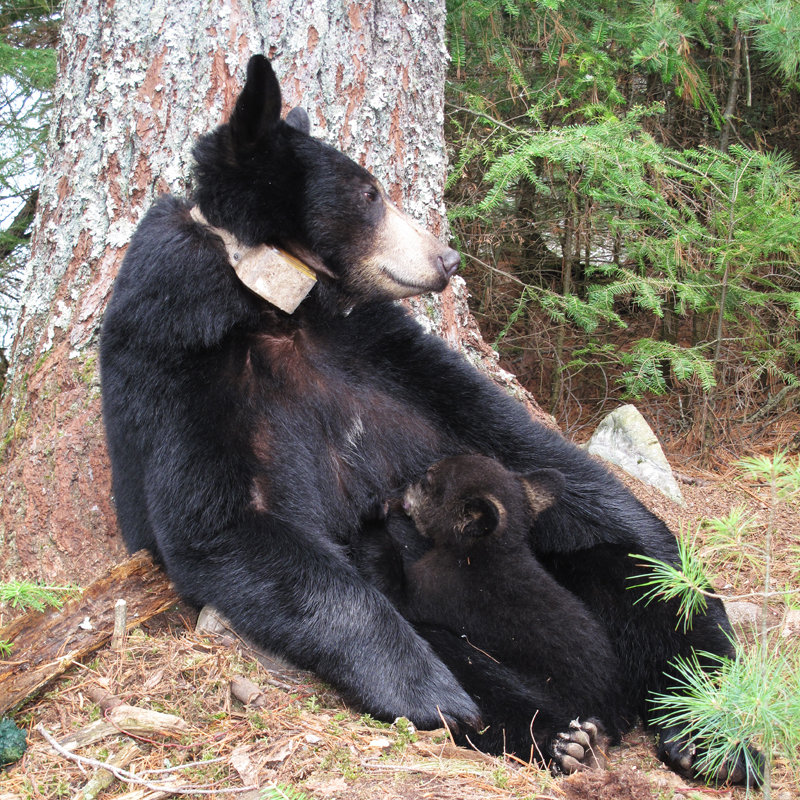 Today was a fun, terrific day, spurred on by the enthusiasm of the Bear Course participants. After a lecture on bear biology, we checked Lily’s GPS location and drove as close as we could and started walking. One of the participants wanted to get experience with the telemetry equipment, so she led the way while getting instruction on how to tune the receiver. Lynn called out the usual, “It’s me, bear.” Lily and Hope continued to rest undisturbed. The group stopped 50 yards away. Hearing Lynn’s voice, Lily came to him for a handful of nuts. Hope followed and promptly lay down at the base of a white pine and fell asleep 5 feet away. Lily was an angel—calm and trusting and becoming a better and better candidate for researchers to accompany her for long periods this summer. Eventually, Hope woke up. Lily played with her while the group watched and clicked away. Shortly, Lily started back to her original white pine with Hope vigorously bounding after her. The group tagged along. Lily sat down, leaned back against the tree and Hope eagerly nursed, making the familiar pulsing hum the course participants had heard since January 22. All were faithful Lily den cam fans. Eventually, Lily and Hope lay down, and the group headed back to the research station for lunch. Lily and Hope had spent the night by this big white pine as evidenced by piles of droppings containing large-leaved aster.
Video from today's visit with Lily and Hope is posted at http://www.bear.org/website/lily-a-hope/den-cam-video-clips.html.
Meanwhile, Sue made contact with Braveheart and gave her a new GPS transmitter so the stream of data could continue. Braveheart resumed sending locations to the research computer.
Mid-afternoon, the group attempted to join 2-year-old female Jo. A challenge. We’re trying to get Jo used to researchers joining her in the woods, but bringing a group was new. She said no thanks and led us on a big circling chase with a lot of “It’s me, bear.” After an hour of leading the group through dense cedar swamps, tangled alders, and balsam fir thickets, Jo believed Lynn’s words and held up on the top of a ridge. The group stopped in the cedar swamp below. Lynn followed her signal up the hill until he could see her watching him. Jo also concentrated on the direction the group had come from, as if wondering if there were any more people coming. Jo watched, listened, and sniffed the air for nearly a half hour. Once she walked aggressively off to the side investigating some sound. Finally, she came to Lynn and followed him to the group. A few minutes later, she blew and ran off, quickly disappearing into dense underbrush.
Everyone got more exercise than anticipated on this walk. Not only had Jo led them in many circles to start with, on the way out we missed the end of the road and ended up walking to the next one before we got our bearings on this sunless afternoon.
In the evening, we watched a big unknown male repeatedly mark a tree and walk over saplings near it, leaving scent. Braveheart and her yearlings were nearby watching him. Braveheart might have been the stimulus for his vigorous marking. She could be in early estrous. She already holds the record for the earliest family breakup in the study, May 10, and this is the earliest spring on record here. Braveheart led her yearlings away while the male stood on his hind legs and back-rubbed tree after tree. The show ended as it got almost too dark to see and the big male moved off in the direction Braveheart and the yearlings had gone.
Back at the research cabin, the food was great, and the company was too. A satisfying day.
Thank you for your continuing contributions. What a difference Lily’s 97,000 Facebook fans have made. Thanks to you, the Bear Center has paid down $160,000 of its debt in the last four months. There’s more to go, of course, but this already puts the Bear Center on a better financial footing. Thank you so much.
—Lynn Rogers and Sue Mansfield, Biologists, North American Bear Center