
Jack is back
March 28, 2010 – 10:45 PM CDT
I arrived at the research field station this morning to find large bear tracks on the deck. Bears are on the move and our field season has officially begun! This is the earliest we’ve had a bear visit—the previous earliest recorded visit was April 8. Last year, when deep snow kept bears from moving around, our first visit was April 17. The tracks on the deck likely belong to one of the dominant males in the study area, and we expect he will be back tonight.
We usually keep a scale baited with food to record bear weights, but hadn’t yet prepared the scale. We readied the scale today and hope to get a weight on the bear if it returns so we can determine over-winter weight loss. I affectionately refer to the scale as ‘our magic scale’ because it automatically records the bear’s weight, takes multiple pictures of the bear on the scale, and stores all this in a file on a computer. Then the trick is to identify the bear from the pictures.
How do we tell bears apart if they’re not radio-collared? We recognize individual bears by fur color, white chest patches, facial coloration, scars, and distinctive behaviors. Most bears in the study area are black, but we do see a few brown-phase black bears. Chest patches come in all shapes and sizes and make identification easier—however, most of the study bears lack chest patches. Many black bears have brown muzzles, but some muzzles are lighter than others. Many black bears have brown eyebrow spots, but the size and placement of the spots differ. We also look for scars. Nearly all mature males have distinctive scars or nicks in their ears from fighting. Some, like BB King, live with wounds that never quite heal. Careful observation of any group of animals allows one to begin to pick out individuals.
We received a call today from someone who was looking for shed moose antlers and found one of our radio-collars instead. From the description, the collar is Donna’s—the bear that was so lethargic in her den when we visited on March 13 has left her den and slipped her collar. 10-year-old Donna is a wonderfully trusting bear, but her habit of slipping collars has prevented us from accompanying her in the woods to observe her behavior and food choices.
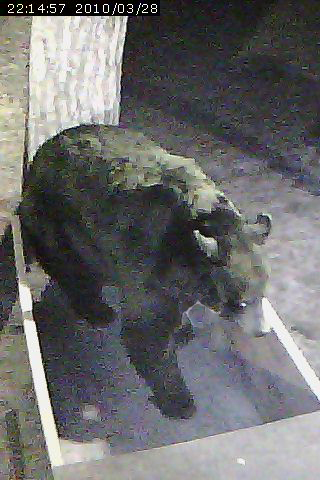 As I was writing this update, One-eyed Jack visited the field station—likely the same bear whose prints I found on the deck this morning. Jack is one of the dominant males in the study area and is featured in the full UK version of ‘Bearwalker of the Northwoods’ (the version on sale in the NABC Gift Shop).
This time we were ready for Jack. The scale was baited and it didn’t take him long to find it. His weight was 504.5 pounds—down from 648.5 on August 30. That’s an over-winter weight loss of 22%. He’ll likely lose another 25% during the upcoming mating season. Our quick ‘rule of thumb’ is: a mature male weighing 500 pounds in the fall, will weigh 400 pounds coming out of the den, and 300 pounds at the end of mating season in early July.
Lynn Rogers has arrived safely in New York and is resting up for his appearance on tomorrow’s Today Show on NBC. He tells me that Fox and Friends is ‘a go’ for Tuesday, and then of course the Martha Stewart Show on Wednesday.
Thank you all for your continued support—and for your patience in waiting for this update!
—Sue Mansfield, Biologist, North American Bear Center