
Safety and checking 3 bears
March 24, 2010 – 8:03 PM CDT
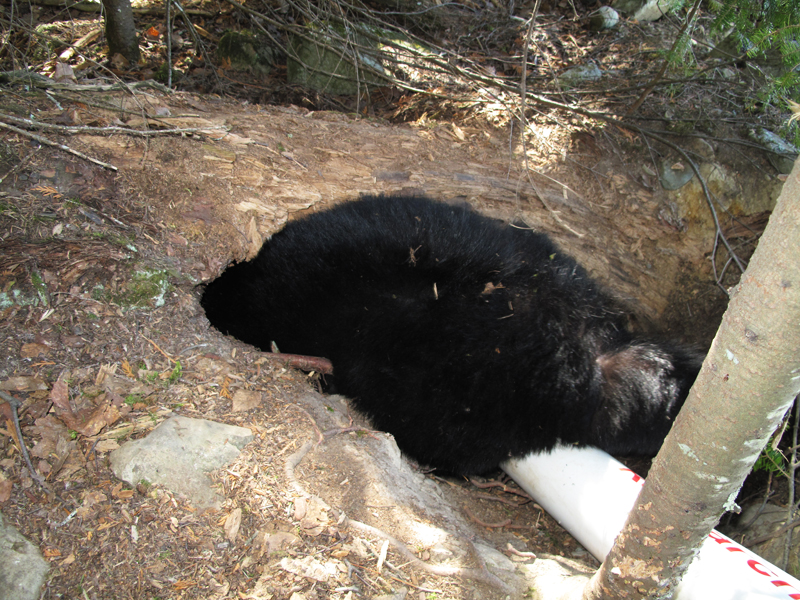 We hadn’t planning on visiting Lily today—but she had other ideas! She bit through the rubber band and pushed the camera away from the entrance. She was fine about Lynn putting it back, but she has checked it out repeatedly today. She hasn’t had ‘shaky legs’ when she came out of her den these past 2 days. This goes along with her lower heart rates in suggesting that she’s in a more active state in which she isn’t reducing the blood flow to her legs anymore. She seems easily ready for action now and doesn’t have to go through the elevated heart rate period and shaky legs when becoming active.
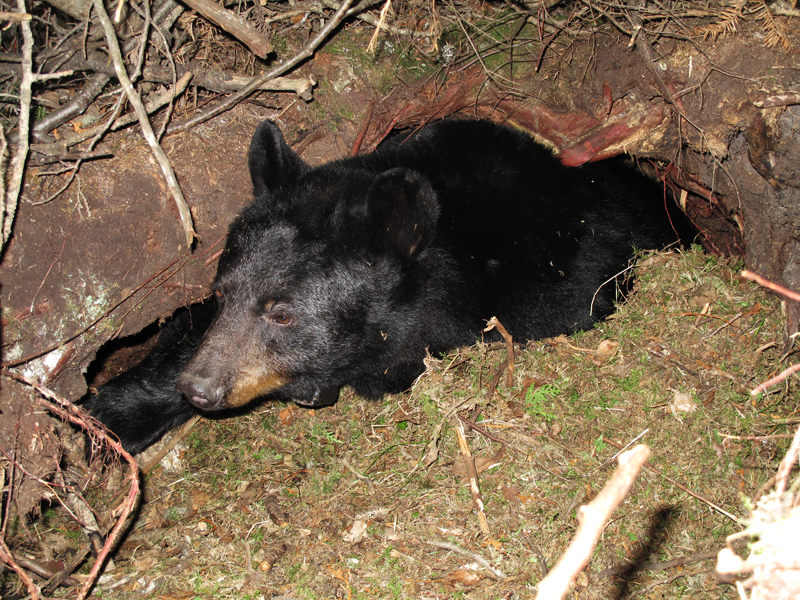 About 5 PM, we checked out Lily’s Aunt Juliet and her 3 cubs to see how they’re doing. Juliet was steady like Lily and had a similar heart rate (96). We asked her what she prefers among red grapes, pecans, or filberts. Between grapes and filberts, she ate the grapes first. Between pecans and filberts, she ate the pecans first. We were mildly surprised at that because we had just used filberts to get her heart rate and tighten her radio-collar, and she liked them a lot. All three of these foods are favorites. Juliet had been out raking in more bedding just like Lily is doing. The picture shows a new mound of vegetation in front of her bed. Juliet’s cubs were very quiet in the den—something we’ve noticed in other litters at this time of year.
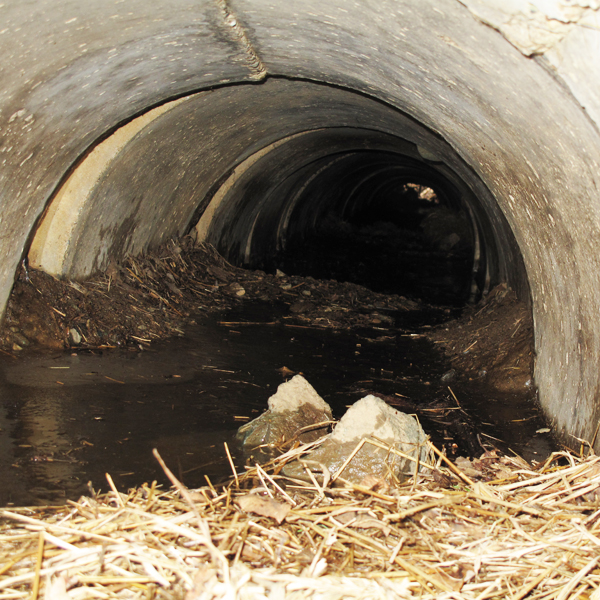 Next, we went to Lily’s Cousin Jo’s den in a culvert under a little-used road. No Jo. Just a radio-collar in water. The big melt the last three weeks must have flooded her out. The culvert was too small for either of us to crawl in and get the collar. We’re trying to think who could (and would…) crawl 15-18 feet in 2-3 inches of water. We hope she will visit the field station this spring so we can re-collar her.
New Lily Fans are asking some of the questions that Lily veterans asked earlier. One person phrased it nicely, saying “Do you have a plan in case Lily were to try to hurt you? She's a wild bear with a baby. What would you do if she were to think Hope was in danger and let instinct overtake conditioning? Do you have a place nearby you could be safe? What would you do?”
Actually, we don’t even think about being attacked. If most of you were here, you would shortly be the same. We know it’s hard to imagine after seeing taxidermy, hunting magazines, and the sensationalized TV programs that are so common. Seeing bears as they really are takes a total mind shift. We interpret their behavior in terms of their fear rather than our fear. Their lives are ruled by fear and food. Large and small, they are basically timid. For research, we try to build trust, not fear. When we walk with them, we are sensitive to their concerns like most of you would naturally be. Each has its own personality. It’s easy to read their limits and when they feel uncomfortable.
To take videos of wild bear behavior, Sue accompanies mothers and cubs far from roads. She is among them with her video camera inches away at times as they forage. The bears mostly ignore us. If they even look at one of us, we wonder why. They are mostly busy working. We feel privileged, not afraid. We show sensitivity to their concerns like most of you would naturally do. For example, whenever Lynn started into Lily’s den today, Lily quickly came over. Each time, Lynn gave her room. He didn’t worry about an attack. He just didn’t want to be in the way.
We don’t consider little “message” bites or slaps to be attacks. They’re communication. We have never had a bear come after us and hurt us. The few misunderstandings we’ve had in the many times we initiated contact have never required professional attention.
We’ve both gone through years of learning to read bears. It would come naturally to most of you. It’s basically a matter of opening our minds to what we are seeing and not being swayed by the sensationalized media.
The latter is what is in most people’s minds. It’s what makes them feel they must carry a gun in the woods. It’s what makes them unwilling to coexist with bears. Most of the scary stories people tell us are not so much about what a bear did but about what the person was afraid the bear would do. In reality, attacks are rare. We should know. We have pushed the envelope for decades and have yet to discover a way to make a bear attack short of attacking it, and then they mostly want nothing more than to escape.
One person expressed a desire for us to respond to the rumors posted by a hunter yesterday. We can refute them all if you like, and we like to hit rumors head-on, but we also hate to be drawn into topics that have nothing to do with understanding bears. Sue emailed him the phone number of a local bear hunting guide who can set him straight, and the hunter can easily find our phone number if he wants.
More nuts arrived. We are so grateful. You know how much money you are saving us with that. These special nuts we use for doing collars and heart rates are very expensive.
Thank you again for your contributions and support. Thank you, too, to the anonymous donor who put the Bear Center in his will for $40,000.
Tonight is the night we shut down www.bear.org at midnight EDT (11 PM CDT) for a few hours as we move to a new dedicated server. This will not affect Lily’s Facebook page or the live den cam feed. The den cam will still be available at http://www.wildearth.tv/static/wildearth/channels/we_bear_den.html or http://www.pixcontroller.com/WebCam/BearDenWebCam.htm.
—Lynn Rogers and Sue Mansfield, Biologists, North American Bear Center