
Donna Bear
March 13, 2010 – 8:04 PM CST
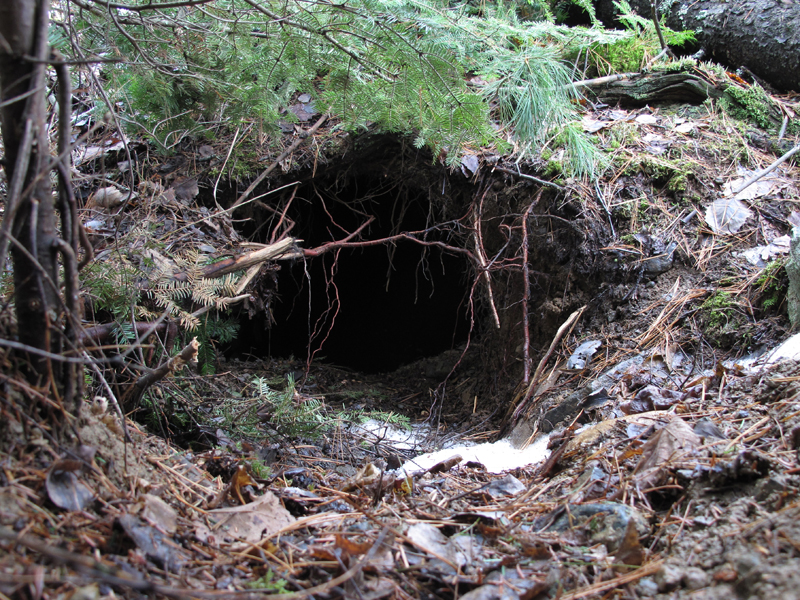
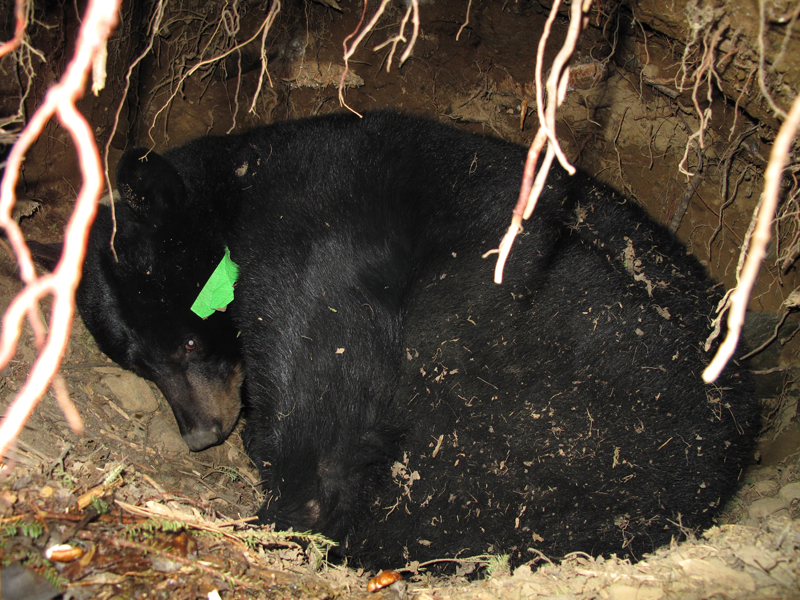 While Lily was outside her den for a few minutes around 3 PM CST, we were sitting outside Donna’s den patiently listening for cubs. Not a peep. We stayed for 45 minutes, which should have been long enough to hear them. Dr. Gary Alt reported that he heard cubs within 10 minutes 88% of the time in Pennsylvania. With no cubs, we have to backtrack on saying Donna defecated shortly before having cubs. This is the first time she missed having cubs, and we don’t know why.
A little history on Donna (born January 2000)
You may have seen her as a cub of Blackheart in ‘The Man Who Walks With Bears.’ We made every effort to have Donna and her sister Dot get used to us so we could walk with their mother Blackheart without scaring the cubs.
As the documentary shows, the cubs became very comfortable with us. We used food and the universal language of touch to gain their trust. They slept on our laps when they left the den. They came to expect treats when we appeared, and they mobbed us for it. With that kind of beginning, what dire predictions might one make about their chances of staying out of trouble as they grew up? The dire predictions make their outcomes that much more interesting.
Now 10 years old, Donna has turned out to be one of the shyer bears in the study. There’s no accounting for personality.
She has produced four litters of two cubs. However, we were never able to spend much time with her because of her habit of removing radio-collars upon leaving her dens each spring. That meant we usually couldn’t find her until she showed up at a feeding station in late summer when natural food was waning. She remembered us at the feeding stations and calmly let us fit new radio-collars around her neck.
But she wasn’t used to us joining her in the woods. She would slip away. Eventually, she might come to our voices, but only after 1-2 hours of patiently talking to her. Once she came, she accepted our company and went about foraging.
The dire predictions we hear about habituated and food-conditioned bears have not held up in example after example in this study.
The den where Donna produced her third litter (January 2007) was an unfortunate choice. It was in a black spruce swamp that flooded in the spring melt. To escape the icy water, newborn cubs smaller than Hope had to crawl up onto her back. When we visited the den on March 25, we saw they had been out and had raked together a bed near the den. Inside the den, Donna was lying on a mound in the back of the den. She was almost out of the water with only one cub on her back. We assume the other cub died of exposure, but we never found its remains. While we were there, mother and cub decided to come out and lay in the bed. To do that, both had to wade through 6 inches of icy water in the den.
The den and nearby bed were visible with binoculars from a narrow dirt road. At dusk on March 27, Donna and the cub were in the bed. On April 1, they were gone. Her radio-collar was in the den under water, so the rest of the story that spring is sketchy. The remaining cub died sometime after that last sighting. Donna, alone in the May-June mating season, mated and produced her most recent litter in January 2008.
She was due to give birth this winter but instead became the first female since the study began in 1996 to miss. Her behavior in the den today was not alert and responsive like Lily. She was sleepy like a bear with no responsibilities. The snow outside her den showed that she has not been out other than to create a pile of feces 2-3 feet from the entrance earlier this winter. The unseasonably warm weather of this El Nino winter has not lured her out in recent days.
On the way back to the Research Center, we checked on Lily’s mother June by telemetry. Her signal was in the direction of her den but showed enough activity that we suspect she and her yearlings were outside.
The ice on a lake we passed was turning black—something we usually don’t see until mid April.
The facts that (1) Lily is leaving her den occasionally, (2) her precocious cub is learning to walk already, and (3) snow is already reduced to patches in the forest, makes us wonder if Lily and Hope will abandon their damp den for a dry bed at the base of a big white pine when Hope becomes mobile around the end of the month. We’ve been wrong before.
Thank you again for your contributions. Also, in reading your comments on Facebook lately, it felt great to see how much many of you have learned!
—Lynn Rogers and Sue Mansfield, Biologists, North American Bear Center