
Bear visits are nearing their end for the year. The last one here at the WRI was October 29—likely Quill. Another feeding station reported that Annie and her 3 cubs made their last visit the evening of the 27th just as the snow was starting to fall.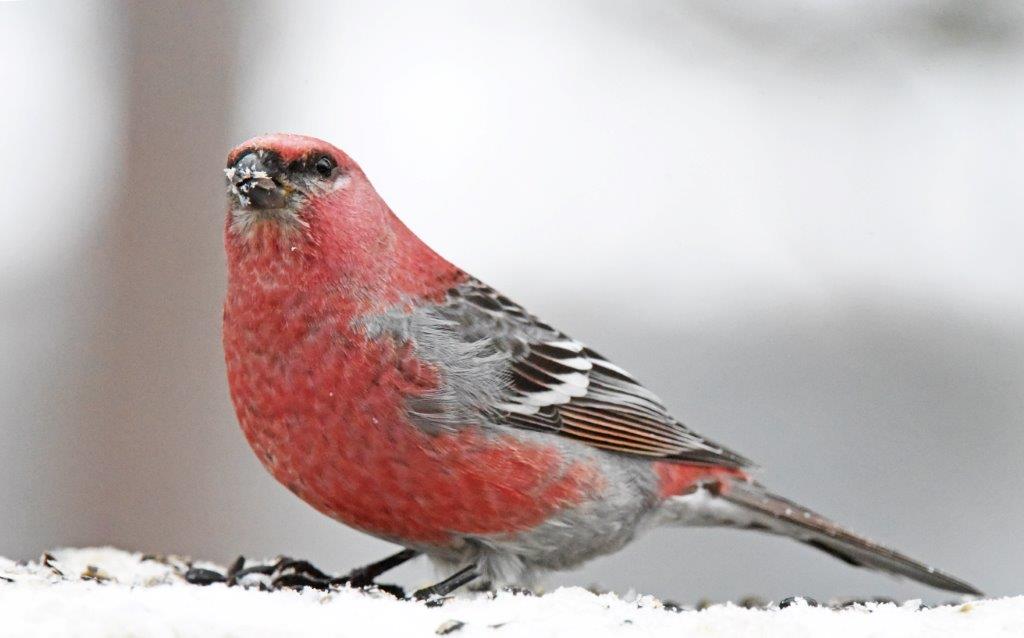 Male pine grosbeak I haven’t heard of any since then except for two that continue to come to one feeding station—Fern and a yearling that they believe is Quill.
A new bird showed up today—one of the most striking—a male Pine Grosbeak. They spend their summers over a hundred miles north of us in the boreal forest.
A Lily Fan caught me again! I say, “Way to go.” It does my heart good when Lily Fans show their knowledge. I let an error from our website slip into the update of October 29. We hired a consultant to go through our website and find errors. We’ll see if this one is in his report that we’re expecting soon. The Lily Fan wrote: If bears use up to 4,000 kcal per day, mainly body fat, but do not eat, drink, urinate, or defecate (as it says on the website), then, why do you occasionally show/tell about mama bears eating snow, exiting dens briefly to urinate/defecate, or, doing that in a back corner of their den???
I know from her question that this Lily Fan knows the answer to her question. But as a preview, here’s a passage from the Den Cam paper draft that we’ll send in soon.
Although captive black bears have gone months without eating, drinking, urinating, or defecating (Nelson 1980, Nelson et al 1983), bears that denned for 5.1 to 7.7 months in this study urinated and defecated by backing out of the den bed to a latrine area near a den wall or out the entrance. Their main sources of liquid were snow and icicles plus the urine and feces that mothers ingested as they toilet-licked newborn cubs. Mothers also licked drops of melt-water from the fur of their cubs. Prior to this study, 3-year-old Blackheart licked drops of melt-water from the fur of her 1-month-old cubs (Dot and Donna) when the temperature was 10°C on 22 February 2000 (Hajicek 2001). Similarly, on 25 March 2007, 6-year-old June licked water from her 2-month-old cubs (Lily, Cal, and Bud) after an early melt (17°C) temporarily flooded them from their den. On 19 September 2008 (16°C), 7-year-old June licked water from the rock walls of a den she had occupied for 15 days.
When adults or yearlings had to pass urine or feces in this study, they backed to a latrine area inside the den or backed out the den entrance. On 3 March 2012, some of the urine that Jewel deposited at the den entrance flowed back into the den. On 1 April 2013, feces from Jewel’s yearling Fern rolled back into the den where Jewel ate it.
The feces of late winter or early spring that are harder and drier than summer feces are often termed “fecal plugs.” This term may stem from an early belief that bears eat fibrous vegetation to plug the digestive tract and prevent further food intake during hibernation, but fecal plugs contain little to no fibrous vegetation (unpublished data). When hydrated, they become a slimy, mucous substance (Hellgren and Vaughn 1989). Feces from hibernating bears may be similar to stools from humans with no food intake—primarily dead bacteria, enzymes, and desquamated cells (Bell et al. 1965). The dryness of fecal plugs is presumably because they form over a period of months, giving the large intestine more time to remove water (Bell et al. 1965). Feces from hibernating black bears can include pieces of foot pads (see below), hairs from grooming, bits of vegetation from raking, and remains of body wastes that mothers ingest from cubs during toilet-licking.
Thank you for all you do.
Lynn Rogers, Biologist, Wildlife Research Institute and North American Bear Center