
Thinking about Quill, I’m guessing he will come back here in spring to where he has learned there is the best nutrition in the world—nutrition that enabled him to about double his weight in about a month. 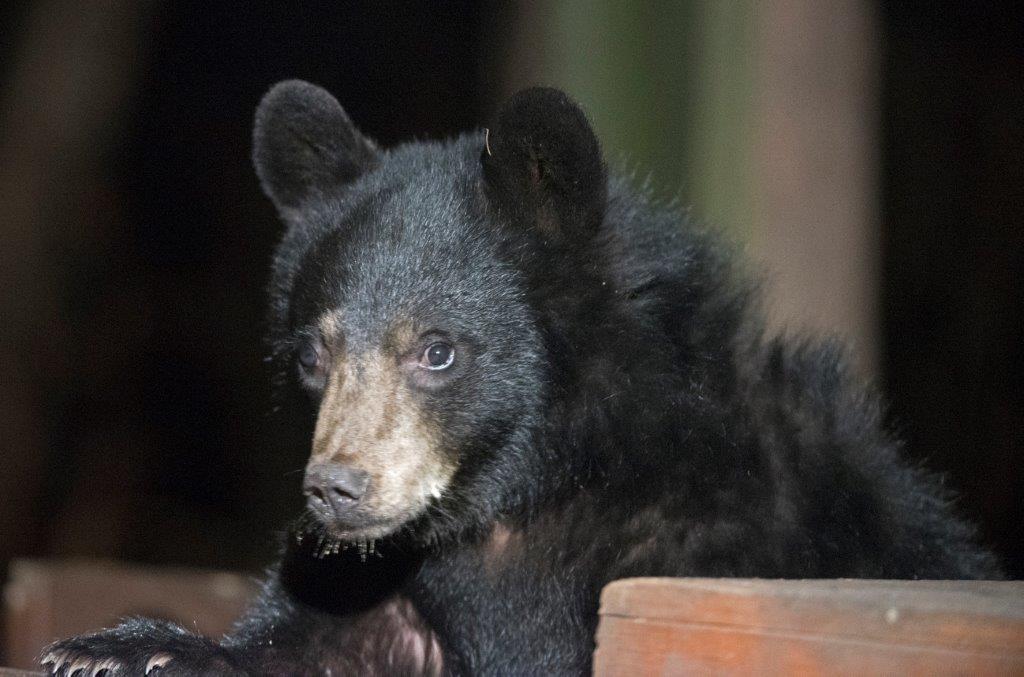 Quill with blue eyes on 11-12-16With that in mind, we have a gallon of formula frozen and ready. We will be keen to get his weight to determine weight loss. I hope we have a good watcher here like Peggy at the time. A shocker would be if Quill comes back with his mother and sibling. A person never knows. We just observe and report.
Lily Fans are researchers. I had never seen or heard of this insect. Lily Fans came up with a picture, the name Snow Fly, and the fact that in Minnesota, the scientific name is either Chionea stoneana or Chionea valga. From the pictures, I can’t tell which it is. The picture below is Chionea stoneana. Common names also are Wingless Winter Crane Fly and Winter Crane Fly.
Wikipedia says:
Adults occur during winter, where they can be observed walking over snow. They produce glycerol in their hemolymph, preventing them from freezing.[1]
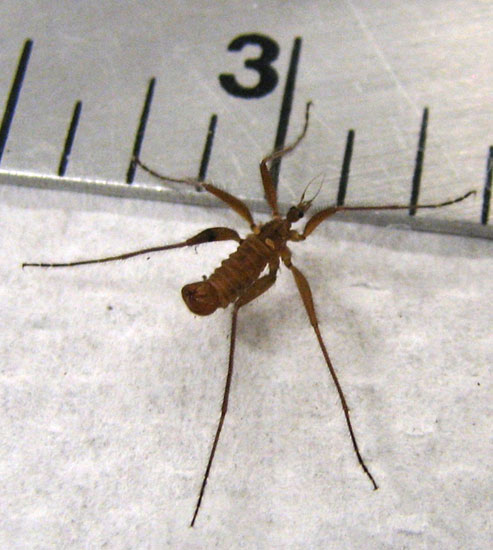 Wingless Winter CraneflyUp to 200 eggs have been found in female snow flies, which are laid singly (Schrock, 1992). The larvae occur under decaying leaves in wooded regions (Marchand, 1917). At least the larvae of some species seem to feed on feces in rodent burrows (Schrock, 1992). Adults seem to actively seek out the coldest place they can find and drink water by pressing their proboscis against the snow (Marchand, 1917), but are not known to feed. Adult snow flies live for up to two months. They can walk at a speed of about 1.30 meter per minute, and at least males have been observed to leap, without being provoked (Schrock, 1992). They are easiest found on snowbanks in the afternoon, in areas that are to some extent forested. The winglessness of the genus is probably attributable to the fact that at sub-freezing temperatures, it is very hard to generate enough energy for maintaining flight muscles. Also, the space normally taken by flight muscles is used to store eggs. Mating is indiscriminate (probably because it is very hard to find a specimen of the other sex for them) and takes 30 to 70 minutes. While winged crane flies face in opposite directions, snow flies position themselves similar to many beetles.[2] This requires the male copulatory organs to be inverted 180 degrees (Schrock, 1992). One of the reasons why adults emerge in winter seems to be the absence of predators. However, "rock crickets" (Grylloblattidae) have been shown to feed on them. Because the cysticercoid form of a tapeworm species has been found in two out of three C. stoneana specimens in eastern Kansas, they also have to be eaten by mice, which are the tapeworm's host. The snow fly larvae likely take up these tapeworms via mouse feces (Schrock, 1992).
A Lily Fan asked about Tasha getting a Den Cam this winter. I’m told that they are having so much trouble getting Holly and Lucky’s Den Cam going that they would rather make that one good and not try Tasha until next winter. Instead of straw for bedding, Tasha has leaves. As if the leaves weren’t enough, she bit branches from trees and chewed them up for more bedding like Lily did with small logs in 2013 and with evergreen branches in 2010. I’m told that Tasha built a wall toward the entrance and is not visible. The plan is to get pictures of her (or the wall) periodically to record what she does and share it in updates.
Thank you for all you do.
Lynn Rogers, Biologist, Wildlife Research Institute and North American Bear Center