
Quill lapped up 6 of his 7 cups of formula overnight. Today we figured out how many calories that would be. Looking at the chart below, it's about 340 calories per cup. So 6 cups would be 2,040 calories. 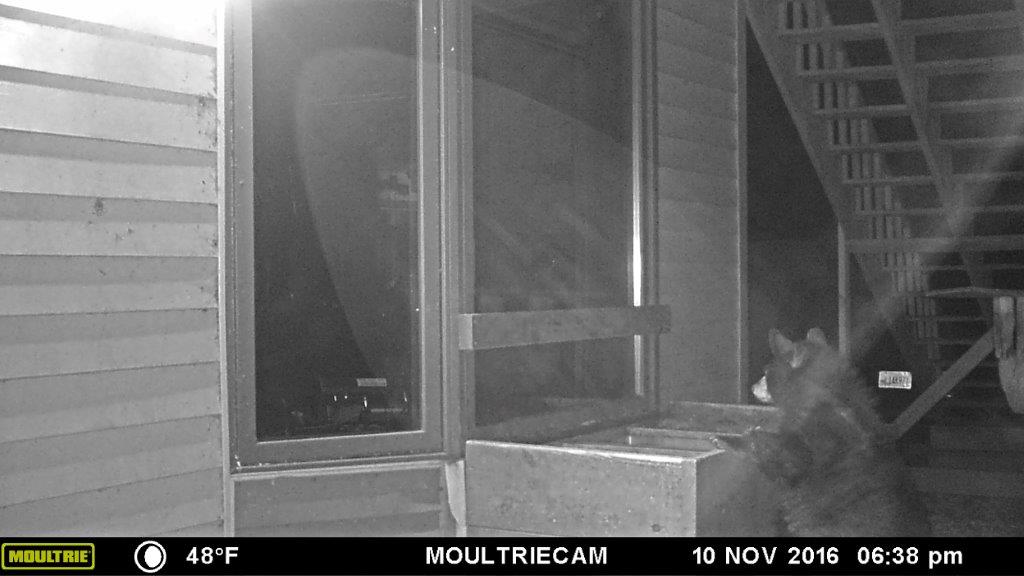 QuillQuill has lapped up as much as 12 cups (4,080 calories) in a night--plus 1 to 2 pounds of walnuts, which is another 2,965 to 5,930 calories. We could go back and add up what he ate to see how many calories went into his weight gain. There is nothing else for him to eat in the woods at this time of year.
It will be interesting to see how late he keeps coming for such nutritious food at a time of year when his mother would have had him in a den snuggled beside her with her milk drying up. Generally, no matter how much food people put out, the bears around here go off to hibernate on schedule--September for most pregnant females and October for adolescents and mothers with big cubs. Mature males are variable. One of the feeding stations recorded a late straggler a week ago, which was weeks after most feeding stations recorded their last bears. Quill might show us something new.
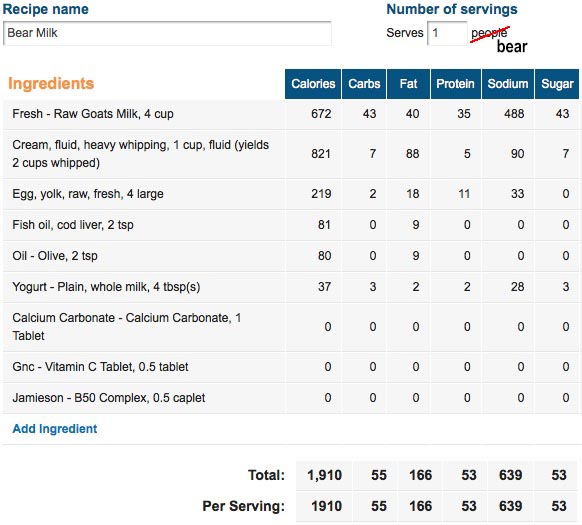 Bear milk calorie breakdownHow much do cubs that make it through winter with their mothers weigh this time of year? On November 5, 1970, a litter of 3 that had access to a dump weighed 33, 34, and 37 pounds. On April 9, 1971, when they were about to leave the den, they weighed 25, 26, and 27, having lost 23%, 24%, and 27%.
On November 11, 1971, the mother who had the best reproductive rate in the study, returned from a trip to an oak stand with her cubs weighing a whopping 59 and 63 pounds. On March 12, the 59-pounder was down to 49 pounds (down 17%) with another month to go before leaving the den. The mother, old 320, had put a lot into the cubs. In the fall before she gave birth, she weighed a good 220 pounds on September 12, 1970, a week or two before she entered a den. In spring, after producing milk for the two cubs, she weighed only 140 pounds on March 21, 1971. By fall, after bulking up at the oak stand the best she could while lactating, she weighed only 145 pounds on November 11, 1971. She lost weight over winter and weighed only 120 pounds on March 12, 1972 with another month to go before emerging.  Flying squirrel on Nov. 10, 2016Without lactating that year she bulked up again and weighed 237 pounds on November 11, 1972. The 59-pound cub, a female, remembered the good oak stand 20 miles away and returned there independently as an adult.
We got a call from a couple from Kentucky who are bear aware, and they said Tasha, who denned on October 26, is in tune with Kentucky bears. I thought Kentucky bears would den later, and they said many do, but they are very few now. It is interesting that Tasha chose to use a wild-type den. I'm told that last winter, she was fed all winter in the home of the man who rescued her when he found her trying to nurse on her mother who was lying dead beside a road in Kentucky.
We are learning from Quill and from Tasha.
 Lily Fans want to know. Do we need permission for the Quill House and for a trail cam near it? No. But once the Quill House becomes a den, it would be illegal for us to enter it or put a Den Cam inside it. Actually, once it becomes a den, we won't dare go near it for fear we'd scare him away. The best we could do then is watch with binoculars from a distance and report how and what he is doing preparing the den and how long he stays in it. We'd see if he leaves the den to come for formula. The trail cam that is near the Quill House will take pictures for weeks or months. We could quietly switch that card occasionally after he settles down, but we'll be lucky if he uses it at all. We're mainly just glad he is bulking up to insure he makes it through the winter with no mother to snuggle up to. We put radio-collars on other orphans long ago, and they made it.
The flying squirrel is the one that was waiting for Quill to get off the scale last night and finally decided to join him.
Thank you for all you do.
Lynn Rogers, Biologist, Wildlife Research Institute and North American Bear Center