
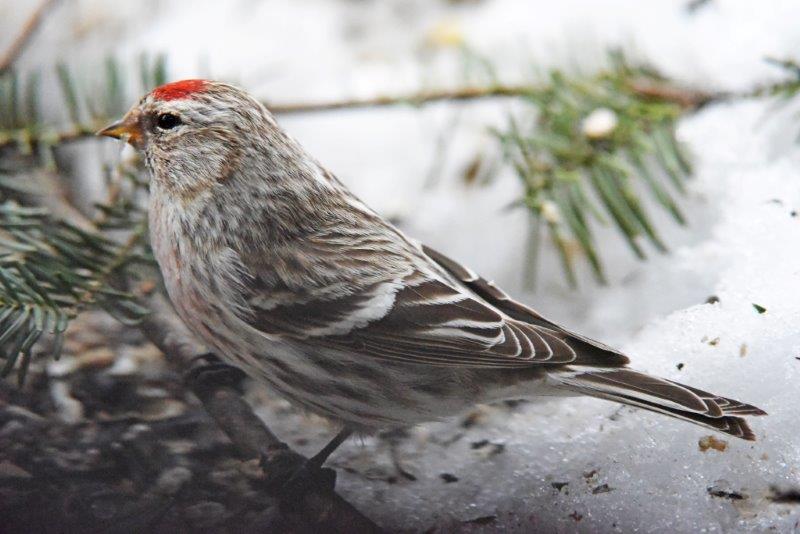
 Hoary redpollBear Curator Sharon Herrell opened Holly and Lucky’s door so they could come down to the pond and perhaps get weighed before feeding starts. They weren’t interested. Sharon emailed, “She looked and ran back into the bunker.” We’ll see how this develops over the next few days.
Lily Fans sent me this heart-breaking article about mange killing bears in Virginia https://m.facebook.com/story.php? story_fbid=593824567440126 &id=100004377639131&p=0&refid=52 . We often see mange in bears here in northern Minnesota but it doesn’t look like the picture in the article. We have verified that what we have here is indeed mange. Here, it occurs in a low percentage of bears and seems harmless. The bears lose hair on their faces and grow it back in spring. They do fine. I’m wondering if the much worse symptoms shown in the picture is really mange. I don’t know if state authorities have actually verified that it is. I don’t know what it could be. I don’t believe it is anything I listed in my old review of bear parasites (Rogers, L. L., and S. M. Rogers. 1976. Parasites of bears: a review. Bear Research and Manage. 3:411-430). From the articles I’ve seen about the bears in Virginia, I wasn’t sure the deaths were from the disease or from euthanasia.
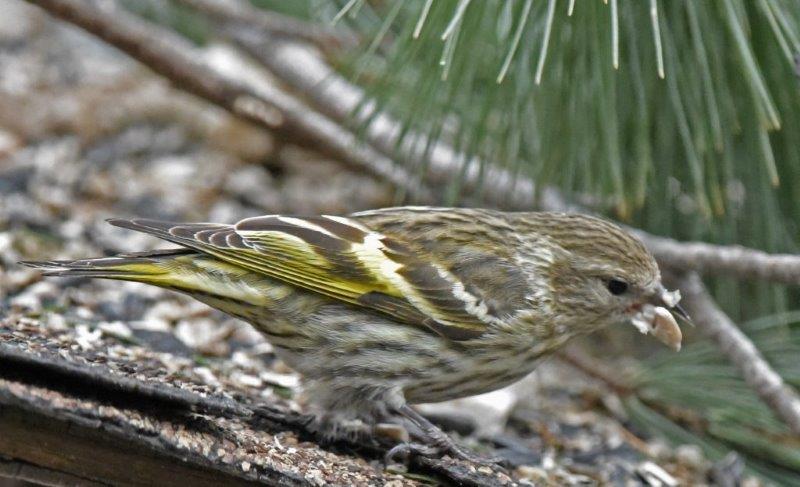 Pine siskinOut the window, a pine siskin (Spinus pinus) (same genus as goldfinches), posed showing his or her yellow, and a hoary redpoll (Acanthis hornemanni) posed showing its frostier, paler color (compared with common redpolls) and slightly smaller bill. Their range extends about 700 miles farther north than the range of the common redpoll (Acanthis flammea) and includes Ellesmere Island and the north shore of Greenland, nearly 2900 miles from here. The southernmost part of their summer range is about 550 miles from here.
Thank you for all you do.
Lynn Rogers, Biologist, Wildlife Research Institute and North American Bear Center