
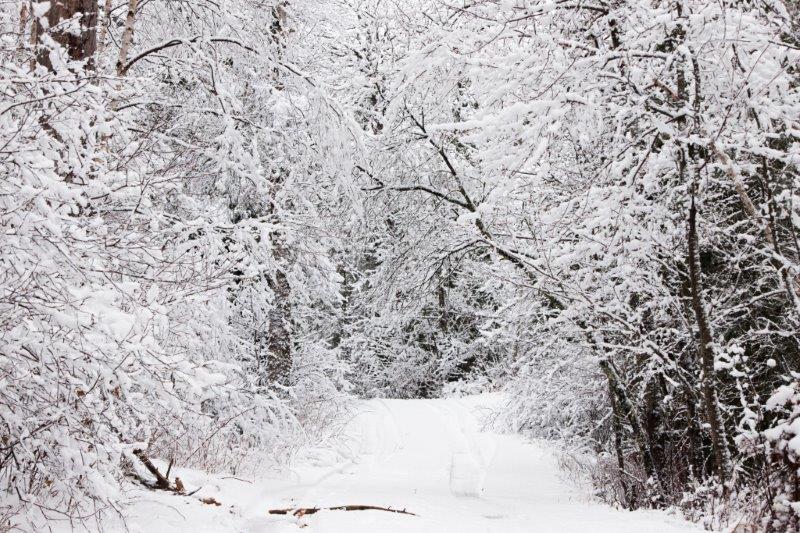
 Snow-laden trees at the WRI - 12/2/15Yesterday, December 2, is the earliest I recall a bear removing its foot pads. Holly is the record-setter, and a Lily Fan captured the video of her using both teeth and claws to do the job. https://www.youtube.com/watch?v=efbbwuRroXU I wrote an article about it back in 1974 when the only mention of this behavior was what was passed down among Native Americans. http://www.bearstudy.org/website/images/stories /Publications /Shedding_of_Foot_Pads_ by_Black_Bears_During_Denning.pdf
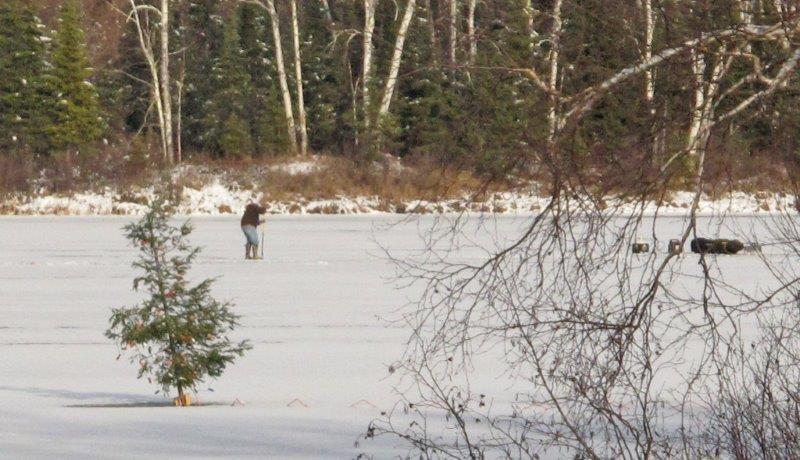
Yesterday began with snow-laden branches. Today, I saw the first ice fisherman out trusting the ice. The people who put their lighted Christmas tree out on the ice already had it there, though, so the ice has probably been safe for a day or two. However, this lake is shallow (Robinson Lake) and is among the first lakes to freeze. I’ll wait a few more cold days to trust the deeper lakes.
An interesting article about interactions between grizzly bears and polar bears showed that grizzlies, especially mothers with cubs, readily drive off much bigger polar bears when competing for whale meat near Kaktovik on the Beaufort Sea in northeastern Alaska. http://www.adn.com/article/20151202/north-slope-bone-pile-small-grizzlies-dominate-bigger-polar-bears Although the account made it sound surprising that grizzlies could dominate larger polar bears, that fact would not surprise Dr. Nikita Ovsianikov of Russia. He, along with others like Dr. Tom Smith of Brigham Young University in Utah, now realize that polar bears are not the aggressive animals they are usually portrayed to be. Nikita put it in perspective when he told me that grizzly bears can be more aggressive and take more risks than polar bears because injuries are not likely to hamper grizzlies from grazing, while injuries may prevent polar bears from catching seals and traveling long distances between the open leads where seals congregate. An injury that a grizzly can survive could be a death sentence for a polar bear, so polar bears have to be more careful. He put that belief into action by walking among congregated polar bears for years carrying nothing more than a stick, which he seldom had to use.
A video of a hungry mother with 5 cubs in North Carolina showed why people are advised not to put garbage out for pickup until it is almost time for the truck to come. https://www.youtube.com/watch?v=Jnhvs_pCS_c.
 Ice fishermanA video from New Jersey also showed a family with 5 cubs. They were playing with kids’ toys in a backyard pool as the children who owned the toys watched in despair. The human mother didn’t seem worried, saying daddy would get them new ones. https://www.youtube.com/watch?v=77dtqOOaGLo I have never personally seen a litter of 5 cubs. I suspect the lack of fall food in northeastern Minnesota has led to a genetically based smaller litter size—even where the bears are supplementally fed. Northeastern Minnesota has few acorns and no hickory nuts or beechnuts. But these foods and others are common in the eastern deciduous forest, and litters of 5 are more common. Even a litter of six has been reported there.
I had a nice talk with BBC producer Ted Oakes a couple days ago. He first came here in 2007 while producing the Insect episode of the BBC Life Series. The scene showed a bee’s nest being defended by its owners against June and her cubs Lily, Cal, and Bud. Ted saw how we worked with the bears. He saw how this community peacefully and safely coexists with bears. He saw a powerful message that needed to be told—that people can coexist with supposedly dangerous animals if they understand them. The next year he put forth that message in Bearwalker of the Northwoods as part of the BBC Natural World Series. Two years later, he furthered that message in My Bear Family and Me with Gordon Buchanan. But, as Lily Fans and we know, that message is not about to be echoed by management agencies concerned mainly about liability, especially if the officials know less about the animals than do the people who live among them. From his world travels, Ted knew the people who know best how to live safely among their wild neighbors—native tribesmen. He had an idea. After finishing their work here, Ted Oakes and Gordon Buchanan teamed up to continue the theme of “coexistence through understanding.” They worked with tribesman living among gorillas in Africa, crocodiles in New Guinea, boa constrictors in another country, and anacondas in the Amazon. They filmed how these tribesmen safely go about living among animals most people consider highly dangerous. Their four documentaries will be released over the next 5 months. Ted said tribesman adapt to living among dangerous animals the same way we adapt to living among cars and trucks.
For my part, I can hardly wait to write a book that shows bears as we know them to be. A book of our everyday experiences, backed by statistics and detailed data on June and the others, could change attitudes and help bears worldwide. In the meantime, I hope the DNR allows us to use Den Cams so people can learn how bears live from the bears themselves.
Thank you for all you do.
Lynn Rogers, Biologist, Wildlife Research Institute and North American Bear Center
All photos taken today unless otherwise noted.