
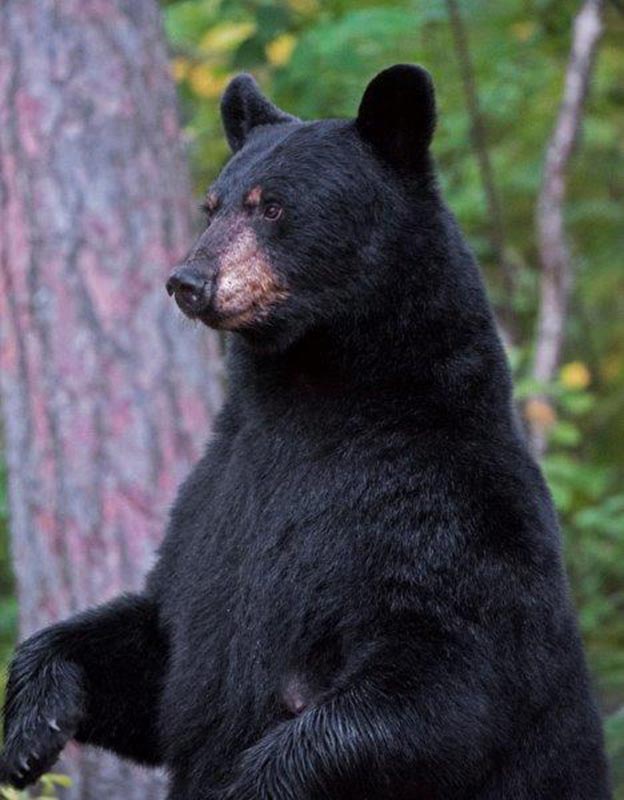
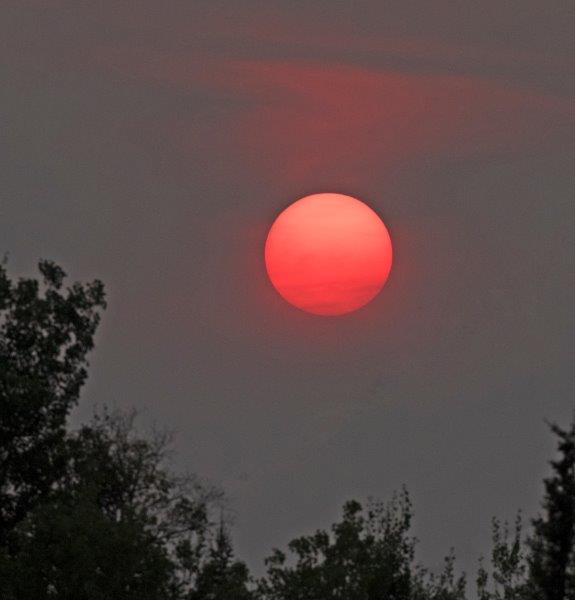
 UrsulaWhile we were snapping a picture of the unusually red sunset, which usually means a forest fire somewhere, we got a call from a community feeder who was watching 11 cubs and their mothers. We zipped there and saw that one of them was Ursula who was surveying the array of bears. We hope the hunters will spare these mothers the day after tomorrow. We know most hunters would, but the targeting of radio-collared bears meant targeting females and orphaning some cubs in recent years, disappointing us in the hunters and the officials who were complicit in that.
Regarding the Connecticut incident in which a bear is in jeopardy for sniffing a woman’s leg, some have questioned my statement that bears don’t raise their hackles as the Connecticut official said the bear was doing. I have never seen a bear do that but have seen circumstances in which I can see how people would think they were seeing that. Basically, when the under fur grows in the hairs all stand straight up. Also, as fur sheds, the last strip of long unshed fur is a strip down the back of the neck, top of the shoulders, and down the spine. It looks like the hackles are raised, but it’s not.
I probably should not have said that Holly will soon have the upper hand over Honey. I meant only that Holly will soon have enough size and status that Honey will not be so persistent in trying to chase her—just as happened when Lucky became bigger and more confident. I don’t know of any fight between Lucky and Honey. It’s just that Honey no longer chases him. Holly’s approaches to Honey seem friendly, but it’s a case of unrequited affection. When Honey backed Holly into a corner yesterday, Holly stood up defensively as Honey made some fast movements toward her, but neither bear touched the other. In many enclosures, captive bears are bored and pacing. We don’t see that. It’s best to let bears be bears and work out their relationships if they are doing it without contact. With Lucky and Ted, Lucky had too much of an advantage and was using it as a rival. That’s why we separated them.
 Sunset with red sunIn the wild, we see ferocious looking behaviors that are simply communicating without harm. For example, Braveheart dared to feed nose to nose with Jack, her mate of the past. Jack yelled at her and opened his mouth at her a few inches from her face. She respected that and moved a few feet away. On the other hand, when Braveheart was feeding next to one of her cubs and a bear we think is 5-year-old Doug approached to 10 feet away, she went after him with loud vocalizations and an open mouth. Doug tried to avoid her rush and ended up lying down half on his side tilted away from her. She saw the submission and let him off with a harmless cuff to his head. In the commotion, her cub ran off. Braveheart then went and found the cub before continuing to eat.
Back in June, we let the DNR and the guide who surrounds this property with hunters know that we will continue to work in the woods around the community during hunting season. We are continuing to obtain data on reactions of bears that are used to being fed at feeding stations. Do they approach people for food away from the feeding stations as the DNR has been saying to the media in recent years, or do they retreat? Last year, we logged many hours without an approach, and we interviewed hikers who have spent an aggregate 10,000+ hours on trails and forest roads among those bears. In their years of hiking the woods, they seldom saw bears and have had no problems. The DNR could not come up with a single witness to back up their claims that we have trained the bears to come up to people. This year, we will expand that study by carrying food and focusing on the most heavily used bear trails around dawn and dusk—the times bears are most active. To cooperate with hunters, we will do this during non-hunting hours so as not to interfere with them. In the morning, we will be out of the woods by the time hunting hours start a half hour before sunrise. Each evening, we will start when hunting hours end a half hour after sunset.
We have written to the DNR asking if a guide was right when he told us last year that hunting takes precedence over research and any other activity during hunting season. We haven’t received an answer. We do know that DNR Wildlife Chief Dennis Simon said in an email dated April 23, 2012 that hunters and trappers are the DNR’s primary clients, which leaves us wondering who speaks for the majority of taxpayers (including the many who want to view Den Cams).
Thank you for all you do.
Lynn Rogers, Biologist, Wildlife Research Institute and North American Bear Center
All photos taken today unless otherwise noted.