
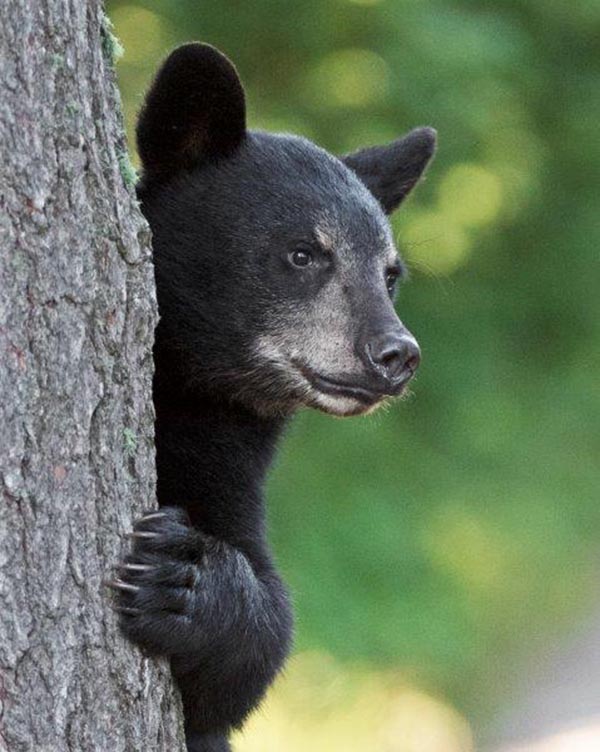
 Braveheart's cub PorterAt the various community feeding stations, we are seeing bears that people seldom see away from the stations: Lily, Ursula, Burt, Jack, Lorie, Daisy, and others. Also, Braveheart and her cubs Gene (Geneva), Stratton , and Porter (who posed on the white pine trunk for the picture). Wonderful day!
A major opportunity today was a half hour radio interview on a Twin Cities radio station that can be heard online at 105theticket.com. Click http://www.105theticket.com/the-ticket-outdoors-podcast where you can find their podcasts for online listening. The interview was between 7:15 and 7:45 PM (misdated as July 5, 2015). I let it all out. Every word was factual, mostly from court records which we have in hand and can distribute. The hosts ended by saying they’ll have me on again.
As this super Black Bear Field Course wound down with its many bear sightings, we said goodbye to the 6 repeat participants and 2 new participants. A great time. Many tears on cheeks as we parted.
Sue and I then met with the world’s top home range data analyst to move a step closer to publication of our GPS data set. The expert said our data are unique in the world because we obtained locations every ten minutes—something other GPS radio-collars do not have the battery power to do. We were able to do it because we could visit the bears and change their batteries every couple weeks, and we had help designing equipment from Digi International and Iowa State University’s engineering department. Beyond that, our ability to visit the bears allowed us to ground-truth the data and see what the bears were doing. This ability to see the bears we are studying is/was also unique. Beyond that, the long-term nature of our study revealed kinship relations and provided a history of social relationships, territory shifts, and year-to-year changes in movements with different levels of wild food availability. The long-term data histories made these bears irreplaceable in my lifetime, which is what led me to ask for protection of these radio-collared bears. That request, in turn, angered the DNR commissioner because of the many letters he received echoing our request, leading to his decision to end the research because of the letters, as the legal discovery of internal DNR emails revealed.
Later in the day, I met with a grad student from California who will be working with us on this data set. He echoed that it is the most detailed data set on black bear movements ever collected with the data available to see in real time on Google Earth on our computers rather than being stored in a radio-collar at intervals of 1 to several hours for viewing at the end of the collar life.
What we hear from these scientists is so different from what the DNR tells the public and the courts about our not being scientists. We hope the truth will come out. Toward that end, we have begun distributing the court testimonies of DNR employees, including Conservation Officer Dan Starr who we mentioned in last night’s update.
We very much want to have a Den Cam this winter and need to refute the unsupported statements the DNR has made to the public. Will this lead the DNR to retaliate by continuing to work with hunters to kill study bears this fall?
Thank you for all you do.
Lynn Rogers, Biologist, Wildlife Research Institute and North American Bear Center
All photos taken today unless otherwise noted.