
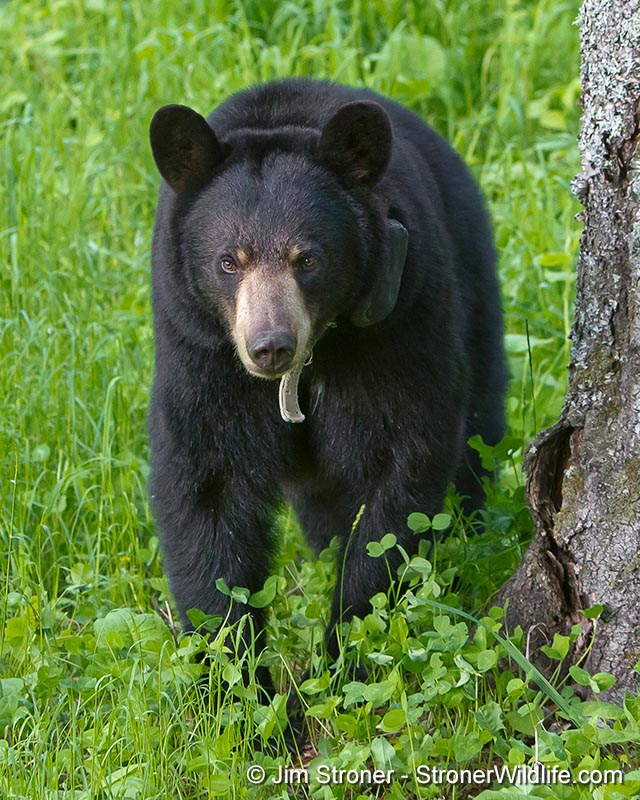
 Lily - June 11, 2011In response to a letter regarding the proposed ban on bear-feeding, a Lily Fan received this response from a Minnesota State Senator.
“I appreciate you contacting me on this issue. I am very familiar with the problem, I personally was nearly attacked by a bear that had been made familiar to humans in Bear Head State Park, and will likely support the bill. I understand Lynn wants to continue feeding the bears, however I have seen first hand the dangers of this activity.”
I’d like to know more; but as I will outline below, I have my doubts if there was any danger and if it was a bear that has been fed.
- I know I used to misinterpret black bear behaviors and think I was in imminent danger until I learned their language (including body language) and realized it was simply that the bear was nervous and had no intention of attacking. Once I realized that, I had the confidence to build trust with wild bears and walk with them, sometimes around the clock, without ever having a bear come after me and hurt me. The most common display that is misinterpreted as being a near attack is a black bear suddenly pouncing toward a person, slapping the ground, and blowing. It’s fast, explosive, and frightening—but harmless. After seeing that behavior hundreds of times over the decades, we feel safe when we see it, knowing it means a bear is nervous but will not attack. We have heard many scary stories about bears over the years that followed the theme that someone was terrified by the presence of a black bear based on all the hype they’d read about bears. The bear did something the person interpreted as a threat. Often that part of the story was a bear just standing there and not running away. The end of those stories was that nothing bad happened. I began hearing such stories in Michigan where my job was fielding black bear nuisance complaints. In nearly all cases, someone wanted a bear captured and moved not for what the bear actually did but for what they were afraid it would do.
- In all our years of research here in Eagles Nest Community, we have not heard any report of a radio-collared bear entering the Bear Head Lake State Park Campground. That remained true even when June shifted her territory to nearly surround the campground. We obtained over a hundred thousand GPS locations for her since 2008 and not one was in the campground. Her offspring followed in her footsteps. When June or her offspring needed supplemental food, they knew a dozen households in the township that had been feeding bears for years, and they went there—not to the campground.
- In our earlier U.S. Forest Service study of bear problems in the Kawishiwi River Campground, 2 bears per year were removed from the campground during 1981-1983 for approaching people for food and making messes. In 1984, we began providing diversionary food a quarter mile away. The campground manager reported that year as the first he could remember when no bear approached anyone for food, a pattern that continue for the 8-year duration of the study. The bears in that study were thoroughly habituated to people at the feeding site, but they did not transfer that habituation to people in the campground. The results of the study were that there was an 88% reduction in bear problems with the diversionary feed, which was a surprise to me because I myself had believed some of the old misconceptions about feeding.
- For decades, Eagles Nest Community has fed bears—since at least as early as 1961—and in the process developed a reputation for having FEW bear problems. For the decade 1996 through 2005, only two complaints from that community were registered by the DNR. Complaints from that community of habituated, food-conditioned bears were 80 percent lower than the statewide average per bear. We began a study in 1996 to determine the effects of the feeding on the bears. We surveyed hikers to learn how many problems they had with bears in all their years of hiking in the territories of the bears that fed at the feeding stations. They seldom saw bears and had no problems.
- The data ran counter to DNR policies on feeding. In December 2005, the Minnesota DNR began a campaign to convince residents of Eagles Nest Community that feeding creates nuisance problem and jeopardizes public safety. The campaign was contrary to the facts and contrary to the DNR’s own records (see number 4 above). A few residents who feared bears believed it, though, which led to controversy with residents who knew better. To further the campaign, DNR officials solicited and even falsified complaints, which they admitted under oath during the hearing this past year.
- Starting in 2011, the DNR began telling the public that we “train bears to go up to people for food.” We wondered if the DNR would come up with a witness to back that statement up in the hearing. They didn’t—not one. Yet, they continued to make that claim to the media, adding that they are simply concerned for public safety. Playing on people’s fears of bears like that has had an effect. Many people now believe that our feeding teaches bears to come up to people for food, as several residents testified—even though they had never had it happen. Their neighbors and township officials who know better testified that there is no public safety problem in the community.
- Starting in 2012, DNR officials began targeting radio-collared bears for removal and worked with hunters who surrounded the community, killing peaceful, non-threatening bears that were causing no problems. When such bears are removed, other bears move in. If the Senator truly had reason to feel threatened in Bear Head Lake State Park in recent years, it is entirely possible that it was a newly arrived bear that was hungry and not yet aware of the dozen feeding sites in the community. In fact, it was a newly arrived bear that the DNR killed in the community on August 2, 2012, and then attempted to link to us. From the bear’s behavior and an internal DNR email, the bear was likely a captive-raised yearling that had been released here.
In summary, in the decades of feeding in Eagles Nest Community, no bear has gone after anyone and hurt them, bona fide complaints per bear run far below the statewide average, and the few bear problems that have occurred were benign compared with those in other areas of Minnesota—especially the lack of attacks and house break-ins in the community.
Lily Fans who have followed the research these past five years already know the above. We hope the Senator sees this and can spread the word among his fellow legislators.
Thank you for all you do.
Lynn Rogers, Biologist, Wildlife Research Institute and North American Bear Center