
 "A Little Bird Told Me" Donna Rogers - 1979Ted still has a little swelling but no evidence of pain. As people pass by his pen, he greets them with his high-pitched grunts.
Yesterday afternoon, a blizzard with high winds came on from the north more suddenly than I can remember and ended by evening. The snow disappeared from sunny spots by this afternoon. At WRI, 19 pounds of food disappeared since yesterday morning. Could four raccoons, a fisher, a mink, a red fox, a gray fox, and some deer devour that much? Or would it take something that eats like a bear? As browse disappears from the forest, deer are here most of each day eating grass. They are becoming accustomed to my usual movements upon driving in to WRI or coming out the door. I felt privileged until a neighbor a half mile away said one of the does that visits his place eats from his food bucket as he carries it to his food trough. Many residents here love wildlife and do everything they can to see wildlife, including bears. The picture of Donna with a chickadee is from 1979 when she was getting her first experiences with close-up wildlife. We titled it, “A Little Bird Told Me” and lured the chickadee with sunflower seeds cupped in her hand. What the chickadee might have been telling her was, “Thank you.” Fun.
Lily Fans are asking about the bear fight video from New Jersey at https://www.youtube.com/watch?v=yBhR5ToR7a8. It is not as vigorous a fight as we have seen, but the pulsing throaty sounds that become more frequent as the interaction continues shows it is serious. Black bear play is quiet. In all the play we’ve seen, we’ve never heard the pulsing throaty sound that we’ve heard in many altercations and is best expressed in the big fight between Lumpy and Jack back in 2006 at http://www.bear.org/website/bear-pages/black-bear/reproduction/14-mating-battle-combatants.html. However, behavior can vary. If anyone has seen different and can broaden our knowledge, we’re always open to new data.
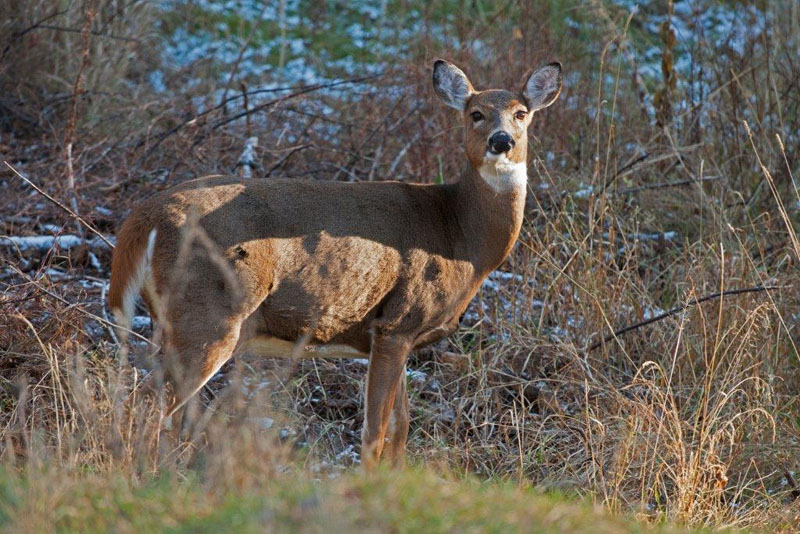 Deer watching but not runningOne Lily Fan noted that the ears were not always back in the New Jersey interaction. True, but that is usual during fighting. The bear in the more defensive position is more apt to put its ears back. We’ve also seen ears back in play when a participant finds itself on its back in a vulnerable position while playing with a larger bear that it doesn’t yet fully trust.
At about the 5:15 minute mark into the video, the bear on top makes biting motions toward the hindquarters of the opponent which is on its back. That reminded me of the 4 broken (mostly healed) baculums I found many years ago and reported in my Ph.D. Dissertation (p 89), saying, “Four males 4-11 years of age had deformed penis bones with bone calluses indicating the presence of mended fractures. In addition, a 3-year-old had a raw and swollen penis, the tip of which was missing. The wound appeared to be fairly fresh when the bear was captured on 24 June.”
I remember speculating that if a male could spare rival males but leave them with deformed penises, the victorious males would benefit reproductively if the reproductively incapable males, having intact hormones, would deter dispersing young males from settling and becoming sexual competitors. Along that line, we have noticed that females run from some males and welcome others, making us wonder if some males make painful attempts to copulate while intact ones can achieve normal copulation.
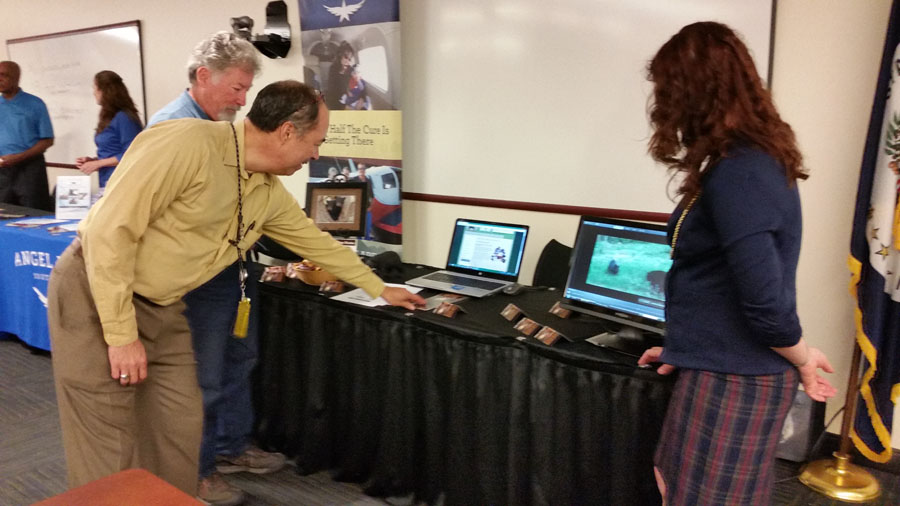 Presentation in Arlington, TX 10-29-14In Arlington, Texas, the Lily Fan who got us enrolled as in the Combined Federal Campaign was invited to advertise the eligibility of the North American Bear Center at a luncheon event at the Nuclear Regulatory Agency. She quickly prepared handouts and a laptop computer presentation on our Education Outreach program. She also played bear videos. The idea was to show federal employees how their local schools, libraries, and other groups can benefit from the North American Bear Center’s Educational Outreach programs if the employees donate through the Combined Federal Campaign. Way to go!
Thank you for all you do.
Lynn Rogers, Biologist, Wildlife Research Institute and North American Bear Center
All photos taken today unless otherwise noted.