
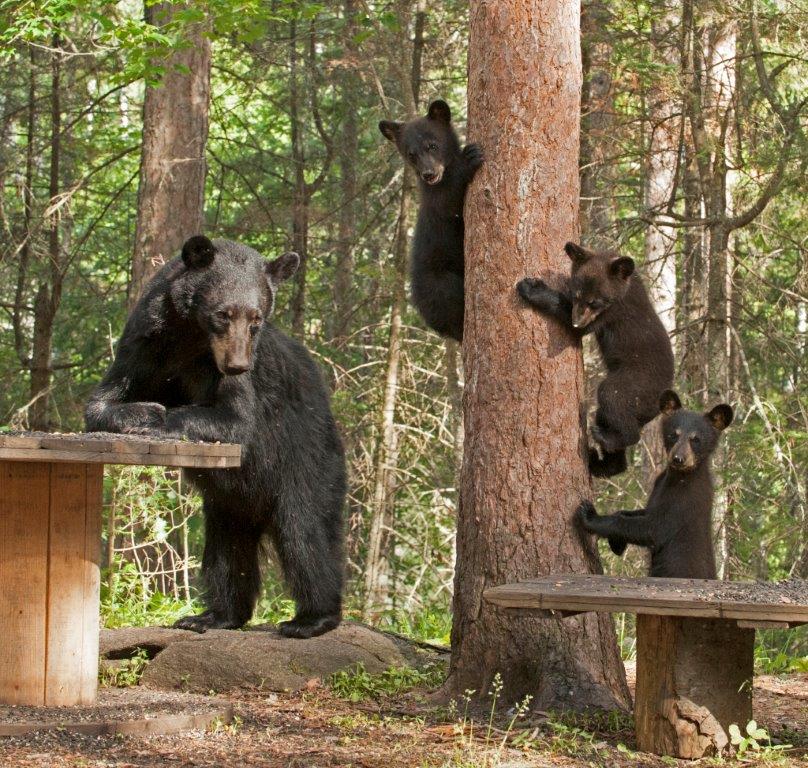
 Jewel and her cubs - 7-2-14Jewel and her 3 cubs came to one of the community feeding stations 2 evenings ago. We were glad to hear it. She surprised the landowner by eating a lot of grass, which reminded us of other bears eating alder leaves before denning. We expect bears to be entering dens soon if they haven’t already. Jewel’s story is familiar to Lily Fans who watched her give birth to Fern and Herbie in 2012 and followed their story through updates, video, and BBC documentaries. Jewel was targeted by the DNR in 2013 but survived and would be a joy to work with in 2015 if the appeal is successful.
 Jewel's cub - 7-2-14At that same feeding station a week ago, the landowner saw 12-year-old Braveheart, which is a relief. Braveheart has her own personality. As a cub and yearling, she was unusual in being playful at times. When she greeted me with an open mouth and a playful toss of her head, I’d put my arm in her mouth, grab a front leg, and put her on her back where I’d rub her belly to make her relax. By late summer as a yearling, she was no longer interested in playing with me. When she had her first litter at 3 years of age, she surprised a visitor and me when we lay down in front of her den to look. She repeatedly lunged at the entrance, which we later learned would be her characteristic response when she had cubs. Unusual. However, one spring amidst her bluster we noticed she’d removed her collar in the den. Blustery as she was, she allowed herself to be distracted by food and fall into the familiar routine being calmly fitted with a collar. Each bear has its own quirks. Out of the den she was the same as any other mother with cubs. One fall during deer season, she became the only bear to pull a deer carcass to her den to eat (other than a mother we experimentally gave a deer carcass in spring). Braveheart is not a bear for a Den Cam. She has the trait of abandoning any den we visit. I remember the last year we saw that. When Sue and I found her in a den, we offered her food so we could adjust her collar. She readily came out to us. No sooner were we done when she calmly ambled off, never to return. Later, at another den, I quietly remained back 20 feet and left within seconds of determining she was there. She made no sound and I hadn’t seen her, but her signal was gone in spring. I don’t know if it was my brief visit or a deer hunter passing by that might have prompted her to move. A couple miles away, Sue and I homed in on her signal, hoping to tighten her loose collar after hibernation. All we found was the collar outside a den she had recently left. Whenever she removed a collar, we had to wait until she showed up at a feeding station to re-collar her.
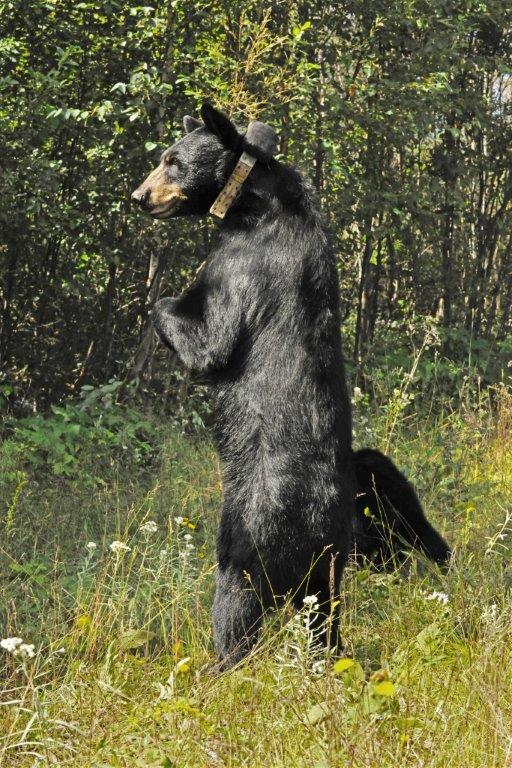 Jewel standing up - 8-7-12The last time we were able to home in on her signal was a year and a half ago. We adjusted her collar, but somehow left it too loose. She removed it only a few yards away. DNR prohibitions then prevented us from re-collaring her, and our long-term record of her movements ended. She is the largest of the females we’ve studied and was long the territory holder around the WRI. She has now shifted her territory and seldom comes to the WRI.
One of our favorite pictures of working with a bear was taken by a Minneapolis Star Tribune photographer when Dennis Anderson and I went to meet Braveheart a few years ago. She knew people were with me. We had to track her for two hours as she circled us beyond view, hearing my voice. Finally, she let us come close enough to see her. I approached her alone. She understood the situation, followed me back to the reporters, and calmly let me adjust her radio-collar and take her heart rate.
 BraveheartDuring her 12 years, this cautious bear has not been wounded by a hunter and has never generated a complaint.
At the feeding stations these days, landowners are reporting a surge in activity by raccoons, mink, pine martens, and deer. Crows are gathering for migration to points south a hundred miles or more and are in flocks of over a hundred that allow plenty of practice targets for sharp-shinned hawks.
At the Bear Center, Lucky is experiencing with Holly what wild mothers go through with their cubs in fall. Mothers seem ready to settle into dens while their cubs are still raring to forage and play. We believe that is one of the reasons mothers with cubs den later than lone, pregnant females. Lucky seems weary, but Holly initiates play.
Thank you for all you do.
Lynn Rogers, Biologist, Wildlife Research Institute and North American Bear Center