
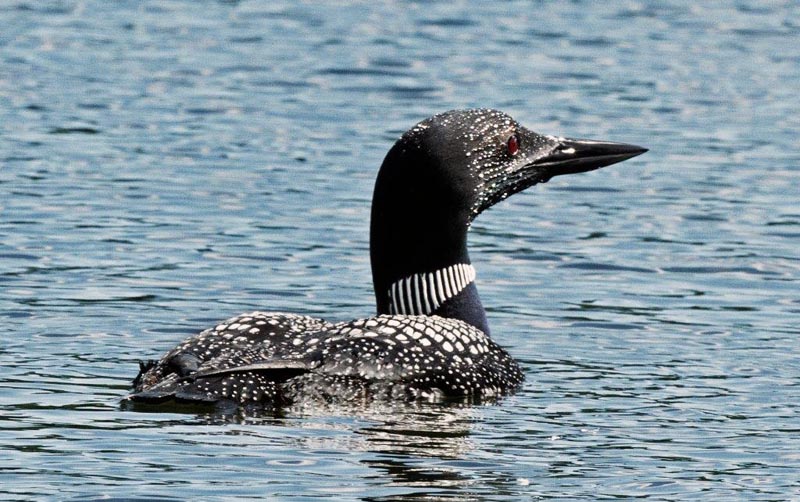
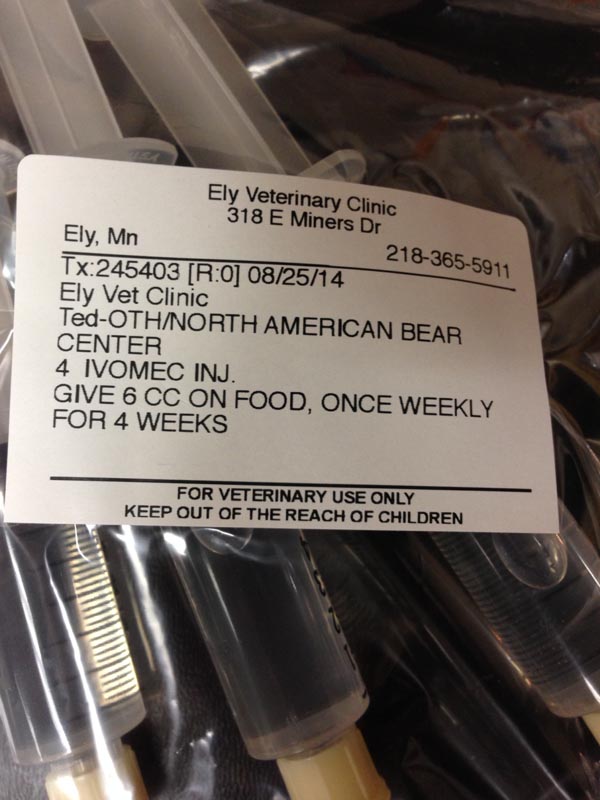
 Common LoonTed began his medicine at supper yesterday and will get additional doses the next three Mondays. He is a half pound short of 600 pounds. Honey is 443, Lucky 403, and Holly 145.5 pounds (nearly twice the weight of wild yearlings).
The closeness between Lucky and Holly made a Black Bear Field Course participant ask if they might den together. As close as Lucky and Holly have become, we believe it is a good possibility and hope they do. Although this would be rare in the wild, Lucky has previously denned with both Honey and Ted, and he was mighty curious about Holly through the hole in the wall last winter.
 Ted's PrescriptionA study at Washington State University showed that at least one bear in 8 knew enough to move a block of wood into position to stand on it to reach a suspended food reward http://www.cbc.ca/m/news/technology/grizzly-bears-can-use-tools-study-shows-1.2743906 .
Today, our morning runner saw no bears to record as part of our habituation project to determine reactions of habituated, food-conditioned bears to people away from the sites where they have learned to expect food from people.
 Hope's White PineAlong that line, we heard from Joel Rosenthal on the subject in West Virginia. He wrote, “I put out food for Rose who comes into the open from the forest for her snacks. She even is nonchalant about people being right next to her, but the second she is back in the trees or away from this feeding site she becomes wary and afraid of the same folks.”
We would add that our experience echoes the same for most of the bears we know, but we are thankful for June, Lily, and a few others who learned to accept us away from the usual feeding stations.
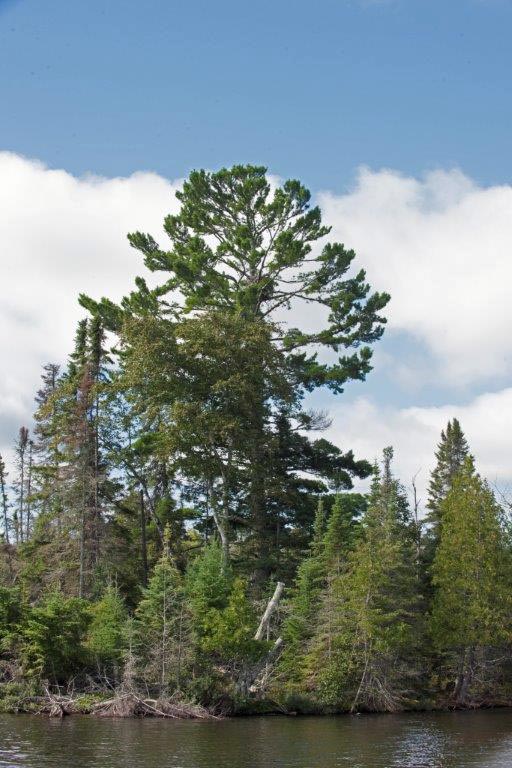
 Painted TurtleIn addition to being intrigued by bears and their vocalizations, the Black Bear Field Course participants had a great time seeing dens and the beauty of nature. Trusting loons, wary painted turtles, and soaring eagles contributed to the joy of being out. Everyone in the group, including participants from England and France, have followed Lily and Hope, so a highlight was seeing the first big tree Lily had Hope climb. Since then, eagles have adorned it with a huge nest.
At the WRI, a beautiful Herring Gull shared seed with the birds and squirrels while hummingbirds buzzed by.
 Herring GullSue Mansfield finished the day by leading the group on her very popular tracking class. Not everyone knows that Sue has no peer when it comes to bear tracking. Before coming to WRI, she spent years tracking bears. The tracking generated questions that could only be answered by walking with bears and watching them in action. Lynn says Sue is the most observant person in the woods he has ever seen. Along the way in her quest for bear knowledge, she learned under Paul Rezendous, author of the book “Tracking and the Art of Seeing.” He had her assist in teaching the bear sign part of his tracking classes. Sue also taught the bear sign field trip in the mammalogy class offered by a graduate school. Participants in our Black Bear Field Course always come back glowing from Sue’s class in the woods. It gives them something else to take home—the ability to recognize bear sign in their own neighborhoods. It opens their eyes to forest sign that would ordinarily go unnoticed.
Another great day.
Thank you for all you do.
—Lynn Rogers, Biologist, Wildlife Research Institute and North American Bear Center
All photos taken today unless otherwise noted.