
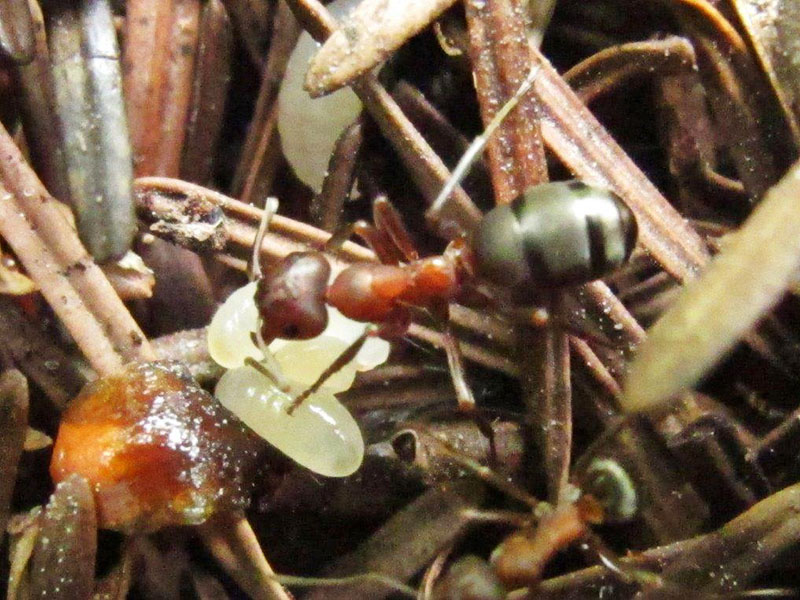
 Ant with larvae - Formica sp.Typically, ant foraging begins the last week of May. But not in this year of near record cold and near record snow. Yesterday, Sue watched Jewel successfully foraging on ants for the first time this year. Also yesterday, Lynn and his grandkids looked for nature at the WRI Cabin, and that included ants. They turned over many logs, briefly uncovering many ant colonies. Reproduction was just beginning. Ant young were all in the larvae stage—none had progressed to the pupa stage. It’s the larvae and pupae that bears forage for, not the adult ants.
Another observation from the cold, snowy winter involves black ash trees. We learned that it is not the air temperature or day-length that causes leaf-out, it is the ground/root temperature. Just out of curiosity, we’ve been checking the big piles of snow the City of Ely cleared from the streets and dumped over a bank into a black ash swamp. The black ash trees away from the bank and snow are fully leafed out. Those where the snow recently melted are just starting to leaf out, and those whose bases are still encased in several feet of snow have not started to leaf out yet. We’ll see if they do leaf out when that last snow melts—probably in a week or two.
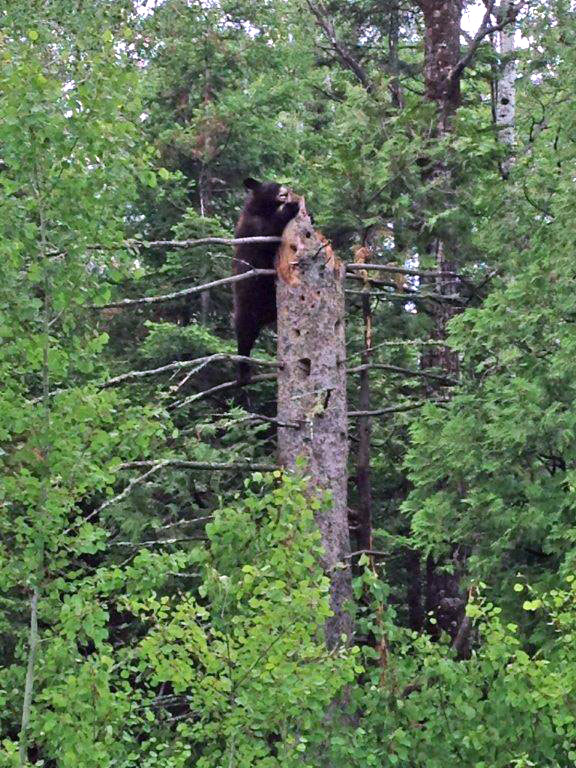 HollyGrandkids are fun. Heinrik (4) and Gabrielle (nearly 3) were interested in any living creature. The beautiful herring gull landed 5 feet from them. Hummingbirds ate 2 feet from them. Red squirrels ate 5 feet away. They watched a painted turtle dig a nest hole. A painted turtle we picked up pulled back into its shell and Gabrielle touched its nose. We’ll teach her not to do that with a snapper. Under logs, we saw ant colonies, slugs, and the hit of the day—a red-backed salamander. We had failed in our attempt to catch a frog but no matter. Gabrielle said she’d rather catch a salamander. Lynn was surprised she knew what a salamander was, but his daughter Colleen is teaching the kids bugs, birds, and more. We turned over a rock that finally was without ants, and there a salamander wriggled to safety, but not before quick Gabrielle gently grabbed it. Both grandkids know how to hold birds, frogs, and salamanders without hurting them. Shortly, she let it go where she caught it. A day of high excitement. Today, they were off to see moose.
At the Bear Center, Holly has been out for 3 days and continues to explore and become comfortable with the bears. When Ted came near today, Holly climbed a few feet up a tree, but didn’t seem too worried as Ted ignored her for food on the ground.
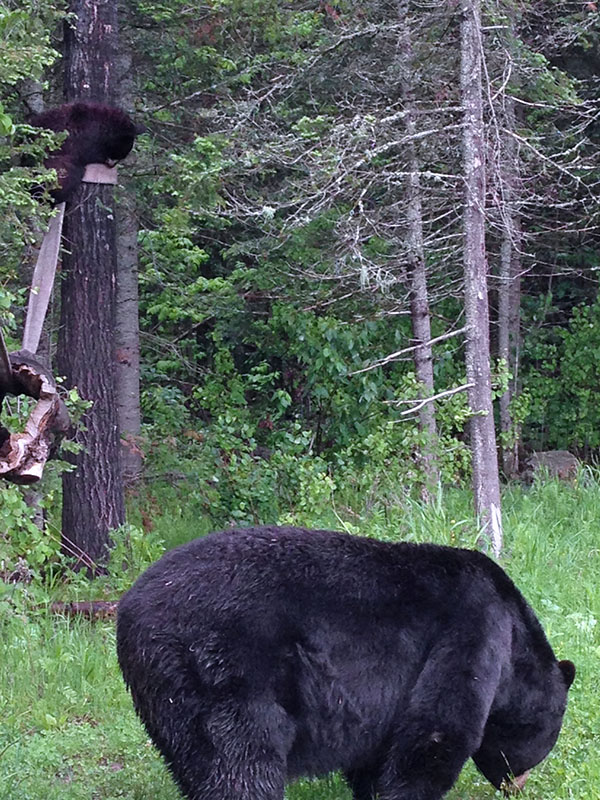 Holly and TedHolly still has a way to go to get used to the viewing windows. Her reflection or more likely the partially obscured forms of people moving behind the windows still have her worried. Often unidentifiable movements are more frightening to wildlife than a person in plain view. Of the hundreds of crows at the WRI Cabin only one has learned that Lynn typing and moving in partial view behind his window is not a danger. All other crows fly away from the feeders with his slightest movement. Only when he is away from his desk will the crows gather and clean up the bird food. Even the brave crow flies away if Lynn is at the wrong window. Ravens and eagles hardly land at all at the suet and birdseed area. The gull will land even if a person is outside nearby. It is amazing to see how some crows learn traffic patterns. If one is eating road kill on the pavement, some know to calmly walk to the side of the road when a car approaches. Then they calmly walk back to their meal. If the car slows for a picture, that’s unusual to the crow and it flies away.
It’s the same with bears that come to the feeders. A few know us and ignore us. Others learn to accept a person behind a window but run from a person that is outside. Some accept a person outside behaving in a certain way in a certain area. Nearly all run from us in the woods. There, we’re out of place. That’s what makes the few who learn our voices and accept us anywhere so special and valuable to science.
Thank you for all you do.
—Lynn Rogers and Sue Mansfield, Biologists, Wildlife Research Institute and North American Bear Center
All photos taken today unless otherwise noted.