
 Lily crosses spruce swampAfter spending yesterday in the small area we mentioned in last night’s update, Lily moved 5 miles to an area not far from a road. Did she make the trip with Harry? Or did the long trip signify the end of mating for her? We checked. Lily was alone, hungry, and calm. We assume Harry would have stayed out of sight for a while if they were still together, but we judge whether a mate is present by how much she looks around and how attentive to sounds she is. She seemed to be alone. Will she find another male? Or is she done for the year? Her vulva is not as swollen as we found earlier, so we suspect she will get on with feeding and fattening to make milk for the new litter of light-muzzled cubs.
 Lily watches Sue approachIt was the hottest day of the year so far—91F. When she came to us across an open spruce swamp, her fur was hot to the touch—probably over 150F based on previous measurements. No wonder she didn’t mind walking in water to get to us. The picture shows the habitat—little black spruce trees (Picea mariana) in a field of Labrador Tea bushes (Ledum groenlandicum) growing in muck made up largely of decomposing Labrador Tea leaves. After we left, her locations showed no indication that she tracked down a male. She went directly to a lakeshore, presumably to drink.
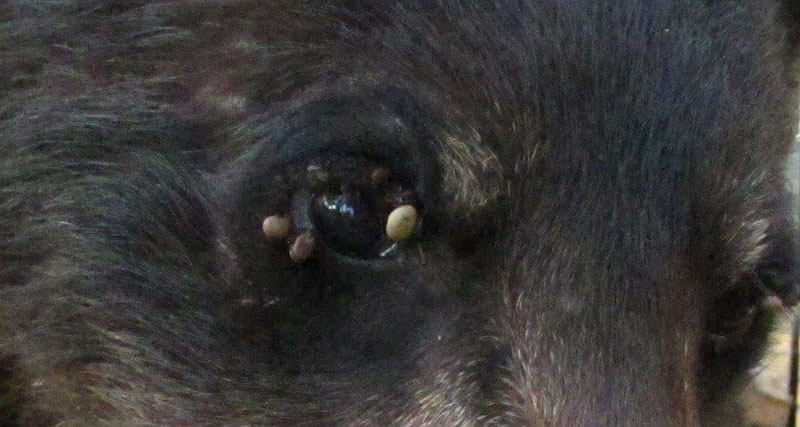 Braveheart's yearlingWith the abundance of large-leafed aster leaves at the eating stage in the woods, community feeding stations are seeing few bears, as we are. This evening, one of Braveheart’s yearling males stopped by, indicating that Braveheart’s family has broken up. Mothers groom their cubs and yearlings for ticks, and after family breakup we often see yearlings with many ticks. This yearling had at least 15 ticks on his eyelids alone. The smaller ones show up poorly in the picture. The picture shows him turning his head to see past one of the larger ticks. We don’t know this little bear well enough to be pulling ticks off.
 Woods LakeAspen and birch leaves still have the young yellowish look but are growing fast in the heat. Soon it will look like summer. The temperature dropped fast at sundown—now only 76F.
Sue triangulated on Faith’s signal but could not connect with her. Faith had a lot of human contact growing up. We know bears have good memories. She knows Sue better than any human. Faith continues to defy common beliefs about bears that grow up accustomed to humans and hand-feeding. Last year, instead of seeking humans for food, she moved away from people and the community feeding stations to an area where she seldom if ever sees anyone. Today, she kept her distance from the human she knew best.
 JulietSue had better success with Juliet—locating her and her cubs off a grassy two-track road. Juliet cooperated for a battery change then led Sue to the white pine where her cubs were.
 Cubs high in white pineAt the Bear Center, Holly enjoyed a stream of water on her in this heat (https://www.youtube.com/watch?v=ElnjRqsnXy4) and Holly got the green light from the veterinarians to mingle with the other bears (https://www.youtube.com/watch?v=fHuggxZiivg). She is due for her debut. Tomorrow morning (May 30th) about 9:30 AM, the staff will try to have Ted out in the big enclosure and Lucky locked up. Then we’ll open the door on Holly’s pen. We have no idea what she will do. After all her pacing, will she be reluctant to face the big world like Honey was in 2007? Will she stay near trees in case there is danger? Will she make it down to the pond for a dip? Will Honey greet her by chasing her up a tree like she did Lucky in 2007? Will Holly recognize the gentle, playful nature of Ted who will likely want to make friends with her like he did Lucky in 2007? It took about 2 months for Lucky to finally give in to Ted’s advances and become Ted’s playmate and denmate for years to come. There could be glitches. The bears were reluctant to move on this hot day, and the heat will continue into tomorrow.
We’ll be there with cameras and video.
Thank you for all you do.
—Lynn Rogers and Sue Mansfield, Biologists, Wildlife Research Institute and North American Bear Center
All photos taken today unless otherwise noted.