
 Herring GullThe aerial photo on Google Earth shows that Juliet and cubs have settled in an upland forest that has aspens and white pines—probably a secure place for the cubs. Sometimes mothers leave their cubs at a big white pine and forage in the area, and other times the cubs tag along. We think the cubs are with Juliet because the fastest movement we saw was less than 0.3 MPH—a speed we’d expect for a foraging mother with little cubs trying to keep up. The family spent the entire last 24 hours in an area less than 0.3 mile in diameter. One of the things we are recording for publication is the difference in travel between females with newborn cubs and those with yearlings or no cubs. It’s something that is known in a general way but has not been recorded as accurately as is now possible with GPS.
 Eagles Nest Lake OneWe checked previous dates of ice-out for lakes in northeastern Minnesota. All show the earliest date of ice out as 2012. That year, Lily and Faith left their den on March 23, the earliest emergence we have recorded in our decades of study. Several lakes had the latest date of ice out as 1996, following the winter when a record minus 60F was recorded in the study area. The spring started with perhaps the biggest Aspen seed crop we’ve seen. Aspen pollen turned the lake here yellow and then puffy white aspen seed turned the lake white. The summer of 1996 was the best berry crop we’ve seen.
Yesterday, we saw unusually big clumps of aspen catkin fuzz blowing in the wind. Is this the start of another great food year? Another thing we saw in 1996 was the biggest balsam fir cone crop we’d ever seen. We’ll look for that again this spring following the unusually cold winter.
Temperatures well above freezing made progress blackening and melting the lake ice on even the deeper lakes although several are still about 95% frozen. In the woods, it’s getting harder to find patches of snow, but some still remain in shaded valleys.
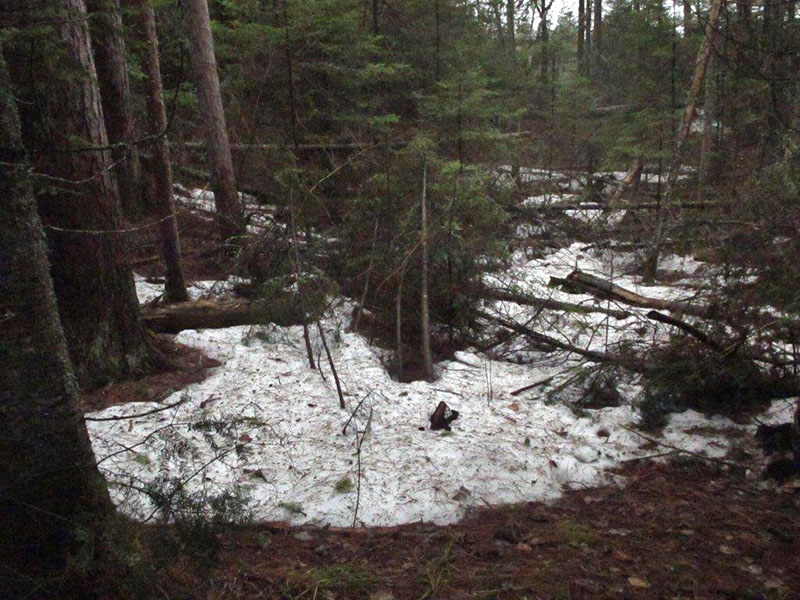 Patches of snowWe’re excited that the Pileated Woodpeckers continue to check out the nest cavity they used back in 2006 when Sue filmed 2 of the 3 fledglings’ first flight from the nest (https://www.youtube.com/watch?v=Rn0I-p7qbHA). The first flight was fairly clumsy, of course, and one of the young woodpeckers almost hit Sue where she was filming out a 2nd floor window of the WRI.
More nature notes. Spring peepers are calling. Flickers have been calling incessantly the last 3 days, and today they mated 25 feet above Lynn’s head. Just as they finished, a young Bald Eagle landed 2 feet away, making them fly. The eagle flew when Lynn reached for his camera. The nice Herring Gull wasn’t so shy. As Lynn was coming out the door with sunflower seeds for the birds and squirrels, the gull landed 8 feet away and watched as he poured the seeds on the railing not 5 feet from it. As soon as Lynn turned his back to go in, the gull hopped down and began eating. A beautiful bird. It started the day right.
Thank you for all you do.
—Lynn Rogers and Sue Mansfield, Biologists, Wildlife Research Institute and North American Bear Center
All photos taken today unless otherwise noted.