
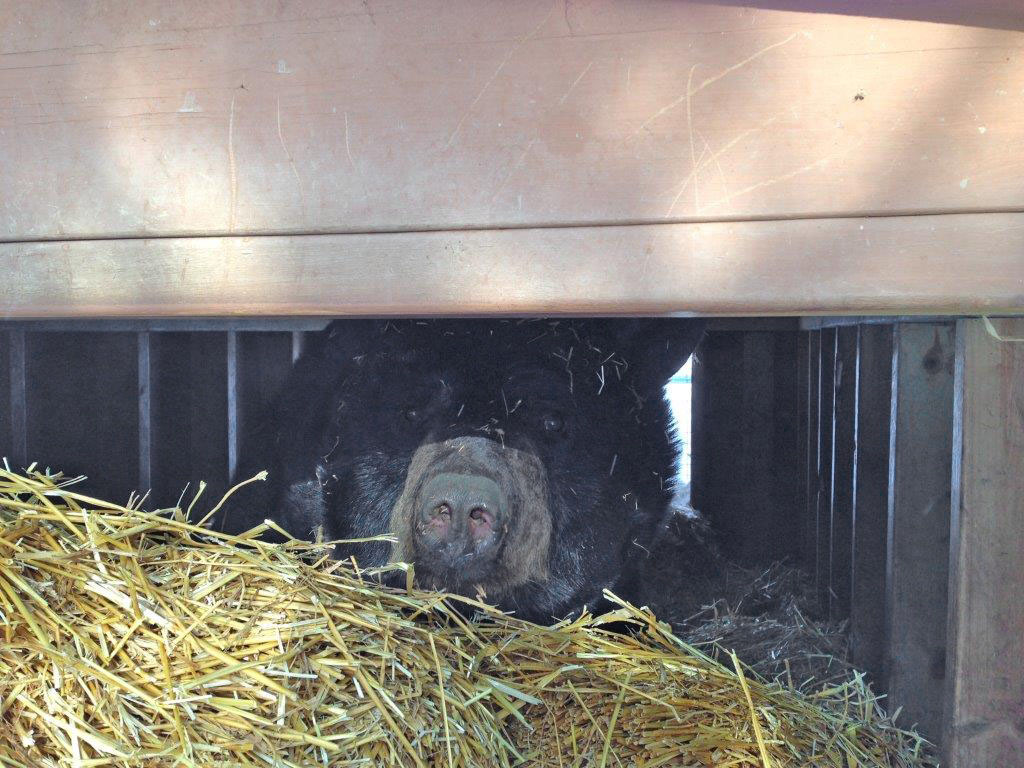
 Ted in denTed got extra straw today and looks content. The question now is whether his Den Cam will be able to see him. The straw should get flattened by him soon, we think.
We are still reeling over the generosity of Joanne Livingston in making a masterpiece bear, giving the record proceeds to the Hope Learning Center, and then agreeing to make a similar but smaller bear for an exhibit in the Bear Center. Her bear, and the story behind it, will be the centerpiece (in glass) for an exhibit in "Bears in Our Culture." The beautiful wooden base will be capped with a cube of glass for the bear. On the sides of the exhibit will be the story of that bear and the story of the first Teddy Bear. On the base or nearby will be the story of how Native Americans revered bears. Some of that will come from Hallowell’s 1926 article in the Journal of Anthropology entitled “Bear Ceremonialism in the Northern Hemisphere.” We may use some information from the website on Arctology, which is the worship of bears, which goes way back. The Teddy Bear fits in because it is another example of how human cultures think of bears. Contrast that with the fear of bears that pulls us both ways. The exhibit is part of our exploring the places bears occupy in our minds and attitudes. To make room for this exhibit, the wolf exhibit will move into the new addition as part of the Northwoods Ecology Hall.
Jeff Fair put black bears in perspective in The Great American Bear (1990) when he wrote: “Here is a creature that can weigh a quarter ton or more, hang by its teeth, and haul down a fully grown Rocky Mountain bull elk in deep snow, but which prefers to climb trees to escape danger, and teases hazelnuts, one by one, from the forest litter. A predator by formal definition, a carnivore by taxonomic rank, it has evolved further away from carnivorous traditions than man himself. Due to this choice of foods—a choice made, in the evolutionary sense, twenty-five million years ago and which first made the bear line distinct—the black bear’s entire ecology, including breeding, productivity, survival, population density, even social organization, is a function of the annual distribution and abundance of tiny fruits and nuts. The production of these foods is controlled and delimited in part by the same cold season which shaped bear physiology.
Meanwhile, together, we move forward on many fronts.
Thank you for all you do.
—Lynn Rogers, Biologist, Wildlife Research Institute and North American Bear Center