
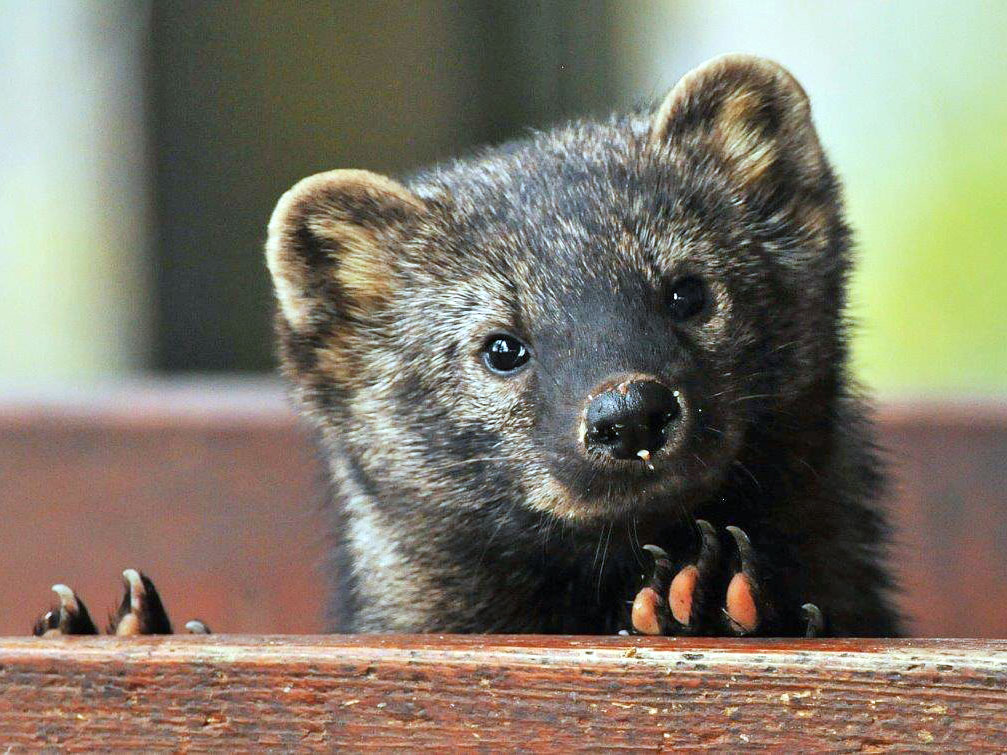
 Fisher on scale Today was beautiful. Out the window, the snow melted as clouds floated by and the calm lake reflected the far shore. This evening big flakes floated down so heavy they nearly obscured the far shore.
During the sunny hours early today, Lily left the spot where she has spent so much time the last couple weeks. From 1:49 PM to 3:23 PM, she meandered a third of a mile to a new spot where she has stayed the last 2 ½ hours. We have no idea why she moved. Was she working on a den that didn’t pan out? Did she run into boulders that made her give up? We can only guess. We’ll check the old area when we can. Meanwhile, we’ll wait and see if she settles in the new location.
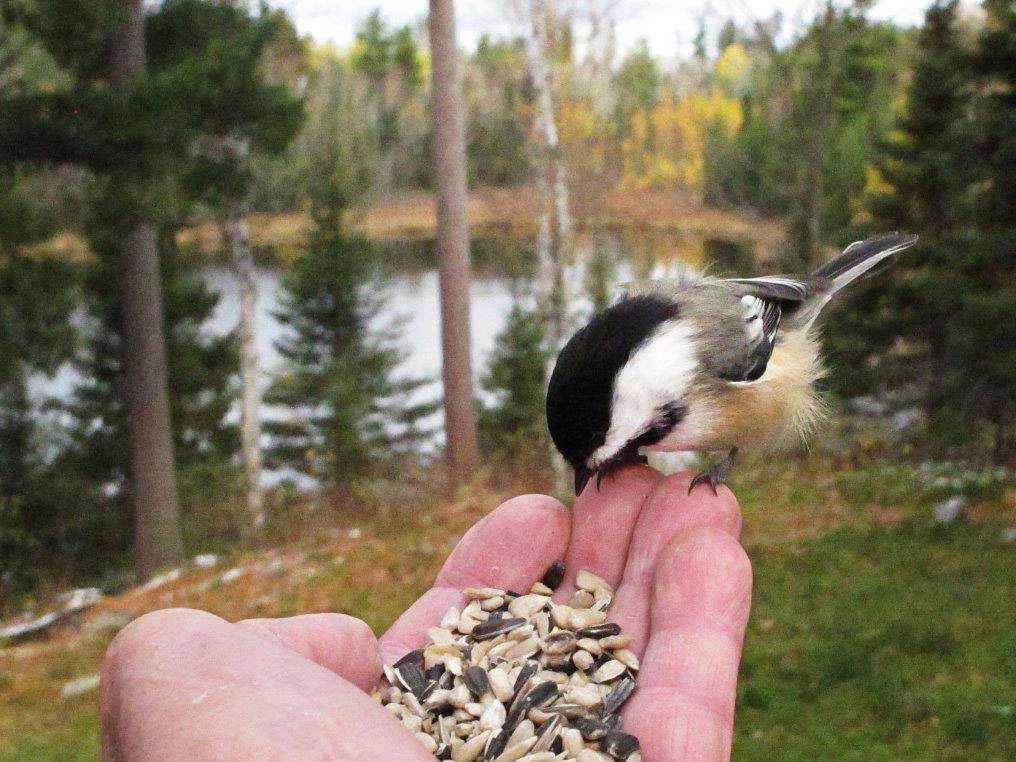 Chickadee on handThe last few days, chickadees and red-breasted nuthatches have been buzzing around Lynn’s head whenever he took a break from writing. The winter flock is back. Last week, Lynn recognized a chickadee with odd white markings from last winter. Today, he offered sunflower seeds, and one chickadee after another landed without hesitation. About that time, the young male fisher stepped on the scale. He popped up on cue when Lynn got his camera.
The big talk at the Bear Center today was ordering the 2014 Shadow’s Clan Calendar for delivery in early November. We haven’t seen it yet, but it was produced by the same people who did last year’s hard-to-beat calendar. This year the theme is cubs. Each month features a cub. We can’t wait to see what they came up with. Jim Stroner probably already knows because he supplied the pictures. Thank you Jim and thank you team.
 White-breasted NuthatchToday, Lynn learned that his old professor Albert W. Erickson is seriously ill. Doc, as Lynn called him, is the one who opened the door in 1967 to Lynn becoming a grad student at the University of Minnesota and starting the research project that continues today. Lynn is indebted to many others who helped along the way, but sharing field experiences with Doc and having Doc invite Lynn to be his graduate student was special beyond words. How it all started was that Dr. Ralph Blouch of the Michigan Department of Natural Resources selected Lynn to be a summer bear research intern at Cusino Experiment Station in Michigan’s Upper Peninsula. Once there, Lynn pestered the long-suffering biologists with questions and immersed himself in the Station’s library whenever he could. He learned everything he could about field procedures and bears. A month into the summer, Lynn’s boss El Harger left for a month vacation and, with Chief Biologist Lou Verme’s blessing, made the unimaginable decision for Lynn to continue the bear work for that month. It was during that month that Al Erickson, the original Bear Man came for a week. Lynn would be working with the top black bear authority in the world. Al had done his original work there and was coming back to get blood and milk samples from lactating females. Lynn asked someone what Al’s middle initial stood for. They said they thought it must be Al Wildman Erickson. Al was fun, energetic, and knew bears but didn’t seem that wild until a moonlit night brought it out of him.
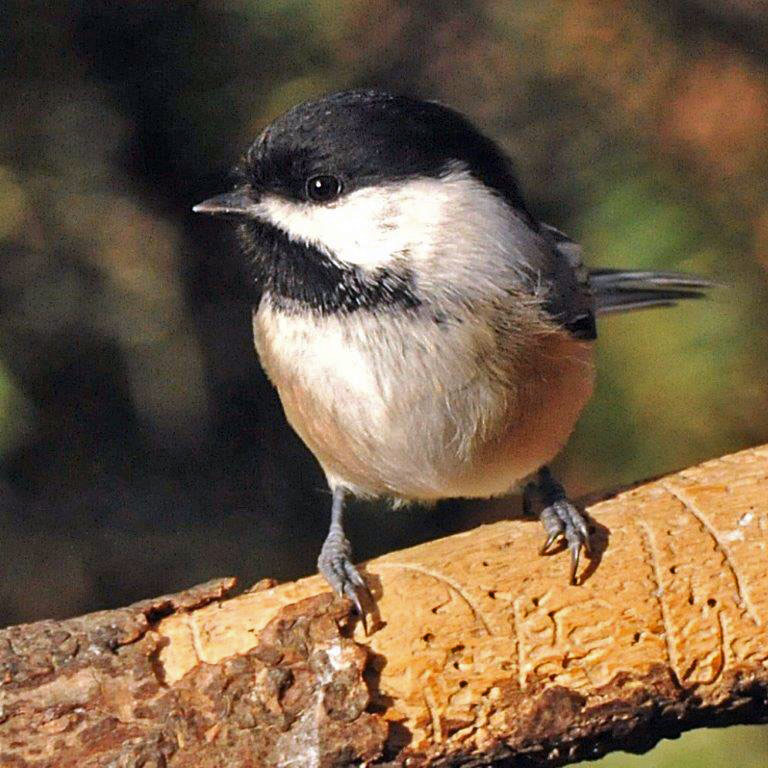 ChickadeeAs Doc and Lynn watched a darted bear disappear into the woods, their eyes fixed on a charred stump and waited for it to fall. By the time they realized their mistake and headed after the bear, it was getting up. Doc tried to scare it up a tree. The bear lunged at Doc. Doc lunged back. The bear turned toward Lynn. He did what Doc did. An onlooker joined in, and the bear started up the tree. Doc swished the bear’s behind with a sapling to keep it up there while Lynn filled a syringe and jabbed the dark mass of the bear’s rump. Shortly, the bear descended. Thinking the bear was drugged, Doc and Lynn grabbed it, but it started to run. Doc leaped on, straddled the bear and grabbed the fur on each side of its head. The bear twisted to bite one leg and then the other, but Doc steered its head away each time. Lynn grabbed a syringe, gave a booster shot by hand, and the bear soon relaxed. Lynn had seen the Wildman in action and learned a lot.
 Red-breasted NuthatchThe week with Doc went by too quickly. Lynn wanted to return to Cusino the next year and do more, but they had never let an intern return before. Lynn also didn’t know how he could accept Doc’s invitation to be his graduate student when he had another year of undergraduate work plus a master’s to complete before he could qualify for the Ph.D. study Doc was offering him. Doc had an idea. He proposed it to Ralph Blouch and Lou Verme. Have Lynn back another summer and let him gather data for his master’s degree so he can step right into the Ph.D. program when he arrives at the University of Minnesota.
By the time El Harger returned at the end of the month, he had heard Lynn was coming back. El asked how many bears Lynn had ear-tagged. El’s record was 26 in a year. Lynn hesitated to say he’d ear-tagged 26 that month, but El said, “Next summer we’ll catch twice that many together.” As it turned out, they ear-tagged nearly five times that many—126. 1968 was a summer of scarce food, and bears were flocking to dumps and residential areas all over the Upper Peninsula. They captured bears day and night using dart guns, various traps, and climbing trees after them.
Lynn saw how timid the bears were and wondered how much else he had believed about them was wrong. Facts that stood out were that:
- No bear came after them and hurt them.
- Darted bears they chased never turned back to defend themselves unless they were within touching distance, and even those bears ran when the pursuers stepped back a couple yards.
- Black bear mothers did not attack—even when we the researchers held their screaming cubs. Mothers often bluff-charged but typically stopped at 20 feet and retreated whether the researchers were facing them or had their backs to them.
- No bear snarled or growled.
- When El had Lynn climb trees to tranquilize treed bears, they all retreated to the top, making it easy to inject them with a syringe on the end of a long stick and tie a rope on an ankle to safely lower them to the ground.
- Landowners told about “rogue” bears, but even those bears just wanted to get away—day or night.
- It wasn’t so much what bears actually did that concerned landowners but what they were afraid the bears might do. (Education was needed.)
- Plus many facts that would lead to kinder, gentler research methods down the line.
Lynn feels very grateful for the second summer that Doc made possible and for the opportunity to be his graduate student, which led to all that followed. Thank you, Doc. And thank you Wally and Mary Lee Dayton for funding the Ph.D. program that Doc was then able to offer.
And thank you all for all you do to continue the research and education today. With the opportunities we see on the horizon, we feel we are just beginning.
—Lynn Rogers and Sue Mansfield, Biologists, Wildlife Research Institute and North American Bear Center
All photos taken today unless otherwise noted.