
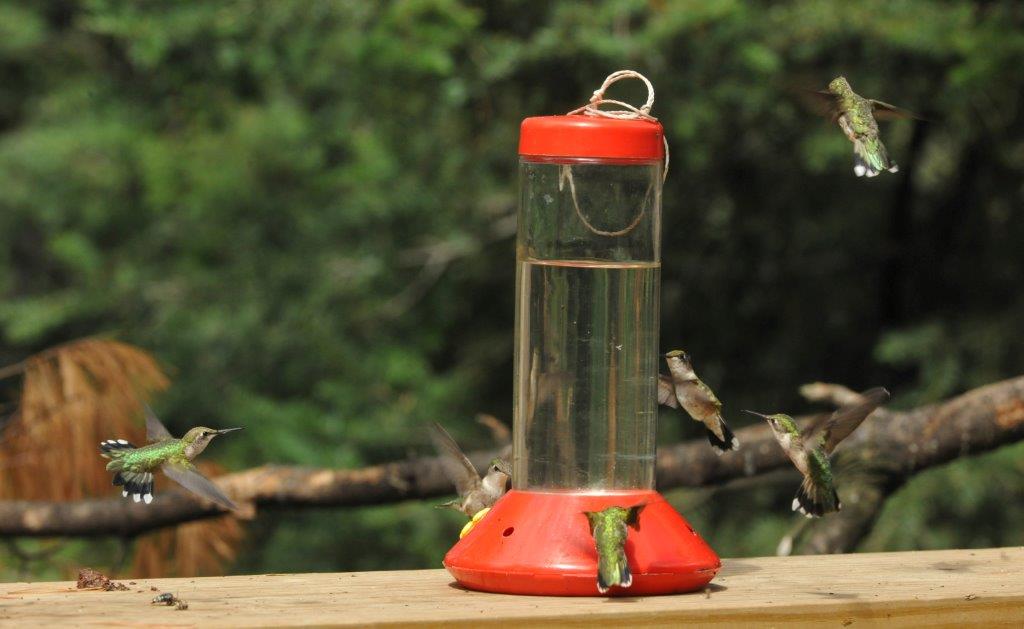
 6 Hummingbirds at feederThe feeding stations here and at the Vince Shute Wildlife Sanctuary are seeing more bears, mostly males, while the radio-collared females are mostly still in the boonies eating wild foods.
We suspect that ant pupae are waning, the highly preferred juneberries are waning, and hazelnuts are not going to be a big crop.
Not to brag, but we picked up the biggest black bear dropping we can remember ever seeing. It weighed 2.42 pounds—exactly 1,100 grams.
Analyzing a male’s dropping a few days ago, we found mostly juneberry seeds, a few blueberry seeds, a few wild sarsaparilla berry seeds (Aralia nudicaulis), and no ant parts.
Pincherries are ripe and abundant and chokecherries will soon be the same.
We are seeing more ruby-throated hummingbirds at the feeders than we’ve ever seen except in the amazing year of 1996. This year, instead of lone hummingbirds making their visits, we see over a dozen swarming around at once with up to 8 competing closely for space at the feeders. We don’t know how many are coming in total. We only know that they are drinking well over half a feeder full of sugar water every day and we’re planning to get more feeders.
How do we explain it? Most of them are juveniles. Did nectar associated with the great blossoming season somehow aid reproduction? Hummingbirds feed their babies (not sure what baby hummingbirds are called) a mixture of nectar, tiny bugs, and tiny spiders. Could a ready supply of nectar in this year of viable blossoms and bountiful berries have given the hummingbirds more time to search for insects and spiders for their young?
Could the same conditions that produced a bountiful year for the bears have done the same for hummingbirds? Some things remain mysteries.
Lynn spent the day mainly working on the legal case and a paper to be submitted for peer review. Sue and her sister spent some well-deserved time catching up.
Thank you for the help you continue to give in this time of crisis.
—Lynn Rogers and Sue Mansfield, Biologists, Wildlife Research Institute and North American Bear Center
All photos taken today unless otherwise noted.