
 Shylow The big moment today was 11-year-old Shylow’s return after an absence of nearly a year. Shylow was born into Shadow’s clan in January 2002. He is the brother of Braveheart who still holds her territory near here. When Shylow was an adolescent, he dispersed to parts unknown to establish a mating range, but he returns here for a short while most years. We are glad to see he made it through another year.
Shylow is a delight. He is one of the bears that feels safe here but is unapproachable in the woods. We never hear of anyone seeing him, and he has avoided hunters for over a decade—perhaps by staying away from people and becoming nocturnal in late summer and fall.
 FireweedOur favorite story of this powerful, gentle bear is the time six Black Bear Field Study participants surrounded him here at the Research Center. That was all fine. Shylow had learned people were safe here where his mother Blackheart brought him as a cub. Shylow was the shyest of the litter, but at about 2 ½ years of age, he became more trusting—with limits. On the day when 6 people surrounded him at once, he was an adult weighing several hundred pounds. He was still cautious as ever. Sitting calmly in the circle of people, he glimpsed another course participant walking over 200 feet away down the driveway toward the group. The person was out of place and seemed a danger to Shylow. He froze, focused on the person, turned, and bolted.
Shylow wore a radio-collar when he was an adolescent—before his neck got bigger than his head. We never were able to approach close enough to see him in the woods.
Today, Sue located Lily to change her batteries and found out the hard way what she'd been feeding on in the woods. Hornets.
We are seeing your questions asking why the DNR is prohibiting us from broadcasting the Den Cams to the public. The reason Commissioner Landwehr gave us in his letter of January 11, 2012, when he imposed the same prohibition on the Den Cam we proposed for Juliet’s den that year, was:
“I believe this condition is necessary, in part, due to the recent negative public reaction to the legal take of one of your previous web-cam subjects (which you have called “Hope”). This bear was provided a highly visible “star status” by virtue of the live web-cam and subsequent coverage on your website. I think the highly charged public discourse that resulted from the bear being legally harvested created immense animosity in some sectors to legal bear hunters, also created hostility towards your research and subject animals, and is an intolerable result of a research project we permit.”
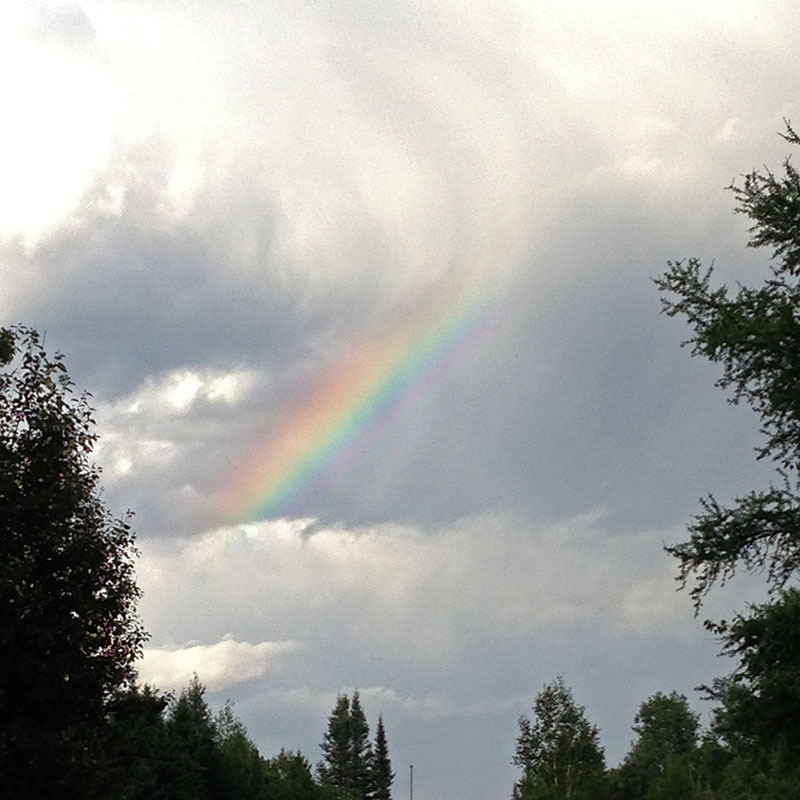 RainbowWe also frequently hear that broadcasting Den Cams to hundreds of schools lets thousands of school children see mother bears keeping their cubs warm and fed. Children then run the risk of growing up liking bears rather than wanting to hunt them. This runs counter to agency programs to introduce children to hunting in order to keep hunter numbers strong. Pittman-Robertson federal taxes on hunting equipment are distributed to the states according to the number of hunters in each state. Those dollars pay the wages of many wildlife officials. We understand the risk that Den Cams pose, but, at the same time, we believe hunters and non-hunters should have a right to learn about wildlife without the message being censored by wildlife officials who have their own agendas. We believe wildlife belongs to all the people—hunters and non-hunters alike. Our message is not intended to discourage children from becoming hunters. Our goal is simply to have everyone know as much as possible about the animals that share their habitat with us. People will not coexist with animals they fear.
The losers in all of this are the bears and the many people (including students) who want to learn. We are at a loss as to what to do. We are attempting to protect our efforts from the DNR powerhouse through legal action.
Thank you for all you are doing.
—Lynn Rogers and Sue Mansfield, Biologists, Wildlife Research Institute and North American Bear Center
All photos taken today unless otherwise noted.