
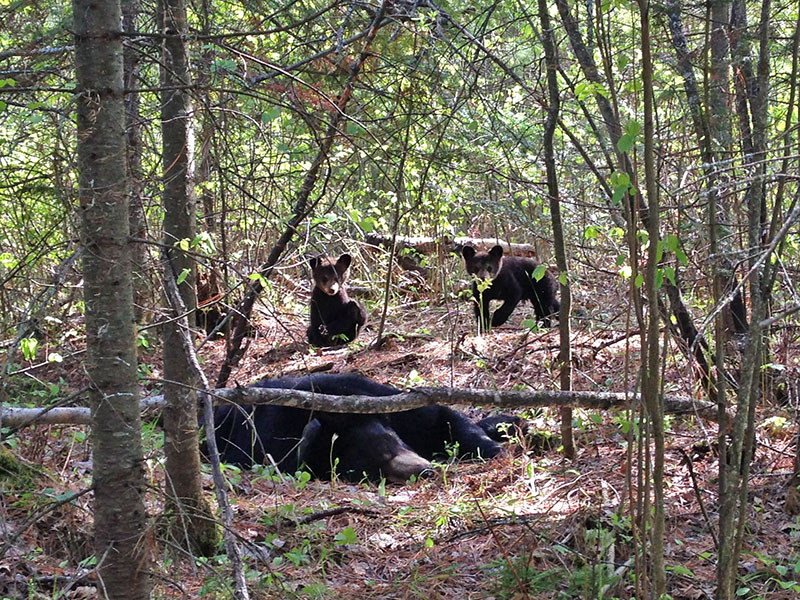
 Lily sleeps while cubs play Sue paid an overdue visit to Lily today. She videotaped as Lily foraged on peavine (Lathyrus spp.) and the cubs rested high in a white pine. Lily climbed up to join them for a bit before coming down to forage on aspen (Populus tremuloides) leaves. Lily and Sue both rested until the cubs came down to nurse. They kept a good eye on Sue as they covered the 20-foot distance from the tree to Lily to nurse. As the nursing session came to an end, the cubs switched nipples as is common.
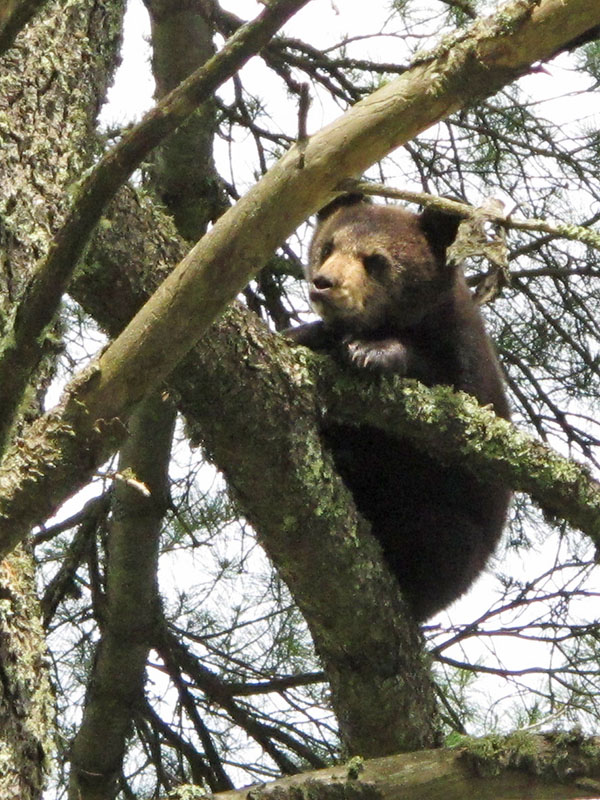 Huffy EliThe cubs showed more about their personalities. Ellie is the calmer more trusting one. Eli is more cautious, eventually climbing back up the pine to huff at Sue from a low branch. Ellie was content to play with Lily at the base of the pine and seemed to be taking her cues from Lily. When Sue got up to leave, Ellie jumped to her feet ready to climb but quickly relaxed. We hope we can get some of the video posted in a few days.
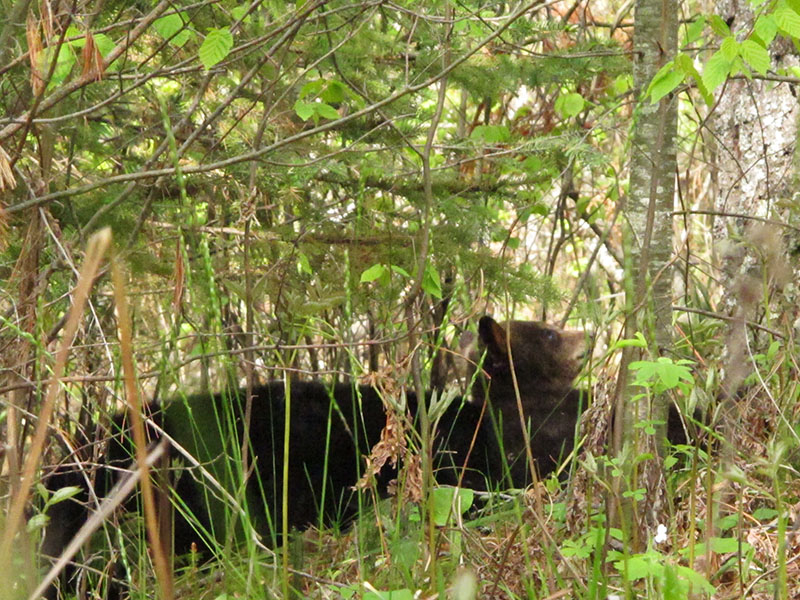 Ellie next to resting LilyElsewhere in the woods, mating action and conflict is beginning. We got our first glimpse at 2-year-old Daisy being pursued by 2-year-old Aspen nipping at her rump. Daisy quicky evaded him and disappeared. One-year-old Shauney, daughter of RC, descended from a big white pine, and Aspen approached her. He tongue-clicked as males often do when they want to mate. Shauney stayed at the base of the tree, ready to climb. Then RC came running out of the bushes straight at her daughter who had the bad manners to be seen by her mother after family break-up. Shauney frantically climbed to the top of the tree. RC climbed a few feet and then went after Aspen. She re-appeared but shortly disappeared with her nose to the ground on Daisy’s trail. We don’t know what it all means. We record each event and look for patterns and variability. What makes the observations scientifically unique is that we know the identity, age and kinship relation for each bear involved.
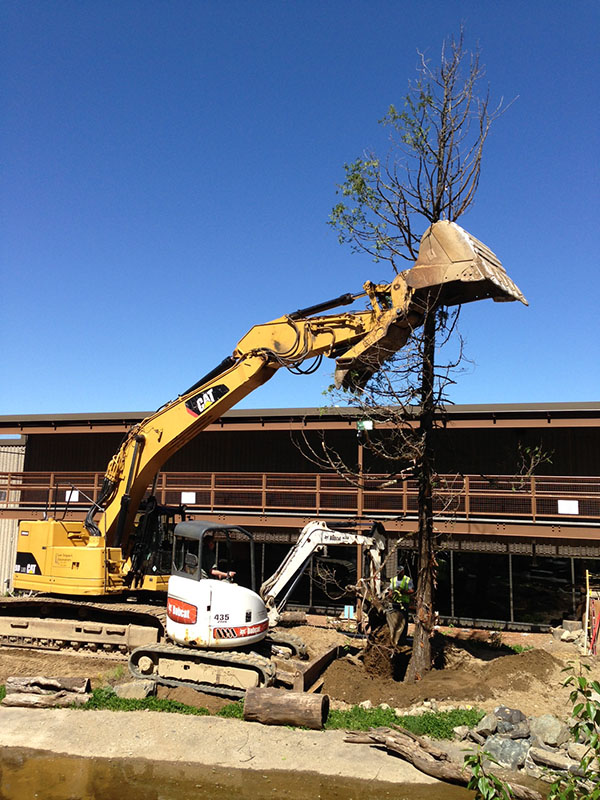 Bear Center treeLucky will soon have a new activity. A big cedar, taller than the Bear Center, is being planted in front of the viewing balcony for Lucky to climb and for Ted and Honey to stand up against. It’s part of an expanded enrichment effort to encourage the bears to use their minds and muscles doing wild behaviors that people can see and learn. Wild bears climb lots of trees. Food near the top of the tree will give Lucky reason to show visitors how easily black bears can scoot their bulk up a tree like a squirrel. The tree stands about 10 feet out from the viewing platform—a safe distance for good pictures. We can hardly wait for the fences to be secure again so we can let the bears explore the changes in their environment. The tree had been removed from the new septic area, and we didn’t want to waste it.
Another change in the enclosure is the black dirt brought in today to grow clover and flowers in the expanded area next to the Hope Learning Center.
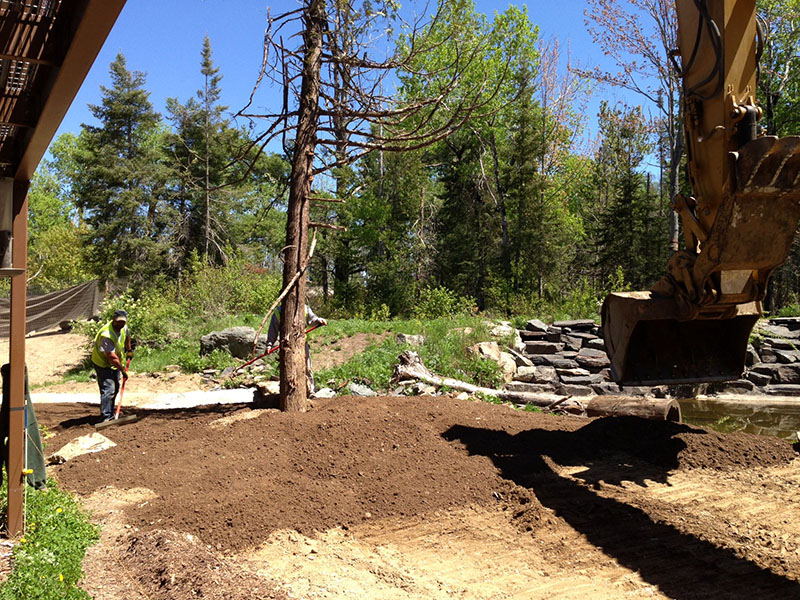 Bear Center tree It was a great day at the Research Center with Professor Gordon Burghardt as we discussed papers to write. One is the development of cub play behavior as recorded via the Den Cams. Gordon is one of the world experts on animal play and is the author of “The Genesis of Animal Play,” which was 18 years in the writing. He said the Den Cam video archives are a treasure—especially when combined with the standardized data recorded by over a hundred Lily Fans who are official Den-watchers. Thank you again. Play behavior by cubs in dens has not been reported in the literature and perhaps has never before been seen in a wild den. We feel very fortunate to be in on the ground floor of the technology that made this advance possible.
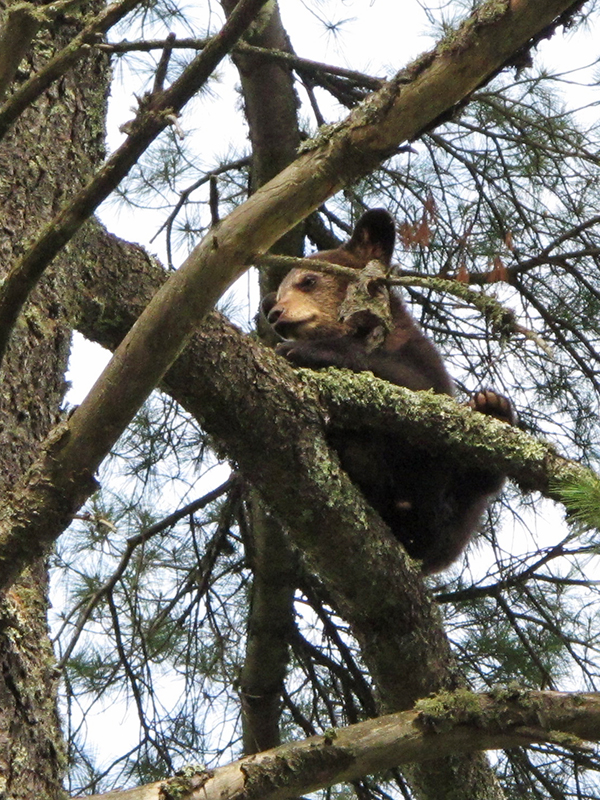 Eli's perchA Lily Fan sent us a link to a video Donna Andrews released for reasons we can’t understand. The short video clip posted makes 2-year-old, radio-collared Juliet appear aggressive, which she is not. She is a nervous bear and unusually blustery, but she has never touched anyone in her moments of upset. But we didn’t know that back in 2005 when the video was taken. Lynn was lying near her to closely observe Juliet’s food selections from a muffin tin while Donna Andrews videotaped the food preference test. Juliet had never swung at anyone. Suddenly, she swung at Lynn, and Lynn defensively swung back. Both missed. The mutual body language taught each party something about the limits of the other. It was the only such interaction between them. Lynn learned a little about Juliet’s quirks, and Juliet might have learned to think twice about swatting at Lynn. That was 8 years ago.
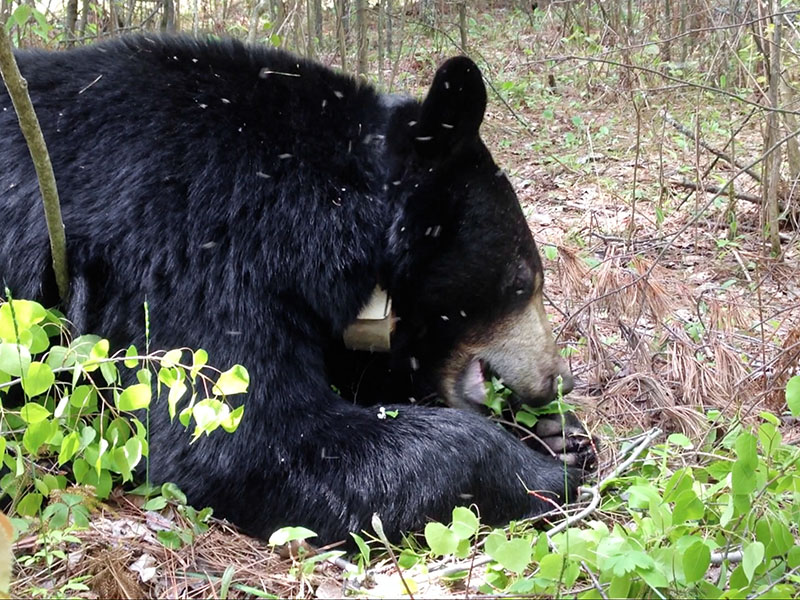 Lily eating aspen leavesIn working closely with wild bears day after day, misunderstandings can occur. We know more now and realize that the most important thing is to allay the bear’s fear—not maintain the bear’s respect for us. We live and learn a little more each year about safely interacting with bears, each of which has a different personality. We don’t crowd Juliet. We let her come to us to change her GPS batteries and adjust her radio-collar. What the video didn’t show was Lynn making up with Juliet a couple minutes later with a treat and stroking her back. Trust was cemented that day. After the fearful exchange, both parties forgave each other. The trust persists.
Juliet is a valuable study animal who the public learned a little about in the documentaries Bearwalker and My Bear Family. We and the bears continue to live and learn. We view each study bear as a research partner. For each bear, it takes awhile, but we each safely learn to trust the other. We each learn the quirks of the other. We don’t recommend that the public experiment like we do, but for us the risks have been well worth what we have learned and been able to share with the public.
The results save the lives of thousands of bears as people realize black bears are not the dangerous animals they thought. The more that people learn about bears, the more willing they are to coexist. We remember the early years of our research back in the late 1960’s and 1970’s when the rule was to gut-shoot bears that came too close to homes. Protecting one’s safety was paramount. Now, the bears have been able to demonstrate to the public how little risk there is living among black bears. More and more people are getting the message and letting their furry neighbors live.
Thank you for all you do.
—Lynn Rogers and Sue Mansfield, Biologists, Wildlife Research Institute and North American Bear Center
All photos taken today unless otherwise noted.