
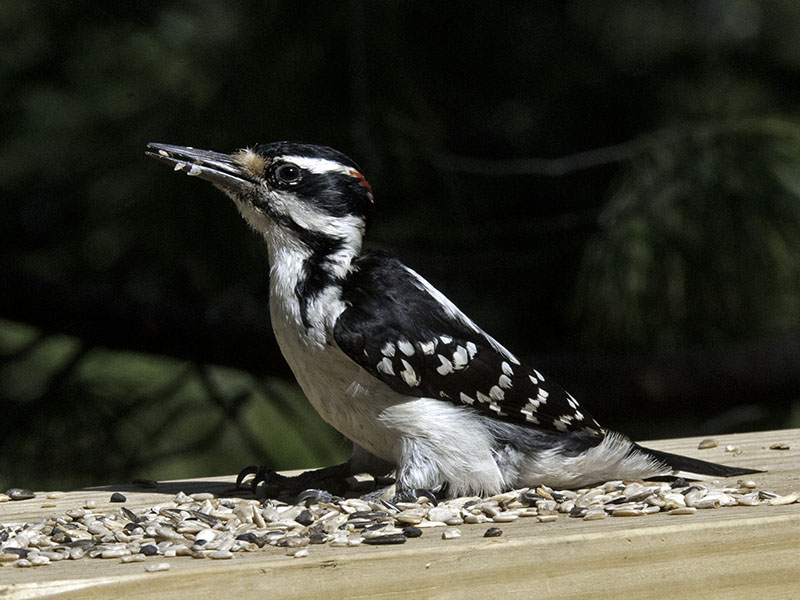
 Hairy Woodpecker With Sue and Lynn stuck inside writing, Research Associate Mike Johnson went out to check on Lily as a start toward working more closely with her. He followed her telemetry signals and got close but not a glimpse of Lily or her cubs. Her signal was very strong, but she was being coy. Mike tried for hours before giving up. We gotta hand it to him for sticking with it, but it will be awhile before he can venture out and change GPS batteries alone. We may have to introduce him to her a few times. We’re thankful for these courageous volunteers who will try what most people wouldn’t consider doing.
At mid-day, we saw one of Samantha’s 41 pound male yearlings alone, indicating that family break-up has occurred for that family.
Last evening, RC was again with Loppy, the big male who was with her on the day of family break-up a few days ago.
 Red squirrel 'rug'Since it was a day of writing, most of the highlights were sights out the window—the usual birds, including a male Hairy Woodpecker (Picoides villosus), a shedding red squirrel (Tamiasciurus hudsonicus) that tried to disguise himself as a rug when he seemed to sense danger, and a special American Crow (Corvus brachyrhynchos). It is the one crow in over a hundred that will watch Lynn in the window and not fly away. This crow is way out in a tail on the bell-shaped curve for learning or braveness or willingness to assess risks versus benefits. As a result, it eats better than the others, at least outside Lynn’s window. This crow learned what the others couldn’t or weren’t willing to learn. For more on that subject, check the second paragraph on page 103 of Weight-carrying ability and caching behavior of Gray Jays, Perisoreus canadensis: Adaptations to boreal winter.
 American CrowIt’s the same as Charlie Russell’s early interactions with grizzly bears. He let the bears self-determine which of them was brave enough to approach him. Only a few dared, as Lynn later discovered in Alaska. With black bears, it’s a higher percentage, but personality (and perhaps intelligence) are the main determining factors. Some black bears learn to trust, others remain defensive for life. We look forward to having Charlie here in June and sharing observations that will help each of us understand bears a little better.
Thank you again to the friends of Pat Boone who honored her with over a thousand dollars in donations to a cause Pat supported—the Hope Learning Center.
For supper, Mike felt bad for not meeting up with Lily and said he’d make dinner. He made a Louisiana style rice dish, thinking of Lynn and Donna’s trip to the state, and did a fine job cooking Ostrich Fern Fiddleheads that Sue had picked a couple days ago. Lynn was skeptical about eating fiddleheads because bears avoid the fiddleheads on the ferns they eat. Mike and Sue were both eating them, though, so Lynn went along. And they were good.
Another video of June from May 25 is posted at http://www.youtube.com/watch?
Thank you for all you do.
—Lynn Rogers and Sue Mansfield, Biologists, Wildlife Research Institute and North American Bear Center
All photos taken today unless otherwise noted.