
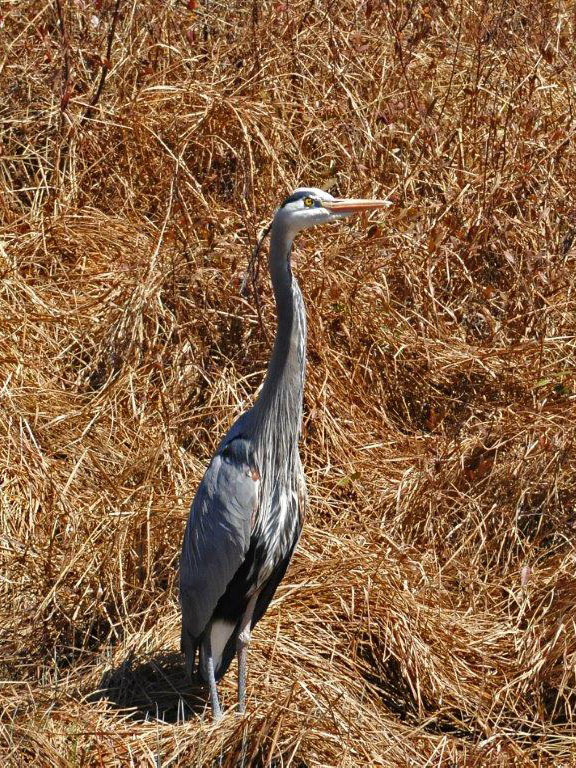
 Great Blue HeronThis year will present the best opportunity of this study to learn mother/daughter relations. In a previous study (Rogers 1987), we reported that female offspring usually establish territories in or near their mother’s territory. We found in that study it is often the mother that relinquishes portions of her territory to her daughters and shifts her own territory to accommodate the daughter.
The shifting and accommodating daughters occurs even though we know mothers often chase their daughters (and sons) when they encounter them. Mothers seem to want the best for their daughters—to an extent. Her daughters will pass on her genes, but the mother can do a better job of that herself. Her own daughters will carry half of her genes, but her granddaughters will only carry a quarter of them. The mother should put her main effort into making sure she maintains enough food-rich territory to ensure the success of her pregnancy and the survival of that litter, rather than going all out for a daughter that will pass on only a quarter of her genes. At least, that’s one way of looking at it. Chances of survival of cubs versus survival of a grown daughter is another factor in these kinds of considerations, but survival of fetuses and cubs is high enough to make the gene considerations paramount.
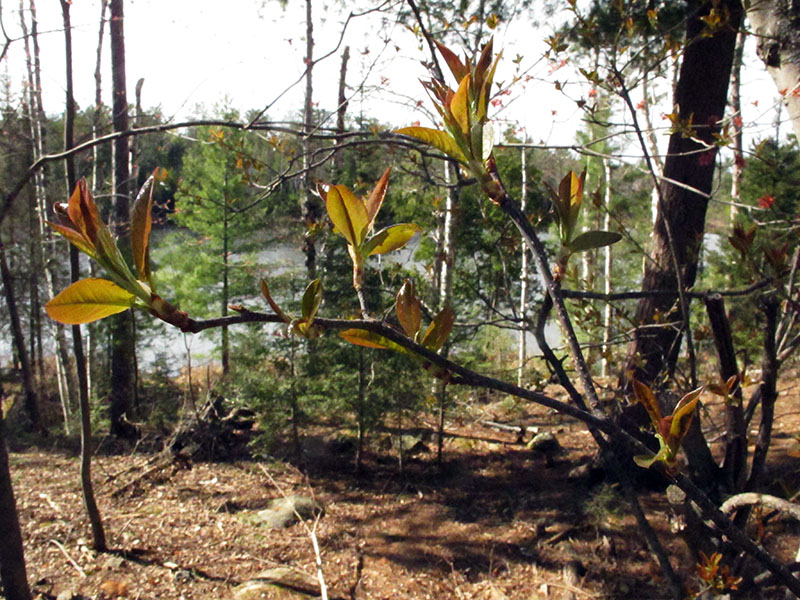 Chokecherry leavesWe have radio-collars on June (12); her daughters Lily (6), Jewel (4), and Aster (2); Lily’s daughter Faith (2); and Jewel’s daughter Fern (1)—plus we have GPS units on 5 of those 6. That should show some interesting interactions like June and Jewel have shown the last 20 hours or so as they seem to vie for territory. The new limit of 12 collars is a hindrance and will leave questions unanswered. We wish we had radio-collars and GPS’s on Shadow (June’s mother) and their territorial neighbors.
We do have a radio-collar reserved for 13-year-old Donna, one of their neighbors, if 4-year-old Star turns out to have more than one cub. Star doesn’t live next to them but is first in line for that collar if Star has only one cub, as we think she does. We don’t see that many litters of one, and we want to see if the Lily/Hope situation repeats itself. Preferably, we would radio-collar both, but we can’t.
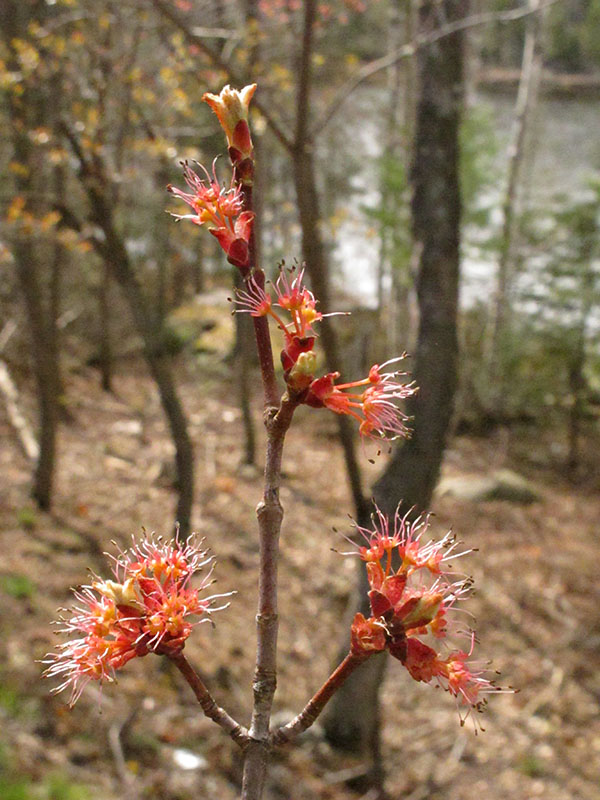 Red maple blossomsOver the years, we’ve had no other opportunity as good as this for studying family relationships. Critical daughters, or their mothers, were killed at the wrong times. We’ll do the best we can with this opportunity. Only in the last few years has it become possible for us to observe relationships and encounters 24/7 via GPS locations that show times and places of encounters and subsequent land use. GPS will let us know better than ever if shifts in territories result from encounters.
GPS also alerts us when it is necessary to make visits in person to clarify what is happening—such as last night when we verified that Fern was still with Jewel. We also have field assistants who can help with these observations and replace GPS batteries as needed.
It’s been a long time coming. In the early years of our permit, we were limited to only 3 radio-collars. When hunters killed two of those bears, permit administrators initially interpreted the permit to mean that we could not radio-collar additional bears, meaning that the study would be totally over when the remaining radio-collared bear was killed.
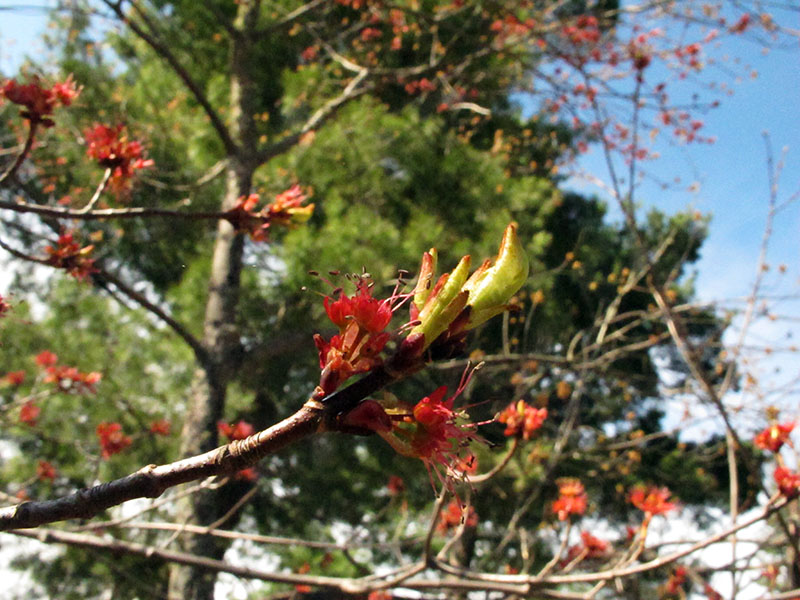 Red maple leavesThank goodness, Commissioner Allen Garber stepped in at that moment and put an end to the monkey business. He decreed that our next permit would say we could radio-collar as many bears as we needed within our study area and we could determine our study area. We were finally able to work toward a scientifically valid sample size, but we were essentially starting from scratch at that point. That was in 2001.
It wasn’t until 2004 that we were able to walk with a bear—June. She gave birth in 2005 as a 4-year-old, but both cubs were males that would disperse from the study area. In 2007, June’s litter included a female—Lily—and provided some data, but that was years before GPS.
Braveheart’s first litter (2005) included a female (Gracie). We collared Gracie as a yearling and be-ribboned her collar to make it visible, but she was taken in the hunt that fall. Braveheart’s next litter was 3 males. Her third litter was 3 females—one disappeared as a cub, and we were able to collar only one of the other 2 (Sarah). Sarah was taken during the 2010 hunt as a be-ribboned radio-collared yearling. That’s part of why we pushed for protection of radio-collared bears in 2011, which instead led to limits on radio-collars.
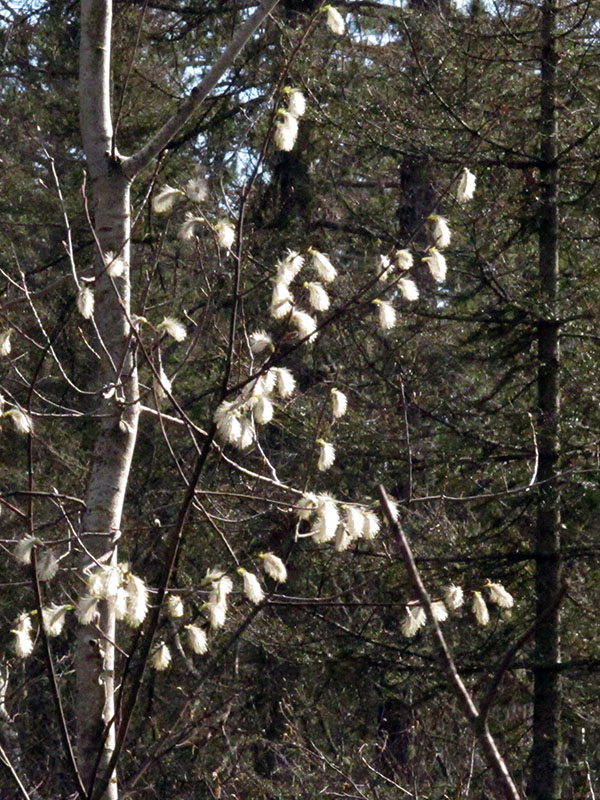 Willow catkinsWe had high hopes for Juliet’s litters over the years, but her first litter was two males. Her second litter included two females, both of which died (Mimi from sarcocystis) as cubs. Her third litter had 2 females (Shirley and Sharon) that we collared as yearlings to study as they matured and established territories. We removed the collar from 2-year-old Shirley in 2012 to meet the limit of 15 the DNR initiated that year, and we removed the collar from 3-year-old Sharon this year to meet the new limit of 12 collars. We will be unable to radio-collar Juliet’s yearling females Sybil and Sophie this year for the same reason.
We had high hopes for studying Jo and her yearling Victoria, but Jo was shot last year, and the collar limit prevented us from radio-collaring Victoria.
June, Lily, and family are providing the best opportunity for mother-daughter land tenure studies that we have ever had in over 40 years of study. Jewel and June are already making it dramatic. Both are still vying for the same area at this moment. We’ll see how it turns out. We’re trying not to take sides as we watch their GPS locations on Google Earth.
The warm weather continues. 70F, calm, and sunny now. Leaf buds are barely opening on a few aspen, birch, red maple, and willow trees. The floating bog under that Great Blue Heron (Ardea herodius) spotted out the window is still brown in this record late spring.
Thank you for all you do.
—Lynn Rogers and Sue Mansfield, Biologists, Wildlife Research Institute and North American Bear Center
All photos taken today unless otherwise noted.